Back to Bizweek
SEARCH AND PRESS ENTER
Latest News

“India sees itself as a force for stability and balance in this turbulent environment”

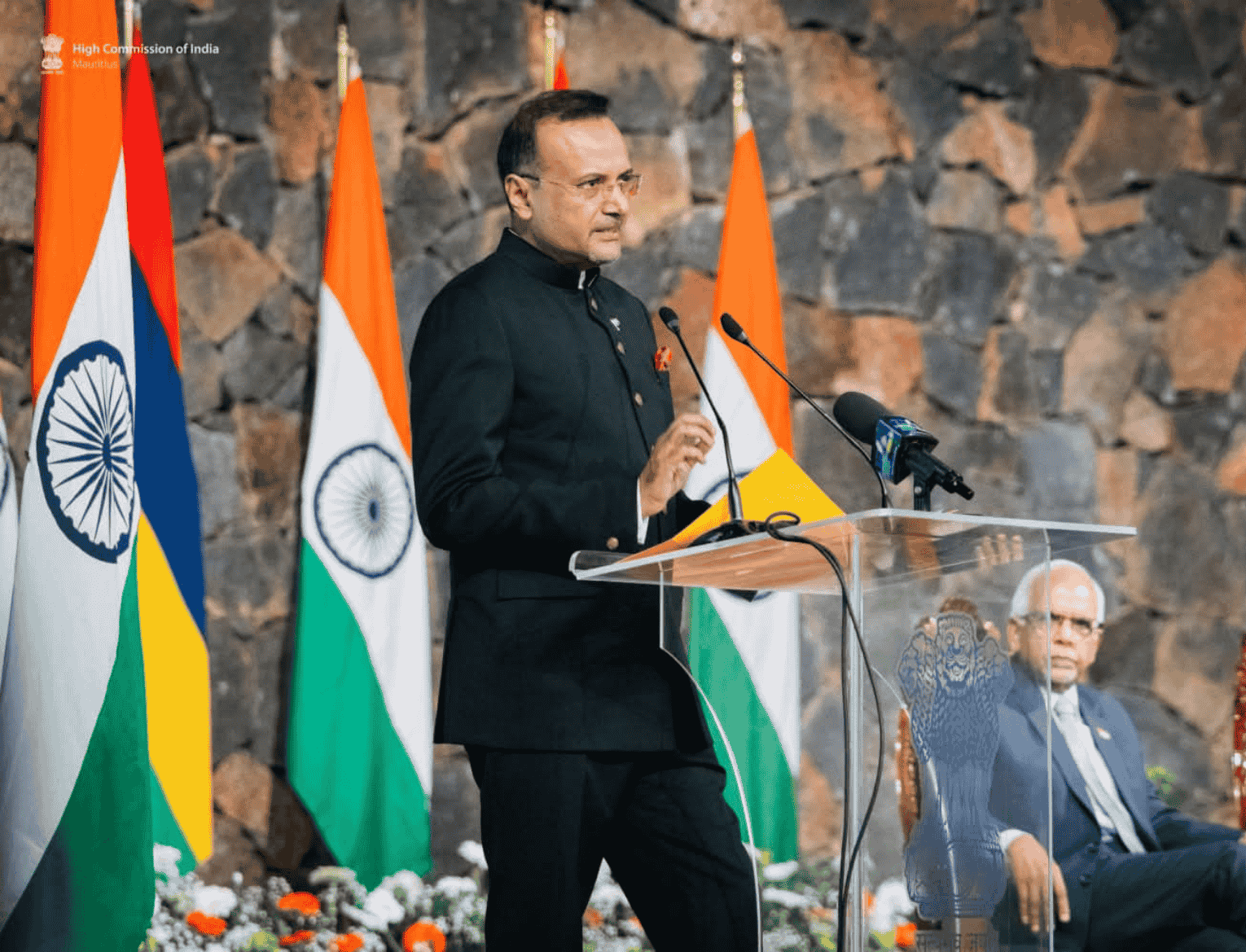
Anurag Srivastava, High Commissioner of India to Mauritius

  • “I would like to see more and more Mauritians benefit from the power of the OCI card, which is like a lifelong visa to India, and much more.”
  • “I encourage students to avail of the scholarship opportunities for affordable, quality education in top-notch Indian institutions.”
  • “There is significant potential to explore how Mauritius could be a key facilitator for Indian enterprises targeting the African market.”

Anurag Srivastava, the Indian High Commissioner to Mauritius, sits down for his first press interview since arriving on the island eight months ago. Answering our questions, he shares his first impressions of Mauritius, outlines his diplomatic priorities, and explains how India intends to strengthen its partnership with Mauritius. From major infrastructure projects like the Metro Express and the new Civil Service College to climate initiatives such as electric buses and solar farms, the High Commissioner highlights the tangible results of cooperation. He also points to Mauritius’s strategic role at the intersection of India’s foreign policy priorities — Neighbourhood First, Africa Forward, the Global South, and Vision MAHASAGAR. Beyond trade and investment, he underlines the importance of people-to-people ties through scholarships, cultural exchanges, and the Overseas Citizen of India scheme, while reaffirming India’s commitment to maritime security and regional economic outreach via Mauritius. Bizweek offers its readers this exclusive interview with High Commissioner Anurag Srivastava.

Your Excellency, you’ve been posted in Mauritius for eight months now. How would you describe your experience so far, both as a diplomat and a resident of the island? 

The eight months since my arrival in Mauritius have been both eventful and productive. Mauritius has lived up to my expectations, both professionally and at a personal level. It has been a busy time in the relationship. We have had several high-level and important visits, as well as extensive engagement with various stakeholders here. As a diplomat, I have seen our partnership strengthen further. As a resident, I have cherished the island’s warmth, beauty, and rich cultural tapestry, making this posting both an honour and a joy.

With your extensive diplomatic career across Asia, Africa, and multilateral platforms, how has your previous experience shaped your approach to deepening India-Mauritius ties?           

The partnership between India and Mauritius is one-of-a-kind. We like to say that Mauritius falls at the confluence of four of our foreign policy priorities – Neighbourhood First (being a close maritime neighbour), Africa Forward, our commitment to the Global South and, of course, Vision SAGAR, now MAHASAGAR.

Each diplomatic posting is unique and requires its own skill sets and learning. Some of this learning comes from institutional memory, and some from one’s own lived experience.

My previous stint as Ambassador to Ethiopia & Djibouti and Permanent Representative to the African Union, and the experience of working with three countries in India’s neighbourhood, in a role with oversight over our development projects in countries of the Global South, ticked relevant boxes for this assignment.

In your welcome address earlier this year, you described Mauritius as one of the most successful examples of India’s development partnership. What makes the Mauritius model stand out, and what lessons can be drawn for India’s engagement with other partner countries?

Our development partnership has really flourished in Mauritius, and the outcome is there for everyone to see. There are big iconic projects like the Metro Express, Supreme Court building, ENT Hospital, Atal Bihari Vajpayee Institute of Public Service and Innovation that dot the landscape. At the same time, there are smaller projects, what we call the High Impact Community Development Projects. These include playgrounds for children, upgrading green spaces, and clean energy projects for the community. Why does this model stand out? Because as our External Affairs Minister Dr. Jaishankar said in one of his visits here, “our collaboration changes the lives of ordinary citizens in this country”. It showcases how impactful well-conceived joint initiatives can be when implemented with a full sense of ownership. The difference, therefore, is largely in terms of both conceptualization of projects as well as their efficient implementation.

You mentioned the 100 electric buses initiative as a key example of sustainability cooperation in your very first speech.  Could you share your sentiments on this? 

This is a project close to our hearts. It showcases the joint commitment of India and Mauritius towards addressing the biggest challenge faced by our planet. We will be providing a total of 100 buses in this project under Indian grant assistance. These buses will be replacing diesel buses, thereby contributing meaningfully towards reducing carbon emission, reducing reliance on fossil fuels and enhancing overall commuter experience. Ten of these buses were handed over earlier this month.  The rest will follow soon, and they will serve as moving symbols of our friendship and our joint commitment to a cleaner and greener planet.

Climate change is an existential concern for island states. How can India’s climate financing, technology transfer and expertise help Mauritius build long-term resilience and energy security?

We have a strong and robust climate and green energy partnership which is supporting Mauritius in its energy transition and in building climate resilience. This partnership has produced projects like the 8 MW solar PV farm at Henrietta and other ongoing projects, including solar street lighting and a community solar farm in Rodrigues. We are, therefore, supporting Mauritius in achieving its climate commitments. You would know that India recently achieved a milestone in the form of a 50 per cent share of non-fossil sources in installed electricity capacity. This fulfils one of our major international climate commitments five years ahead of schedule. Our support for a greener Mauritius is also evident through our collaboration in initiatives like the International Solar Alliance, the Global Biofuels Alliance, and the Coalition for Disaster Resilient Infrastructure.

Having served as the Official Spokesperson of the Ministry of External Affairs, how do you view the evolving role of public diplomacy and strategic communication in shaping foreign relations today?

Public diplomacy and strategic communication have become central to foreign policy and diplomacy in present times. I say this because we all know how narratives shape global agendas, particularly on subjects like climate, technology and conflicts, and how misinformation – the bane of our times – and the misuse of AI can create havoc in our societies. Today, influencers, non-state actors, and even citizen journalists can shape perceptions faster than governments can respond. Therefore, in this interconnected world, foreign policy success depends as much on effective communication as on smart negotiations.

As Official Spokesperson, I had the opportunity to not only witness all of these from close quarters, but also work in bringing about a paradigm shift in our approach to media and public outreach.

What are your top three priorities as India’s High Commissioner to Mauritius for the remainder of your tenure?

As High Commissioner, my foremost priority would be to ensure that the relationship attains greater heights in keeping with the vision of our leaders. This would involve further strengthening our traditional areas of partnership like maritime security and cultural exchanges, as well as specific focus on others.

Firstly, revitalizing our capacity building cooperation by fostering linkages between educational institutions and offering more training and scholarship opportunities to students and professionals. Second, I would say unleashing the potential of our economic partnership by unlocking CECPA, making financial interoperability a reality between our two economies through seamless digital payments and an operational local currency settlement system. And last, but not least, reinforcing our people to people ties.

The priority there is to create lasting frameworks through better connectivity between our countries and our peoples. This is not merely through physical connectivity, but through arrangements which reinforce our ‘Dil ka Rishta,’ like the Overseas Citizen of India (OCI) card scheme. I would like to see more and more Mauritians benefit from the power of the OCI card, which is like a lifelong visa to India, and much more. In fact, through this medium, I would like to encourage all those readers who fulfil the criteria for these cards to reach out to us so that we can help them get this permanent connection to India.

The Indian Ocean remains a strategically vital space for both India and Mauritius. How would you describe the current state of India-Mauritius cooperation in maritime security?

Our cooperation in maritime security has been exceptional. For India and Mauritius, the Indian Ocean is our home. It is where our opportunities and future lie. Especially for Mauritius, as a Big Ocean State, it makes sense to look toward the ocean. While the potential is huge, Mauritius, like other countries, also faces many challenges, especially illegal fishing and drug trafficking. So, we are constantly working with Mauritius for a safer, secure and more prosperous Indian Ocean.

With growing regional concerns around illegal fishing, piracy, and maritime trafficking, how are India and Mauritius collaborating to ensure a safe and rules-based maritime environment?

We collaborate in this domain by provisioning defence assets and supporting capacity building of personnel and institutions in Mauritius. India has supplied platforms like CGS Barracuda, CGS Valiant, helicopters, and a Dornier aircraft. These are, of course, important, but we feel training and capacity building also play a central role in putting this equipment to good use. Apart from these, the Indian Navy and the Mauritius Coast Guard also undertake joint surveillance and patrolling of Mauritius’ Exclusive Economic Zone. We are also helping Mauritius set up a National Maritime Information Centre, as well as collaborating in other initiatives for better maritime domain awareness. Together, these create a reliable ecosystem to ensure the protection and safety of our maritime environment.


 “Mauritius is the first African country to adopt our leading FinTech solutions – UPI and RuPay cards.”


You noted Mauritius’s role as a stable and respected offshore market economy. How is India looking to leverage Mauritius as a hub for trade, finance, and investment – not just bilaterally, but for regional outreach to Africa?

Our trade cooperation is age-old. It started when many traders from India arrived on the Mauritian shores. Over the years, India has remained one of the largest trading partners of Mauritius. In fact, CECPA is India’s first preferential trade agreement with any African country. Our technological capabilities in FinTech and in digital payments are also advancing, and we have regularly shared them with Mauritius. Mauritius is the first African country to adopt our leading FinTech solutions – UPI and RuPay cards.

The location of Mauritius, its membership of regional economic blocs and the opportunities that it offers as a party to the African Continental Free Trade Agreement, among others, open up several possibilities. For example, there is significant potential to explore how Indian investments into Africa could be strategically restructured to route through Mauritius. Or how Mauritius could be a key facilitator for Indian enterprises targeting the African market. As I said, the possibilities are immense, and it could lead to transformative economic outcomes for all stakeholders.

With the CECPA now in force, are there discussions to expand or deepen its provisions to unlock further trade and services potential?

Signing CECPA was a key moment in our partnership. The CECPA opens exciting avenues for collaboration in emerging sectors such as artificial intelligence, sustainable infrastructure, agribusiness, fintech, renewable energy, pharmaceuticals, and education. These areas align with Mauritius’ priorities and offer immense potential for mutually beneficial partnerships.

We have been working with the Mauritian Government to improve the ease of trade through CECPA. More recently, the Mauritian Cabinet approved a further duty reduction under the Agreement. This is an important step. We are also planning a Joint Committee meeting between our two sides to strengthen cooperation. We look forward to further liberalization and discussion between both sides to successfully realize CECPA’s full potential.

India and Mauritius share a rich cultural heritage and strong diaspora ties. Are there any upcoming educational or cultural initiatives under the Indian Council for Cultural Relations (ICCR) or other platforms?

Our cultural connections are made stronger by our educational exchanges. The India-Mauritius educational partnership enjoys a special place in our bilateral relationship. Over the last few decades, we have tried to keep this great legacy of this partnership alive. We have offered scholarships from the Indian Council of Cultural Relations in fields as diverse as law, accountancy, philosophy, traditional Indian medicine, dance and music to Mauritian students. We have been doing so not only to honour this legacy, but also to build bridges that connect knowledge with opportunity, culture with curiosity, and hearts with horizons.

Information on scholarships offered to Mauritian students through ICCR is put out in March/April every year. It can be accessed on our social media platforms and website. I would like to encourage students to avail of these opportunities for affordable, quality education in top-notch Indian institutions.

How is the High Commission supporting Mauritian youth in accessing higher education opportunities in India, especially through scholarships, exchange programs, or digital learning platforms?

It’s not just the well-known ICCR scholarships; we also have other special scholarships and exchange programmes available. A great example is the AYUSH Scholarship Scheme, which supports courses in traditional Indian medicine and wellness, like Yoga and Ayurveda. Our Know India Programme, which provides Mauritian youth an exposure to India and to our shared heritage, always receives an enthusiastic response from the Mauritian youth. In fact, in the last 12 months alone, 372 Mauritians travelled to India to avail of fully paid training opportunities; 89 Mauritians received Indian educational scholarships; and 58 young people visited India to participate in various youth programmes.

My very first event here was the send-off for six Mauritian youth who participated in our Republic Day camp as part of our NCC Youth Exchange Programme, in which Mauritius has been participating since 2022. This programme provides a unique opportunity to meet our Prime Minister.

We are witnessing a turbulent geopolitical environment from ongoing conflicts in Europe and the Middle East. How is India navigating this evolving global order while maintaining its strategic autonomy?

Indeed, we are living in a time of significant geopolitical flux. By preserving strategic autonomy and deepening our global partnerships through multi-alignment, India seeks not just to adapt to the changing world order, but to help shape it towards peace, dialogue and shared prosperity. We see ourselves as a force for stability and balance in this turbulent environment. At the same time, we have been de-risking our external exposure as well as building internal capabilities in technology, health, and manufacturing under our Prime Minister’s vision of Atmanirbhar Bharat (self-reliant India). We see this as a strategic necessity. It is essential for navigating global volatility with confidence.

India has positioned itself as a voice of the Global South, especially during its G20 presidency. How is that positioning influencing India’s current diplomatic priorities and its relationships with small island nations like Mauritius?

Vision MAHASAGAR lays out our vision for the Global South. This vision is built on core pillars like Trade for Development, Capacity Building for Sustainable Growth, and Mutual Security. It’s a clear sign of our commitment to the Global South, and that definitely includes Mauritius. In fact, we’ve held the Voice of Global South Summit three times, and Mauritius has participated every single time. We have also held two Global South Young Diplomat Forums with diplomats from all across the Global South. India has created “Dakshin,” the Global South Excellence Centre, a think tank working on capacity building, skilling, and knowledge sharing among the Global South. When India held the presidency of the G20, we created the G20 agenda based on the hopes, aspirations, and priorities of the Global South. A key example of this was the African Union being made a permanent member of the G20. These are a few examples of our commitment to the Global South.

As you continue your mission in Mauritius, what message would you like to share with the Mauritian public, the business community, and our readers about the next chapter in India-Mauritius relations?

As our Prime Minister Shri Narendra Modi said during his March visit, Mauritius is not just a trusted partner, it is family to us, because our nations are connected by our shared kinship, history, heritage, and values. These links give us a strong foundation to work together. My message, therefore, to the Mauritian public, the business community, and your esteemed readers is one of partnership, progress, and shared prosperity. I am confident that we are on a collective journey towards a brighter future anchored in trust, opportunity, and mutual prosperity.

Prime Minister Narendra Modi’s visit to Mauritius in March, on the occasion of the country’s National Day, was widely seen as a reaffirmation of the special relationship between our two nations. From your perspective, what were the key outcomes of that visit?

PM Modi’s state visit to Mauritius was very significant and historic. The visit took place at the invitation of PM Navin Ramgoolam, and PM Modi participated as the chief guest at the National Day celebrations. The date, March 12, holds significance for both India and Mauritius. For India, it is the day Mahatma Gandhi started his Dandi March, and Mauritius specially chose this day in deference to Mahatma Gandhi. Since 2000, it was the eighth time an Indian dignitary participated as the chief guest. It was PM Modi’s second visit to Mauritius in 10 years, and Mauritians welcomed him with great excitement and warmth. In fact, we held a community reception with enthusiastic participation from the Indian diaspora and friends of India from all walks of life. As part of the celebration, we also had an Indian marching contingent at the National Day parade, and INS Imphal made a port call at Port Louis.

The visit was also important because a new government had recently taken over in Mauritius. It provided an opportunity for early engagement between the leaders and helped set the direction of our partnership for the next few years.

The visit also kicked off a new era for our partnership. It led to the elevation of our ties to an Enhanced Strategic Partnership. The first such strategic partnership with a neighbouring country. The 2025 visit also turned out to be a historic moment for Indian foreign policy. Vision SAGAR was expanded to a broader Vision MAHASAGAR, which stands for ‘Mutual and Holistic Advancement for Security and Growth Across Regions.’ These developments reflect the importance of our partnership with Mauritius, not just bilaterally, but also in our overall foreign policy.


“Over the years, India has remained one of the largest trading partners of Mauritius.”


How did the visit contribute to reinforcing India’s strategic and people-to-people ties with Mauritius, especially in terms of new agreements, funding support, or symbolic gestures?

Our bonds of shared history and heritage have been carried forward into modern times, resulting in a robust, multifaceted bilateral relationship. Further strengthening this comprehensive partnership was a subject of discussion between the Prime Ministers during the visit.

The Prime Ministers jointly inaugurated 22 projects during the visit. The highlight was the Civil Service College, which has been renamed the Atal Bihari Vajpayee Institute of Public Service and Innovation. They also inaugurated an Area Health Centre in Cap Malheureux. This inauguration followed other health projects we have inaugurated over the last year, such as the Mediclinic at Grand Bois, the Area Health Centre at New Grove, and the world’s first overseas Janaushadhi Kendra for affordable medicines. The Prime Ministers also inaugurated 20 Community Development Projects, which will bring grassroots-level infrastructure and tangible benefits to Mauritians.

The visit laid the groundwork for collaboration in more diverse sectors. We exchanged eight Memorandums of Understanding (MoUs) in areas including financial crime prevention, promotion of Small and Medium-sized Enterprises (SMEs), public service capacity building, maritime security, and local currency trade.

What follow-up initiatives have been undertaken by the High Commission since the visit to ensure that the commitments made during the State visit translate into concrete outcomes on the ground?

I mentioned the India-Mauritius Joint Vision for an Enhanced Strategic Partnership which was agreed upon during the visit and which sets the agenda for our relationship for the next few years. The joint vision envisages enhanced cooperation in a wide range of fields, including health, capacity building, space, education, maritime security, and disaster management.

We are working with our Mauritian colleagues to make this vision a reality. As you would have seen, we recently delivered the first batch of 10 e-buses to Mauritius. We also handed over anti-drug equipment during the visit of Foreign Secretary Vikram Misri last month. Other projects are in various stages of implementation. For example, India has a very successful space program led by ISRO, and we are building a joint satellite with Mauritius that should be launched into space in the next few months. Work is also progressing well on the Renal Transplant Unit, the Forensic Science Laboratory, and the National Archives and Library.

We are also working to operationalise India’s support of MUR 500 million for another set of Community Development Projects. This will continue our endeavour to take our collaboration to the doorstep of every Mauritian citizen. India’s support for the construction of a new Parliament building was also announced during the visit. This will be a shining example of our shared democratic values.


Skip to content