Back to Bizweek
SEARCH AND PRESS ENTER
Latest News

We make a living by what we get, we make a life by what we give

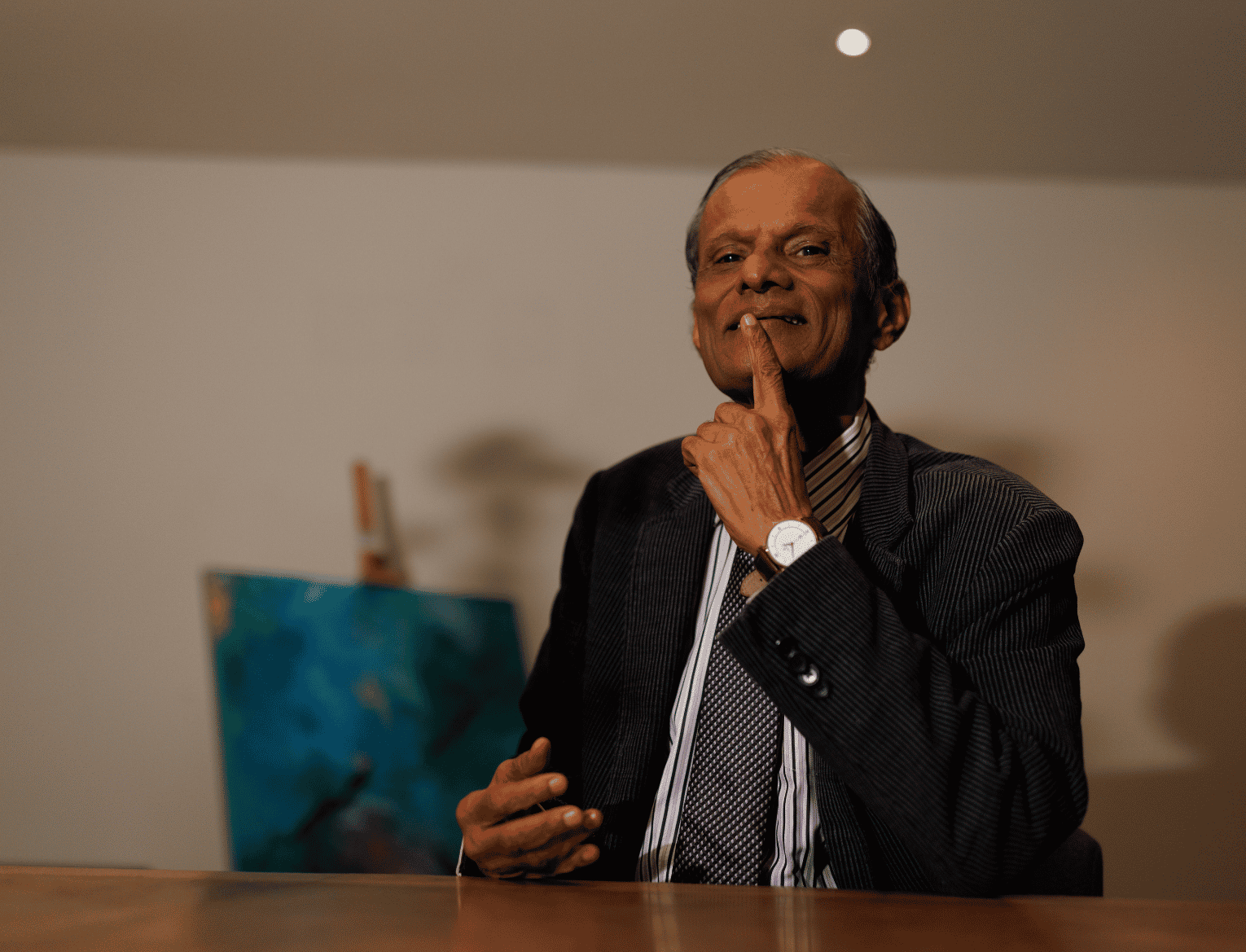
Nikhil Desai, Director of The Centre for Excellence and International Motivational TEDx Speaker & Trainer

After spending three decades training leaders and professionals across more than 42 countries, motivational speaker and corporate trainer Nikhil Desai believes that lasting excellence begins not with technology or strategy, but with personal growth. During his latest visit to Mauritius, where he conducted sessions for several organisations, he spoke to Bizweek about the power of developing people, the importance of mastering stress and self-doubt, and why the most meaningful legacy anyone can leave is the positive impact they have on others.

Having already reached around 250,000 people through your programmes, your ambition is now to reach half a million. Tell us about that mission and what drives it.

I have always believed that when I reach one person, it is never just one individual who is impacted. That person influences family members, friends, colleagues and everyone within their circle.

My goal is to grow from a quarter of a million participants to half a million people worldwide. If each of them positively influences just ten others, that means five million lives can be impacted through my programmes.


“Excellence is not about intensity; it is about consistency.”


That is an incredibly fulfilling experience for me because I firmly believe that we make a living by what we get, but we make a life by what we give. This is my way of leaving behind a meaningful legacy.

You are currently conducting high-impact sessions for organisations in Mauritius, including the Financial Services Institute (FSI), the National Insurance Company (NIC) and AXIS Fiduciary. What have your interactions revealed about the strengths and challenges of the Mauritian workforce?

Through my work with FSI, NIC and participants from several other organisations, the biggest strength I have observed is people’s willingness to learn. People are eager to develop themselves. They are eager to stay motivated and to fulfil their true potential. That has been one of the most important insights I have gained during my time here.

Mauritians are warm, welcoming and genuinely interested in taking valuable lessons back into both their personal and professional lives.

I also believe there is tremendous strength in simplicity. Mauritius has retained that simplicity alongside a rich culture, and those are qualities that I deeply respect and admire.

Let us go back to the beginning. When did this journey start, and how did you become a motivational speaker? Could you also give us an overview of the key message that has guided your work over the years?

That is a very interesting question. I believe the seeds of my speaking career were planted while I was pursuing my MBA in the United States, where I worked as a teaching assistant.

I taught undergraduate students for around 20 hours each week. One day, I asked them whether they wanted me to focus solely on the academic subjects or whether they would also like to discuss the subject of life.

These young men and women came from different parts of the world. Many were living away from their families and their home countries for the first time, and naturally, they were facing uncertainty and confusion.

To my surprise, every one of them said they wanted to talk about life. As a result, I dedicated five of my 20 teaching hours each week to open discussions about life’s challenges. During those sessions, many students found answers that helped them deal with their own personal struggles.


“Failure is only a failure if we fail to learn from it.” 


Often, they had friends with whom they could enjoy themselves, but very few people with whom they could openly discuss the problems that truly mattered. They also discovered that many others were experiencing similar challenges, which helped remove the feeling that they were alone.

One of the biggest questions many of them carried was, “Why me?” Through those discussions, many began to find clarity and perspective.

What happened after those discussions with your students?

Something very interesting happened. At the end of the semester, I submitted a report to the Dean of the Business School explaining that when you focus on the student rather than solely on the subject being taught, you achieve better academic results.

The Dean was delighted because students’ grades had improved significantly. He asked me whether I could devote even more time to these life discussions during the following semester. So, I increased the sessions from five hours to seven hours a week, which represented around 35 per cent of my teaching time. Once again, the students’ grades improved.

That became an important lesson for the university, for the students and for me. When people feel better about themselves and understand themselves more deeply, they perform better, whether they are students or professionals.

It is a principle that I have carried throughout my career in motivational speaking and corporate training. It has helped produce the kind of results and feedback I continue to receive from people around the world.

Many participants tell me that my programmes are “SAP”. I usually ask them what they mean, and they reply: Simple, Actionable and Practical. I deliberately avoid unnecessary jargon or complicated theories. While I could speak about them, what truly creates lasting change is content that people can easily understand, apply immediately and use in their everyday lives.

How are these life lessons relevant to the corporate training programmes you conduct in Mauritius?

I have always believed that personal excellence is the foundation of professional excellence, and that personal and professional excellence together become the foundation of organisational excellence.

When individuals understand themselves better, manage their time effectively, control their stress and communicate more successfully, they naturally perform better professionally. When enough individuals within an organisation achieve that level of excellence, organisational excellence follows. Everything therefore begins with personal excellence.


I am going to ask you to reveal one of your secrets. Even if you do, I doubt many of us will fully master it. How do you bring out the best in people? How do you unlock excellence?

I have developed my own trademark formula, and I am happy to share it. I call it the VEST of Excellence; where V stands for Vision, E stands for Enthusiasm, S stands for Stress Mastery, and T stands for Trust. This framework forms part of my flagship programme, In Pursuit of Excellence: Unleashing the Potential in You and Your Organisation.

It was also the motivational keynote I delivered during the 3i International Conference in Mauritius last month, where around 200 delegates from across the world attended. The response was extremely encouraging. Many organisations appreciated the session, and that led to an invitation from the Financial Services Institute to conduct the programme for its teams.

Following both the conference and the FSI sessions, several participants and organisational leaders asked me to deliver similar programmes within their own organisations. That is one of the reasons I have returned to Mauritius within such a short period. During this visit, I am conducting two programmes for the National Insurance Company, another for AXIS Fiduciary, as well as several other sessions.

How do you define excellence in today’s rapidly changing business environment?

For me, excellence is not a one-time achievement. It is a habit. Excellence is not about intensity; it is about consistency. The more consistent we become in whatever we do, the closer we move towards excellence in that area of our lives.

That is why I often say that our habits either make us or break us. In fact, I am currently writing a book entitled The Right Habits of Super Successful People, which will be published later this year. If we build good habits, they will build our lives. And if we build excellent habits, we will ultimately enjoy an excellent life.

Can good habits emerge from periods of chaos?

Absolutely. In fact, periods of chaos often create opportunities for new and better habits to develop. Take the Covid-19 pandemic as an example. It was undoubtedly a difficult and uncertain period for the entire world, but many positive developments also emerged from it.

Let me give you a personal example. On 14 March 2020, I conducted a programme in Mumbai for participants from various organisations. It was one of the first events where we stopped shaking hands because of Covid-19 and instead greeted one another with “Namaste.”

I was delighted to see that ancient tradition return. The word Namaste means “I bow to the divinity within you.” It is a beautiful expression because it reminds us to acknowledge the dignity and humanity of every individual we meet. During that period, we saw world leaders across the globe embracing the same greeting.

Before the pandemic, I had always believed – and I still believe – that face-to-face programmes generate greater energy and have a stronger impact than virtual ones. However, the pandemic accelerated the adoption of online learning. For example, IBM’s United States team invited me to deliver an online motivational session for around 3,000 employees across Europe and the United States.

Bringing together 3,000 people from different countries for a one-hour in-person session would have been almost impossible. Online technology made it achievable. So even in the midst of what appeared to be chaos, something valuable emerged. 

The same applies to meetings. In the past, particularly in cities such as Mumbai, people would spend several hours travelling through traffic simply to attend a 30-minute meeting. Today, organisations recognise that while face-to-face training remains extremely valuable, many meetings can be conducted just as effectively online.

Once people know your work, trust your credibility and respect the experience you have built over many years, they are comfortable discussing projects over a video call instead of insisting on an in-person meeting.

That has saved an enormous amount of time and provided much greater flexibility. These are just a few examples of how unexpected and difficult situations can produce positive and lasting change.

You have spent more than three decades helping organisations maximise human capital. What are the most common mistakes that prevent individuals and teams from reaching their full potential?

At the individual level, I believe the greatest obstacle is self-doubt. People are often held back by the fear of failure, the fear of criticism and the fear of change. These fears prevent them from taking the action needed to realise their true potential.

One of the most important lessons we can learn is that failure is only a failure if we fail to learn from it. Take the example of Thomas Edison, the inventor of the electric light bulb. People often reminded him that he had failed thousands of times before succeeding. His response was remarkable. He said, “I have not failed 10,000 times. I have simply discovered 10,000 ways that do not work.”

That mindset brought him closer to success with every attempt. It is also worth remembering that Edison was not simply the inventor of the light bulb. During his lifetime, he registered more than 1,000 patents. His story reminds us that overcoming self-doubt and refusing to fear failure are essential if we want to achieve meaningful goals, particularly when our work seeks to create value for society.

Besides self-doubt, what other factors prevent individuals and organisations from reaching their full potential?

At the organisational level, one of the greatest challenges is communication. I often describe communication as the lifeblood of an organisation. If blood stops circulating through one part of the human body, that part eventually becomes paralysed. The same applies to organisations. When communication does not flow effectively between departments, teams or individuals, the organisation itself becomes less effective.

Communication is about much more than speaking a language well. It is the process of transferring both information and understanding from one person to another. Without understanding, genuine communication has not taken place.

Another common obstacle is the way people respond to feedback. I believe we should respond to situations rather than simply react to them. When someone offers constructive feedback, we should view it as an opportunity for growth.

I often say that feedback is the breakfast of champions. Anyone who wants to become a champion must learn to accept constructive feedback with an open mind instead of reacting defensively. These are some of the barriers that prevent people from realising their full potential.

Earlier, you mentioned a formula for success. Could you explain it?

When we are young, we learn what I call the ABC of life – reading, writing and acquiring knowledge. As we grow older and aspire to greater success, we need to learn the CBA of life.

The first letter, C, stands for Conceive. Every meaningful achievement begins with a vision. I often say that whatever you can visualise, you can actualise. The second letter, B, stands for Believe. Once you have a vision, you must believe in it wholeheartedly and develop confidence in your ability to achieve it. Finally, A stands for Achieve. When vision is supported by belief and followed by consistent action, achievement becomes possible.

When you speak about different stages of life, are you referring to a particular age or simply to life experience?

I believe that, on average, our priorities evolve with every decade of our lives. The goals we pursue in our twenties are often very different from those we pursue later in life. As we mature, we become more reflective. Material success remains important, but many people begin searching for deeper fulfilment and spiritual growth.

Eventually, we realise that we should not spend our lives merely being human doings or human havings. We should strive to become true human beings. That, after all, is what we are. In the earlier stages of life, we sometimes forget this because we become preoccupied with achievement, possessions and status.

As we grow older, we begin to appreciate the importance of the inner dimension of life. Human beings are made up of body, mind and spirit. Most of us take care of our bodies. Some of us also invest in developing our minds. Yet we often neglect our spirit. As we become older and wiser, we begin to understand that nurturing the spirit is just as important as looking after the body and the mind.

You have worked with organisations in more than 42 countries. What distinguishes organisations that consistently perform well from those that struggle to sustain growth?

The organisations that achieve lasting success invest not only in technology but also in people. Today, there is tremendous emphasis on technological advancement, which is understandable. However, people’s development is increasingly being pushed into the background.

Research from Harvard Business Review suggests that approximately 85 per cent of an executive’s success comes from soft skills, while only 15 per cent is attributable to technical or functional expertise.

That finding reinforces something I have observed throughout my career. I remember conducting a programme in San Francisco attended by senior representatives from several organisations, including the Head of Training for the United States Coast Guard.

The programme focused on achieving excellence through stress management. Afterwards, she told me that organisations needed more programmes of that nature rather than concentrating almost exclusively on technical training.

I fully agree. Soft skills make a hard difference. Organisations should not view investment in people development as an expense but as an investment that delivers one of the highest returns. Technology certainly drives systems, but people drive technology.

When organisations develop capable, motivated and emotionally resilient people, they create sustainable success that technology alone can never achieve.

Do you believe businesses are investing enough in people and leadership development?

My answer is very clear: no, I do not think they are. Whether knowingly or unknowingly, many organisations continue to underinvest in people development. Some believe they do not have sufficient budgets, while others allocate resources to priorities that are undoubtedly important, but overlook one of the most critical investments they can make, which is developing their people.

If organisations invested more consistently in leadership and people development, they would see stronger employee engagement, better teamwork, lower staff turnover and higher productivity.

Employee attrition is extremely costly. Recruiting a new employee involves far more than paying a recruitment agency. Organisations must also invest time and money in hiring, onboarding, training and integrating that individual into the business.

By the time a new employee reaches full productivity, several months have often passed. If that person leaves shortly afterwards, the organisation loses not only its financial investment but also valuable time and knowledge.

I have seen organisations recognise the value of investing in people. For example, I conducted a time management programme for Caterpillar in Singapore. The company brought together employees from seven countries because it understood that effective time management directly improves organisational performance.

Instead of continuously recruiting additional staff, organisations can often achieve better results by helping existing employees manage their time and stress more effectively. Ten well-trained employees who work efficiently can often accomplish the work that would otherwise require twelve people.

Time management and stress management are closely connected. When people fail to manage their time effectively, stress increases. Equally, when stress becomes overwhelming, productivity declines and valuable time is lost.

That is why one of my most popular programmes is entitled Manage Your Time, Master Your Stress, Energise Your Life. It has become one of my flagship programmes because it addresses two of the greatest challenges facing today’s professionals. In addition to group programmes, I also provide one-to-one executive coaching for senior leaders on these subjects.

Stress, uncertainty and burnout have become defining features of today’s workplace. What practical steps can organisations take to maintain motivation and performance without exhausting their workforce?

This is undoubtedly one of the biggest challenges facing organisations today. Every business wants to improve productivity, but it should never come at the expense of employee wellbeing. Across the world, we are witnessing an increasing number of cases where relatively young professionals suffer heart attacks, strokes or severe health issues linked to prolonged stress.

This makes it essential for organisations to address employee wellbeing proactively. One of the most important lessons we must all remember is that life is not a sprint; it is a marathon. If we live every day as though we are constantly sprinting from morning until night, sooner or later we will pay a heavy price.

A marathon requires endurance, consistency and balance. For that reason, organisations should integrate stress management and emotional wellbeing into their learning and development programmes rather than assuming employees will manage these challenges on their own.

Stress is one of the greatest destroyers of productivity, health, energy and relationships. Ignoring it carries far too high a cost. I have noticed that organisations in the United States and across Europe invest significantly in stress management programmes for their employees. In many other parts of the world, including this region, there is still room to strengthen that commitment.

Leaders should focus on keeping their people energised. I often say that employees are not an organisation’s greatest asset. Energised employees are. When organisations help people remain energised, everyone benefits. It creates a genuine win-win situation.

How can organisations help employees stay energised?

The first step is recognising the direct relationship between stress and energy. When stress levels are high, energy levels fall. When people learn to manage stress effectively, their energy returns.

That is precisely why programmes such as Manage Your Time, Master Your Stress, Energise Your Life, Achieving Excellence Through Stress Management, and my flagship programme, In Pursuit of Excellence: Unleashing the Potential in You and Your Organisation, continue to resonate with organisations around the world. All three programmes are designed to help people become healthier, more resilient and more energised, both personally and professionally.

Many professionals continue to experience self-doubt despite possessing strong qualifications and abilities. How can they overcome these internal barriers?

The first step is developing greater self-awareness. While studying in the United States more than 40 years ago, travelling between cities was very different from today. There was no Google Maps. Whenever I planned a journey, I had to visit the American Automobile Association, or AAA, to obtain printed road maps. 

That experience inspired another framework that I now use. I call it the AAA Formula. The first A stands for Awareness. We need to understand our strengths, our weaknesses, our blind spots and the way we communicate and influence others.

The second A stands for Attitude. Greater awareness leads to a healthier attitude, and attitude determines altitude. It is not our circumstances that determine how far we go in life, but the attitude with which we respond to them.

The final A stands for Action. Once awareness and attitude are in place, consistent action produces meaningful results.

I also use another acronym, the word GOAL — Getting Organised And Living. The more organised we become in our thinking and our actions, the more effectively we move towards the goals we have set for ourselves.

If you had one message for Mauritian professionals and business leaders striving for excellence in today’s world, what would it be?

My message to business leaders is simple: never underestimate the power of your people or the potential they possess. As leaders, your responsibility is to help unlock that potential. When you do so, leadership becomes more rewarding, employees become happier and more engaged, and organisations become more productive in an increasingly competitive world. Treat people as your greatest asset. They are even more valuable than machines or technology. 

For individuals, I would say that excellence should be viewed as a journey rather than a destination. There is no final point at which we can say we have arrived. Life is a continuous process of learning and growing. As someone once said, “success is a road that is always under construction.”

I also encourage people to embrace what I call the Six Ls of Life. The first L is Listen. Become a good listener. The second L is Learn. Good listeners become lifelong learners. The third L is Love. Love yourself first, because if you cannot love yourself, it becomes difficult to genuinely love others. The fourth L is Laugh. Too many people have forgotten how to smile and enjoy life because they are overwhelmed by stress and responsibilities. The fifth L is Live. When you practise the first four principles, you truly begin to live life. The sixth and final L is Legacy. Legacy is not merely about wealth or material possessions. It is about living a life that makes a positive difference in the lives of others.

True success is not measured only by achievements in the external world. It is equally measured by the peace, fulfilment and happiness we cultivate within ourselves.

Looking back on the hundreds of thousands of people you have met during your career, is there one particular encounter or experience that you cherish the most?

There are several, but one that remains especially memorable was being invited to conduct a motivational programme aboard a Royal Caribbean cruise ship sailing from Singapore. The audience included around 300 participants from different countries, among them two former Indian ambassadors.

This took place about a year after the Covid-19 pandemic. What made the experience particularly meaningful was seeing such a diverse international audience respond so warmly to my session.

When the programme ended, the entire audience rose to give a standing ovation. That was an incredibly fulfilling moment. Going on a cruise is enjoyable. Conducting a motivational programme on one is even more rewarding.

Another unforgettable experience was speaking at the Baku HR Summit in Azerbaijan. The conference brought together around 600 human resources leaders from across the world, with speakers representing countries, including the United States, the United Kingdom, Germany, Switzerland and Azerbaijan.

I was deeply honoured when participants rated my presentation as the highest-ranked session of the entire conference. The response afterwards was overwhelming. Many delegates wanted photographs and conversations, and the appreciation I received made the experience truly unforgettable.

You have also interacted with well-known personalities from the Indian film industry.

Yes, I have been fortunate to meet several remarkable people. One of them owned a property next to mine in Lonavala. It was the veteran actor Dharmendra. Whenever I visited, he would invite me over and, over time, he attended some of my stress management sessions.

More recently, actress Dia Mirza presented me with an award recognising my contribution to global excellence in motivational speaking during a ceremony held at the Taj. Receiving that award from her was a tremendous honour.

Successful public figures often appear to have everything. What are they usually searching for?

I believe there are two kinds of successful people. Some continue searching for external recognition, praise and glamour. Others eventually reach a stage where they begin moving away from the spotlight because they are searching for something deeper.

People such as Dharmendra had already achieved extraordinary success in the external world. What they were looking for was inner peace. They had wealth, fame and recognition, but they wanted calmness, balance and fulfilment. That search for inner peace is something I encounter frequently when working one-to-one with senior executives and public figures.

Many of them possess everything the world associates with success, yet they still seek tranquillity within themselves. I am reminded of what the American actress Goldie Hawn once said when she was asked why she travelled to India. She replied, “I came to India to find the guru within me.”

I have always found that to be a profoundly meaningful statement. Ultimately, many of the world’s most successful people discover that while external success is important, inner peace is what gives life its deepest sense of fulfilment.

Skip to content