Back to Bizweek
SEARCH AND PRESS ENTER
Latest News

Real estate: Changes that are filtering capital without freezing activity

Business breakfast 

  • “There was a period of hesitation and anticipation, as investors waited to see how policies would translate into practice” – Brian Blatch, Executive Director at Park Lane Properties Mauritius. 


  • “There is still no tax on dividend distributions as well as no capital gains tax, and that remains an important differentiator in the region” – underscored Deven Marianen, Chief Executive Officer of Carpus Group. 


  • “Financing is more complex, compliance requirements are higher, and banks apply much stronger risk frameworks” – Lewis Ah Ching, Chief Executive Officer of MaxCity Property Fund.


  • European demand, particularly from Germany and France, remains resilient, while South African interest is strengthening.

A tighter regulatory framework, stricter lending conditions and recalibrated tax measures are transforming the real estate market of Mauritius. As speculative capital thins out, policymakers and market participants say the sector is settling into a more disciplined, institutional phase. One where resilience, compliance and long-term value matter more than rapid turnover.

Rudy Veeramundar 

The real estate market of Mauritius is no longer expanding on the momentum of easy credit and speculative inflows. Instead, it is entering a phase of consolidation shaped by regulatory tightening, fiscal recalibration and more selective financing. Changes that are filtering capital without freezing activity. That was the central assessment to emerge from a panel discussion held in Ebene this week, where developers, bankers and legal advisers converged on a single conclusion: the market is not slowing so much as being re-engineered. Despite tighter financing conditions, property transactions increased by 5 per cent in 2025, with more than 842 sales completed. For panellists, the figures pointed to a sector absorbing reform while shedding its more speculative edges.

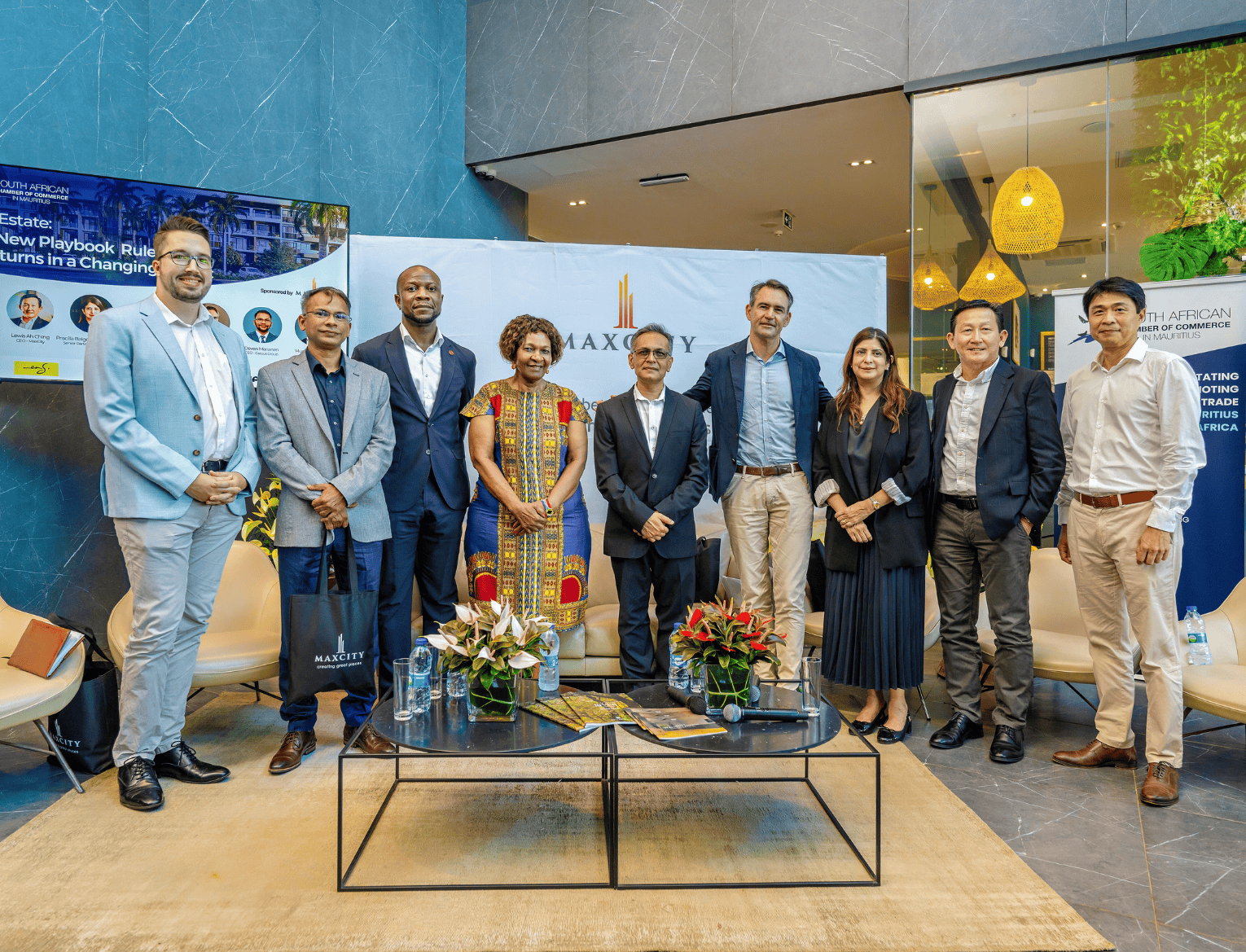
The discussion took place at a business breakfast organised by the South African Chamber of Commerce in Mauritius (SACC), in partnership with MaxCity Group, under the theme “Real Estate: The New Playbook – Rules, Risks and Returns in a Changing Market”. Hosted at 1 Exchange Square, the flagship office development of MaxCity in Ebene, the event was held in the presence of Dr Nelly Manzini, High Commissioner of South Africa to Mauritius.

Policy tightening as market architecture

Amal Munhurrun, Senior Manager at the Economic Development Board Mauritius, framed recent changes to loan financing rules and lending frameworks as structural safeguards rather than cyclical interventions. “Recent reforms in loan financing were necessary to safeguard the sector and ensure more responsible investment behaviour,” he said. The objective, he argued, was to reduce volatility and discourage short-term speculation, even if that meant redirecting certain flows elsewhere. “There has been some diversion of speculative investment to other markets,” the Senior Manager of EDB acknowledged. “However, this has allowed Mauritius to refocus on higher-quality, long-term investors.

European and South African investors continue to account for close to 80 per cent of foreign real estate investment, he said, with many relocating their businesses and integrating into the local operating environment. “Mauritius continues to be perceived as a safe, stable, and well-regulated jurisdiction,” Amal Munhurrun added, identifying institutional credibility as a decisive factor in sustaining investor confidence. The government, he said, remains firmly committed to the sector. “The government firmly believes in real estate as a strategic pillar of economic development.” Beyond direct investment, he highlighted the sector’s spill-over effects across construction, services, finance and employment.

Looking ahead, policy priorities are shifting away from volume-driven growth towards resilience and sustainability. “Our future focus includes greening infrastructure, improving connectivity, and diversifying our national asset portfolio,” he said. “The objective is not rapid expansion, but sustainable, balanced growth that benefits the country over time.

Tax reform reshapes incentives

For developers, the recalibration of fiscal policy has altered project economics as fundamentally as regulatory change. Deven Marianen, Chief Executive Officer of Carpus Group, said taxation now sits at the centre of commercial decision-making. “Tax policy now directly influences how we sell, lease, and finance real estate. It shapes the entire commercial model,” he said. While reforms were initially perceived as restrictive, Deven Marianen argued that they are introducing predictability and aligning incentives more closely with long-term investment behaviour. “The objective is more sustainable revenue and better-aligned investor behaviour,” he said. “Volumes may adjust, but stability improves.” Mauritius, he added, continues to retain fiscal attributes that distinguish it regionally. “There is still no tax on dividend distributions as well as no capital gains tax, and that remains an important differentiator in the region.

Banks apply a harder filter


Property transactions increased by 5 per cent in 2025. 


From the banking sector’s perspective, reform has translated into tighter screening rather than reduced appetite. Segun Omoniwa, Head of Coverage, Wealth at Absa Bank Mauritius, described change as a permanent condition rather than a transitional phase. “The only constant in this sector is change,” he said. Banks, he explained, are placing greater emphasis on governance, sponsor credibility, phased execution and sustainable cash flows. This has narrowed the pipeline of bankable projects while strengthening those that remain. “We are seeing fewer speculative projects and more disciplined, resilient developments,” Segun Omoniwa said, arguing that this improves risk management and enhances long-term stability across the real estate ecosystem. “Projects with clear fundamentals and strong governance are more likely to reach financial close and deliver on their objectives,” he added.

Compliance as an investment signal

Legal and regulatory reform has also reshaped investor behaviour. Priscilla Balgobin-Bhoyrul, Senior Partner at Dentons Mauritius, said enhanced compliance and AML/CFT requirements initially created uncertainty and extended transaction timelines. “There has undoubtedly been a period of unease, with investors asking what comes next,” she said, stressing that “clear, consistent engagement from regulators and institutions is essential to maintain confidence and allow the market to adapt constructively.” 

Over time, however, the effect has been to elevate market quality. “We are seeing fewer speculative buyers and more serious, well-prepared investors,” she said, describing the shift as evidence of growing market maturity.

Residential demand recalibrates

On the residential side, policy signals were initially disruptive. Brian Blatch, Executive Director at Park Lane Properties Mauritius, said recent budget announcements led to a pause in buyer activity. “There was a period of hesitation and anticipation, as investors waited to see how policies would translate into practice,” he said. As regulatory clarity improved, transaction flows resumed. “Once the rules were better understood, activity resumed,” Brian Blatch said. “We are now seeing more realistic pricing and healthier transaction flows.


Fewer speculative projects and more disciplined, resilient developments. 


European demand, particularly from Germany and France, remains resilient, while South African interest is strengthening. Administrative delays affected some transactions, he noted, but did not undermine longer-term confidence.

Developers adapt to a higher bar

For developers, the cumulative impact of regulation, financing discipline and rising expectations has raised the threshold for participation. Lewis Ah Ching, Chief Executive Officer of MaxCity Property Fund, said the sector has become markedly more sophisticated over the past five years. “Financing is more complex, compliance requirements are higher, and banks apply much stronger risk frameworks,” he said. At the same time, tenants and investors now expect international-grade standards. “Differentiation and quality are no longer optional.”  

Sustainability, he argued, has moved from aspiration to necessity. “Green building criteria, LEED and EDGE certification, and ESG principles are now fundamental requirements,” Lewis Ah Ching said. “Sustainability has shifted from being a trend to becoming a core business necessity.” He cited MaxCity’s focus on mixed-use developments, tenant wellbeing and environmentally responsible infrastructure, including 1 Exchange Square and Grand Baie La Croisette. In logistics, the group has delivered four sustainable warehouses aligned with international standards since 2020. 

Operating across office, retail, residential, and logistics allows us to adapt quickly to changing market conditions,” Lewis Ah Ching explained. “To remain relevant, developers must anticipate change, innovate continuously, and stay aligned with both local realities and global standards.

From growth cycle to institutional phase

The event opened with remarks from Michael Bell, Board Member of the SACC and Business Development Manager at Osiris, who reiterated the Chamber’s role, describing it as being “committed to strengthening commercial relations between Mauritius and South Africa.

Jennyfer Show, Marketing and Communications Manager at MaxCity Group, said that the partnership between MaxCity and the SACC was “a positive journey marked by meaningful collaborations and concrete business opportunities”. She added that “creating great places is not only about buildings, but about the quality of dialogue, networks, and communities that develop around them.

In his address, Danny Fon Sing, Group Chief Executive Officer and Executive Director of MaxCity Group, reflected on the company’s origins since its founding in 1994 by himself and his father, Maxime Fon Sing. MaxCity, he said, was established “not simply to construct properties, but to improve how people live, work, and connect.

The discussions suggested that the real estate sector of Mauritius is approaching the end of a transition phase. Stronger rules, tighter financing and higher compliance standards are forcing capital to choose between short-term exits and long-term commitment. The market, participants argued, is not retreating. It is settling into a more institutional, sustainability-driven and resilient form of growth.

Skip to content