Back to Bizweek
SEARCH AND PRESS ENTER
Latest News

We want to build the best car museum in the world

Terry Smith, Founder, Milestones Motor Museum

The Milestone Motor Museum is an ambitious attempt to frame the automobile as one of the defining forces of modern economic and social life. Rooted in Mauritius but global in scope, the project moves beyond nostalgia, using cars to explore industrial ambition, rivalry, failure and success, and national identity.

Klyven Veeramundar

Private museums often begin with a collection. Milestone begins with an argument. At its exclusive preview in late January, founder Terry Smith was careful to dismiss the idea that guests were being shown a finished institution or even a representative one.

“This is not the Milestone Museum,” he told the audience. “And this is not the Milestone Museum collection. This is merely a selection of cars that are here for the country.”

The distinction was deliberate. Milestone is not organised around market value or prestige but – like the name says – around milestones, that is moments when automotive development reshaped societies. In Terry Smith’s view, the car is “the artefact that most influenced human beings in the 20th century,” rivalled only, and belatedly, by the computer.

From production lines to social mobility

Terry Smith repeatedly returned to the Ford Model T as the clearest illustration of how cars altered economic structures. Henry Ford’s 1913 production breakthrough radically cut build times, but the real shift lay in how the gains were used.

“He didn’t take all the profit,” Smith said. “He took the car from being the plaything of the aristocracy to something owned by doctors, dentists and bankers.”

The result was mass mobility, and with it, new patterns of work, settlement and consumption. In Milestone’s telling, such cars are no less important than supercars or racing legends. Economic reach, not exclusivity, is what defines impact.

Excess, rivalry and technological daring

If democratisation forms one pillar of the museum’s narrative, unrestrained ambition forms another. Cars such as the McLaren F1 are presented not as luxury objects, but as experiments in engineering without compromise.

Designed without power steering, power brakes or electronic aids, the McLaren F1 was “considerably more capable than most people,” a fact underlined by the number of owners who crashed it.

Rivalries loom large as well. From Ford’s feud with Ferrari to Lamborghini’s birth from personal insult, Milestone treats competition as a catalyst for progress. “A number of cars emerged because Enzo Ferrari upset people,” Terry Smith noted. Innovation, the museum suggests, is often born of conflict rather than consensus.

Failure as instruction

Unusually, Milestone also foregrounds failure. Cars such as the DeLorean, Volkswagen Phaeton and other commercial missteps are included not as curiosities, but as lessons.


“A number of cars emerged because Enzo Ferrari upset people”


“Some of these cars are worthless,” Smith said bluntly. “But they’re incredibly important.”

In doing so, the museum resists the temptation to sanitise industrial history. Misjudgement, overconfidence and flawed strategy are treated as integral to progress, not footnotes to it.

France: design, state power and survival

For his part, French Ambassador Frédéric Bontems framed the Citroën DS as an expression of national daring. Introduced in 1955, the DS was “totally revolutionary by its form and its mechanics,” particularly its hydropneumatics suspension.

He also focused on history. In 1962, President Charles de Gaulle was in a DS when there was an assassination attempt. Despite multiple bullet impacts, the car remained operational and, as Frédéric Bontems says, “the driver managed to save the General.” In that moment, the DS became more than a design icon; it became part of the political history of the French Republic.

Japan: credibility earned, not assumed

Japan’s intervention centred on the Toyota 2000GT, described as a decisive moment in the country’s industrial evolution. At a time when Japanese cars were associated with practicality rather than prestige, the 2000GT signalled technological confidence.

“This is a very iconic sports car,” a Japanese representative said.

Kan Masahiro, the Japanese ambassador to Mauritius, linked that moment to Toyota’s contemporary dominance, noting that the company has led global vehicle sales for six consecutive years. The implication was clear: credibility in global manufacturing is built incrementally, often beginning with symbolic risks.

The United Kingdom: memory, culture and continuity

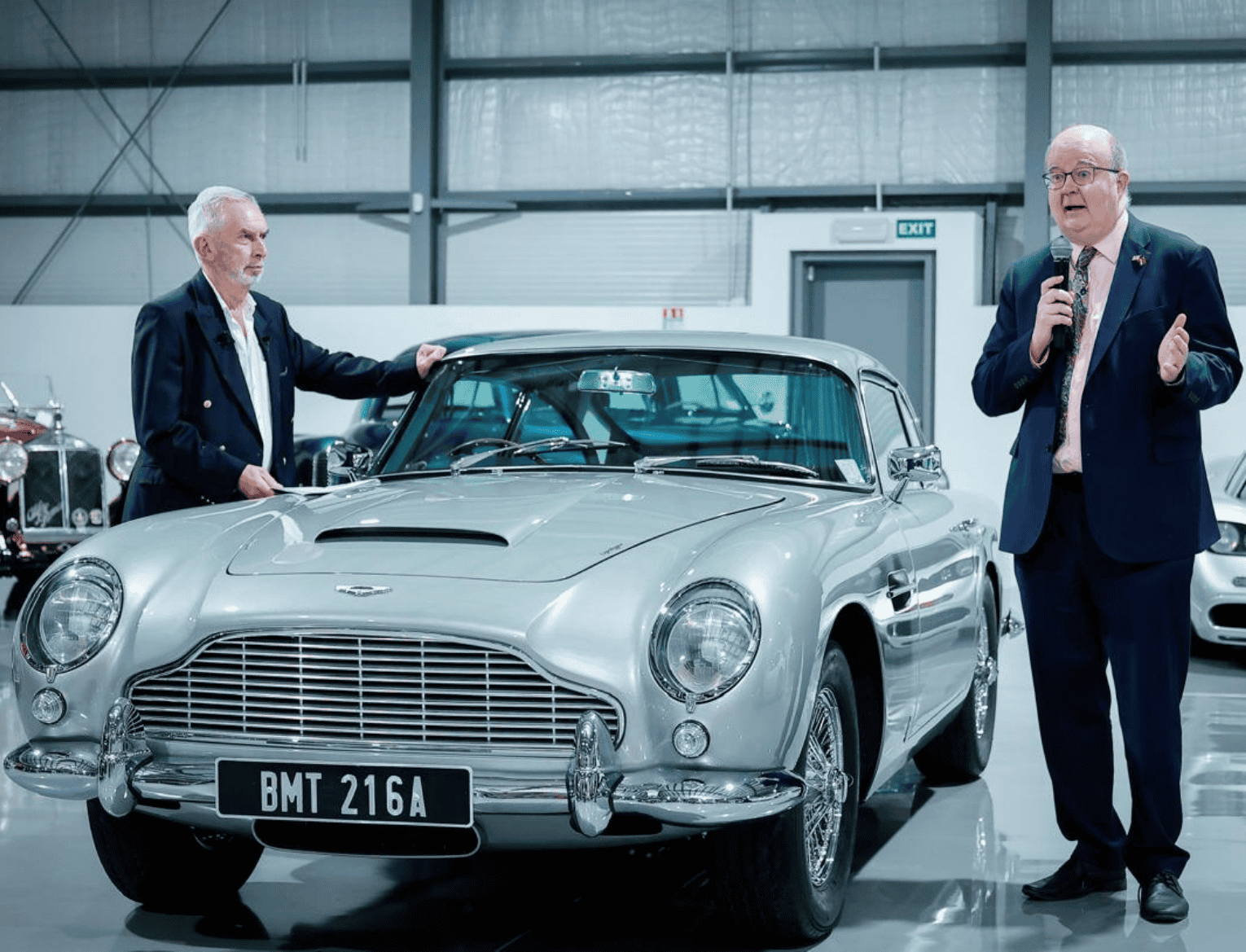
British High Commissioner Paul Brummell approached the subject from a more personal angle, speaking beside the Aston Martin DB5. Rather than focusing on performance, he reflected on the car’s place in British popular memory. 

“This is quite an emotional moment for me,” he said, recalling how a model DB5 was one of his first childhood toys, complete with ejector seat and hidden gadgets.


“Why have eight cylinders when you can have sixteen?”


The High Commissioner traced the car’s journey from engineering object to cultural symbol through its association with James Bond, noting how later film versions quietly stripped away violence in favour of subtlety. The DB5, in this telling, embodied a distinctly British fusion of restraint, craftsmanship and storytelling.

“This is going to be a great project for Mauritius,” he added, praising the collection’s global scope and cultural ambition.

The United States: scale, confidence and desire

The American contribution focused on the Cadillac V16, a car that embodied an era when industrial ambition was expressed through scale and complexity.

“We can’t be discreet,” one speaker remarked. “Why have eight cylinders when you can have sixteen?”

Produced at a time when American manufacturers led the world in luxury and innovation, the V16 was presented as a reminder that mass production alone was not enough. Desire mattered too. Cars had to be loved, not merely used.

Why Mauritius?

Terry Smith acknowledged that offers to host the museum came from far larger markets, including the Gulf and Australia. The decision to locate Milestone in Mauritius was personal, but not accidental.

“I actually live in Mauritius,” he said. “And I want to share it.”

The project is intended as an economic as well as cultural institution. Plans include a cinema, rotating national programmes, themed events and a destination restaurant. Smith also emphasised job creation and long-term opportunities for communities around Beaux Songes.

An institution with an argument

Terry Smith does not shy away from ambition. “We want to build the best car museum in the world,” he said, invoking exploration rather than caution as his guiding principle.

Whether Milestone ultimately fulfils that claim will depend on execution. But its premise is already clear. This is not a museum about cars as possessions. It is about cars as forces—shaping economies, rivalries, identities and everyday life.

Skip to content