Back to Bizweek
SEARCH AND PRESS ENTER
Latest News

A Mauritian Trade Deal with Global Resonance 

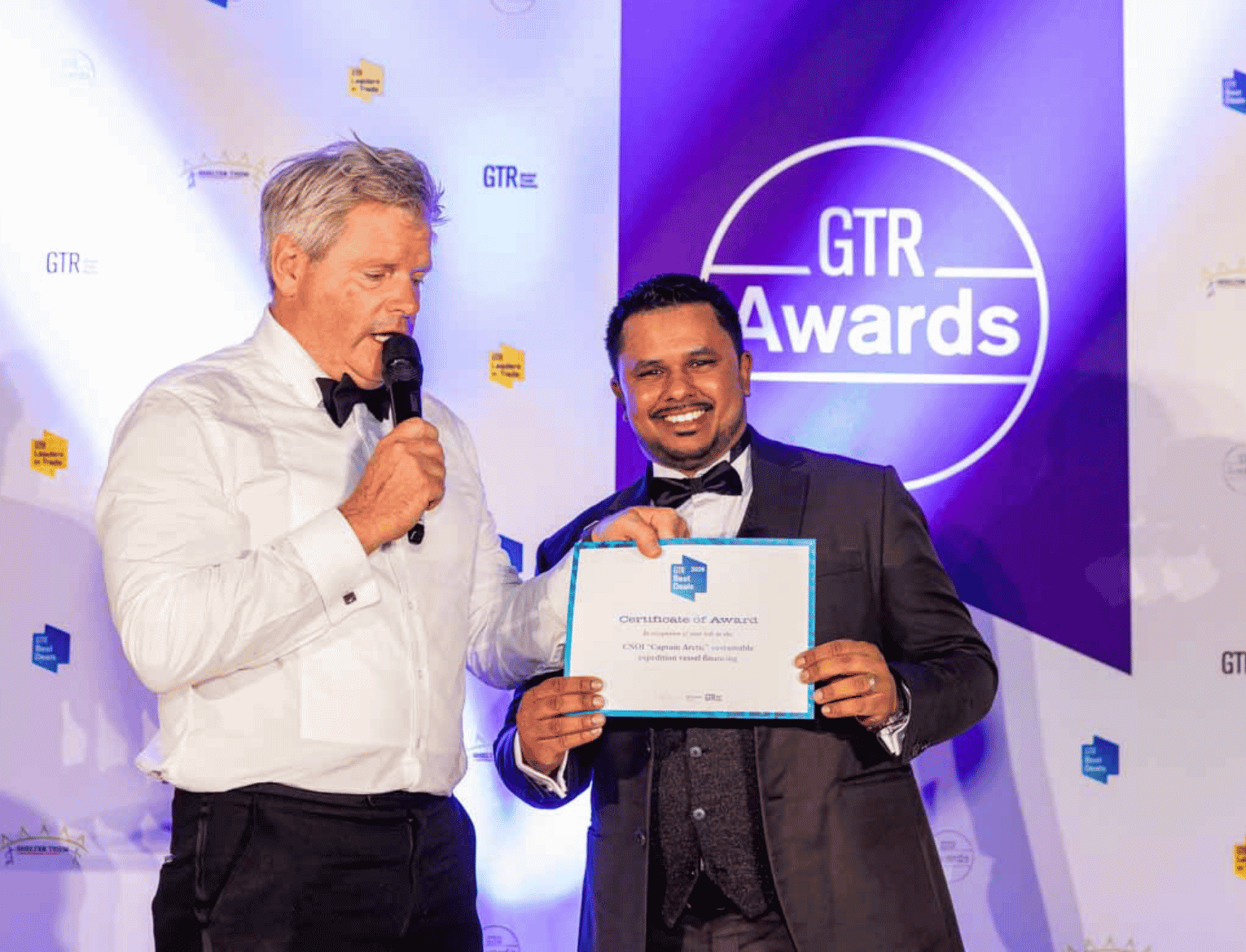
Some awards recognise excellence. Others redefine perceptions. When Global Trade Review (GTR), the world’s leading publication dedicated to trade, commodity, export and supply chain finance, selected the Mauritius Commercial Bank’s financing of the Captain Arctic expedition vessel among its Best Deals of the Year 2025, it did far more than honour an innovative transaction. It placed a Mauritian financial institution alongside the world’s leading trade finance houses and, perhaps for the first time, acknowledged that a financing structure conceived in Mauritius could influence global thinking on complex cross-border finance. The distinction comes after an exhaustive editorial assessment of more than 500 submissions from around the world, of which only sixteen transactions were ultimately recognised. Beyond the award itself lies a larger story—one about financial engineering, collaboration, industrial ambition and the quiet evolution of Mauritius from a financial gateway into a producer of world-class financial innovation.

In London, where Global Trade Review’s editorial team spends much of the year scrutinising the mechanics of international commerce, awards are not handed out lightly. There are no public votes, no sponsorship-driven rankings and no commercial committees deciding which institutions deserve recognition. Every year, hundreds of submissions arrive from banks, export credit agencies, insurers and multinational corporations across every continent, each claiming to have structured one of the year’s most innovative trade finance transactions. Most are impressive. Very few are exceptional.


The Mauritius Commercial Bank (MCB) developed a financing structure that substantially reduced the client’s borrowing costs.


By the time the judging process concluded for the GTR Best Deals of the Year 2025, more than five hundred transactions had been examined. They ranged from commodity finance in Latin America to export finance in Asia, from complex supply-chain solutions in Europe to infrastructure financing across Africa. Only sixteen survived months of editorial scrutiny. Among them was a transaction structured thousands of kilometres away from the world’s traditional financial capitals. Not in London, New York, Singapore or Frankfurt, but in Mauritius.

For Shannon Manders, Editorial Director of Global Trade Review, the significance of the award begins with the integrity of the process itself. GTR is first and foremost a specialist publishing house. For almost twenty-five years, its journalists have covered the world of trade finance on a daily basis, reporting not simply on institutions but on the transactions themselves. That perspective shapes the way the awards are judged.

We have been covering trade finance, commodity finance, export finance and supply-chain finance for nearly twenty-five years,” she explains. “These awards are one way of recognising both innovation and excellence across the industry.” Unlike many industry accolades, however, commercial considerations are deliberately kept outside the room. “The judging is entirely an editorial process,” she says. “Our commercial team does not get a look-in. We simply inform them which deals have won.

The distinction is more than procedural. It reflects GTR’s belief that financial innovation cannot be measured by the size of a balance sheet or the prestige of an institution. Each submission is assessed against a far more demanding criterion: whether the transaction genuinely advanced the practice of trade finance and delivered a measurable benefit to the client.

We look at the transaction itself,” Shannon Manders explains. “We examine what makes it innovative and its impact on the client. That is the most important thing: the difference it has made for the client involved in the award-winning deal, and whether it represents something genuinely new in the market.” Because GTR’s editorial team follows these markets every day, it is able to place each submission within a much broader context, looking beyond headline values to understand whether the structure itself contributes something new to the evolution of international finance. Every shortlisted transaction is also subjected to an extensive due diligence exercise to ensure that it satisfies the publication’s own editorial standards.


The African continent continues to face a trade finance gap estimated at between US$120 billion and US$140 billion annually.


It was through that lens that the Captain Arctic transaction came to the attention of GTR.

The project itself was already unusual. Built by Chantier Naval de l’Océan Indien (CNOI) in Mauritius, Captain Arctic is a next-generation polar expedition vessel designed to operate in some of the world’s most environmentally sensitive waters. Combining retractable aluminium sails fitted with photovoltaic panels, hydro-generating propulsion systems and biomass heating powered by recycled wood pellets, the seventy-metre vessel represents a new generation of low-emission maritime engineering capable of reducing emissions by up to ninety per cent. Yet the vessel was never the principal reason why the transaction attracted international attention. What fascinated GTR’s editorial team was not the ship but the financing that made its construction possible.

Rather than relying on conventional project finance, the Mauritius Commercial Bank (MCB) had developed a financing structure that combined bank guarantees with insurance guarantee to make an A-rated guarantee for a cross-border transaction in a manner that substantially reduced the client’s borrowing costs. According to the bank, the structure lowered financing costs by almost forty per cent while enabling the project to secure the advance payments necessary to procure specialised materials and sustain construction. To GTR, that represented something far more valuable than technical ingenuity. It demonstrated that innovation could produce tangible commercial outcomes.

What impressed us most,” the Editorial Director of Global Trade Review recalls, “was the creativity of the financing structure. Rather than relying on traditional project finance, the parties combined banking and insurance guarantees to deliver a much more competitive funding solution.” The figures themselves were striking. “According to MCB, financing costs were reduced by almost forty per cent. To me, that sounds like a tangible commercial benefit, rather than innovation for innovation’s sake. That is why we liked it. It was actually reducing costs for the client. I mean, it is a no-brainer.

That distinction lies at the heart of contemporary trade finance. Financial markets have become increasingly sophisticated over the past two decades, producing an endless stream of new instruments, platforms and structures. Yet complexity alone rarely creates value. Many innovations add layers of engineering without materially improving the economics of a transaction. The Captain Arctic financing achieved precisely the opposite. Its sophistication remained largely invisible to the client. What the client experienced was simply access to competitive financing.

The award was certainly a recognition of technical excellence. But it also challenged long-standing assumptions about where sophisticated financial innovation originates. For decades, African financial institutions have frequently been viewed primarily as participants in global transactions conceived elsewhere. Here, however, was an African bank recognised not for executing someone else’s structure but for designing one of its own.

Perhaps the most symbolic moment came when Shannon Manders reflected on what the award might represent in the history of Mauritian finance. “This might be our first Mauritian Best Deal,” she observed almost in passing. Having spent seventeen years at GTR, she was careful not to claim absolute certainty. “I am ninety-nine per cent confident,” she said. “It is the first I have seen.


In October, GTR and local industry stakeholders will convene a strategic roundtable bringing together leaders from banking, trade finance and international business to discuss the trends shaping commerce across Africa and the Indian Ocean.


Whether or not historians ultimately confirm that assessment is almost secondary. The remark nevertheless captures the quiet significance of the moment. Mauritius has spent decades building an international financial centre renowned for facilitating investment and trade into Africa. The Captain Arctic transaction suggests that the country’s role may now be evolving beyond intermediation towards innovation itself.

The path to that recognition, however, began not with an ambition to win international awards but with a client asking a deceptively simple question: could the financing be made competitive?

That question would ultimately lead MCB Teams to go the extra mile, leverage on key partners and make every effort to craft a bespoke transaction that would enable trade finance and thus would attract the attention of the world’s leading trade finance publication.


Part II

The deal behind the distinction

The conversation that would eventually produce one of the world’s most innovative trade finance transactions did not begin with an ambition to win awards or redefine financial engineering. It began with a client seeking more competitive financing for a complex shipbuilding project.

For MCB’s teams, the challenge was not simply one of pricing. Competing directly with European funding costs was unrealistic. The real question was whether the transaction itself could be structured differently. That shift in perspective proved decisive. Rather than focusing on what could not be done, the teams explored how banking, guarantees, insurance and international funding sources could be combined to achieve a better outcome for the client.

What followed was a process of collaboration, persistence and problem-solving. As new constraints emerged—including requirements linked to the credit standing of guarantee providers—the teams worked closely with clients, banking partners, insurers and specialist advisers to identify alternatives. Each obstacle required a fresh assessment of the available options and a willingness to challenge conventional approaches.

The eventual solution brought together expertise from trade finance, corporate banking, risk mitigation and insurance markets. More importantly, it demonstrated the ability to connect multiple stakeholders across jurisdictions and disciplines around a common objective. The transaction was not the result of a single innovation or institution, but of teams capable of navigating complexity, building trusted partnerships and adapting structures to meet evolving client needs.

Viewed through this lens, the significance of Captain Arctic extends beyond the financing itself. The deal showcased capabilities that are becoming increasingly important in modern trade finance: curiosity, technical expertise, collaboration and the ability to translate challenges into opportunities. While the award recognised a transaction, it also reflected the collective effort of the people who made it possible.

As Arnaud Levasseur, Executive Vice President, Global Trade Solutions at MCB, reflects: “This transaction demonstrates what can be achieved when teams bring together complementary expertise around a client’s needs. The recognition belongs not only to the financing structure itself, but also to the people and partnerships that made it possible.”

In many respects, the deal serves as a bridge to a broader discussion—one that extends beyond the transaction itself and towards what such achievements reveal about Mauritius and Africa’s growing role in international finance.


Part III

From a Mauritian Success Story to an African Narrative

If the technical ingenuity of the Captain Arctic transaction explains why it earned one of Global Trade Review’s highest distinctions, its broader significance lies elsewhere. Beyond the financing structure itself, the award raises a more profound question: what does this recognition say about Mauritius, and what might it signal for Africa’s future in international finance?

For more than three decades, Mauritius has built a reputation as a trusted international financial centre. Its strong banking sector, sound legal framework and strategic position between Africa and Asia have made it an important gateway for cross-border investment. Yet despite these strengths, the country has often been viewed primarily as a facilitator of capital flows rather than a source of financial innovation.

The recognition of Captain Arctic suggests that this perception is evolving.

When asked whether GTR was surprised to see one of the world’s most innovative trade finance transactions emerge from Mauritius, Editorial Director Shannon Manders offered a perspective that speaks volumes.


“Mauritius has long punched above its weight in international finance,” she observed. “Its geographic position, banking expertise and legal framework have enabled it to play an important role in facilitating investment into Africa.”

Coming from the editorial leader of the world’s foremost trade finance publication, the comment is significant. GTR evaluates transactions from every major financial market and measures innovation against a truly global benchmark. Recognition from such a platform reinforces what many industry participants already know: Mauritius possesses the foundations required not only to support international finance, but also to shape it.

Shannon Manders believes the country should embrace that reality with greater confidence.

“Mauritius should not underestimate its importance,” she notes. “You have many of the ingredients international investors value—experienced financial institutions, a robust legal framework and strong connectivity. Deals like this reinforce the country’s reputation and demonstrate its ability to innovate in a challenging global environment.”

The significance of this achievement, however, extends beyond Mauritius.

The award also highlights a wider opportunity for Africa. The continent continues to face a trade finance gap estimated at between US$120 billion and US$140 billion annually—one of the principal barriers preventing businesses from participating more fully in global trade.

According to Arnaud Levasseur, addressing this challenge will require more than capital alone. Progress will depend on collaboration, innovation and a collective willingness to rethink traditional approaches. No single institution can bridge the gap in isolation; meaningful progress will come from African financial institutions working together, sharing expertise and developing more creative trade finance solutions.

This philosophy sits at the heart of the Captain Arctic transaction. Rather than relying on concessional funding or exceptional treatment, the project demonstrated how commercial innovation can unlock opportunities. By combining banking and insurance guarantees in a novel way, the structure reduced costs, addressed risk concerns and delivered a practical solution for the client.

In that sense, the transaction offers more than a successful financing model. It provides a blueprint for how financial institutions across Africa can leverage expertise, partnerships and innovation to address complex challenges.

“The GTR award is putting into the spotlight a project that has gone beyond the norm and taken innovation to the next level,” says Levasseur. “It creates an example for others to follow.”

The symbolism is powerful. For many years, African financial institutions have often been perceived as participants in structures designed elsewhere. Here, a transaction led from Mauritius has been recognised for contributing to one of the world’s most innovative trade finance solutions.


Levasseur views this achievement not as a story of competition, but as a demonstration of what can be accomplished when institutions combine their respective strengths. The future of trade finance, in this view, belongs to organisations that embrace collaboration, draw on diverse expertise and work collectively to solve increasingly complex challenges.

That spirit of partnership runs throughout the Captain Arctic story. The transaction brought together banks, insurers like Atradius, advisers, brokers like AU Group, European financial partners and the client itself. Its success was not the achievement of a single institution, but the result of complementary expertise working towards a common objective.

The same collaborative spirit is now attracting international attention. Building on the momentum created by the award, GTR plans to deepen its engagement with Mauritius. In October, GTR and local industry stakeholders will convene a strategic roundtable bringing together leaders from banking, trade finance and international business to discuss the trends shaping commerce across Africa and the Indian Ocean.

“We’re certainly excited about Mauritius,” says Shannon Manders. “We look forward to gaining first-hand insight into what is happening in the region and allowing those conversations to shape our future editorial coverage and events.”

Looking further ahead, GTR has already indicated its intention to return to Mauritius for a major international conference, reinforcing the island’s growing relevance within the global trade finance ecosystem.

Perhaps the most enduring legacy of Captain Arctic, however, lies beyond the financial sector.

For Levasseur, the true significance of the project is ultimately about people rather than awards. It is reflected in the engineers, welders and technicians whose expertise contributed to the vessel’s construction, the jobs and skills developed across Mauritius and Madagascar, and the confidence generated when a country realises that ambitious projects can be conceived, financed and delivered through local capability supported by international collaboration.

“It creates a sense of pride,” he reflects. “It shows that hard work pays off.”

Ultimately, this is why the transaction resonated so strongly with GTR’s editorial team. It was not recognised because it carried the label of innovation; it was recognised because it delivered measurable impact. It solved a genuine commercial challenge while supporting wider industrial, technological and economic ambitions.

For Mauritius, that distinction may prove as valuable as the award itself.

For decades, the island has positioned itself as a bridge between Africa and the rest of the world. The Captain Arctic transaction suggests that its next chapter could be even more ambitious. Beyond connecting capital and opportunities, Mauritius is increasingly demonstrating its ability to generate ideas, structures and solutions that influence international markets.

In the competitive world of trade finance, that may be its most valuable contribution of all.

Skip to content