Back to Bizweek
SEARCH AND PRESS ENTER
Latest News

“My priority is working with the government of Mauritius to implement the treaty on the Chagos”

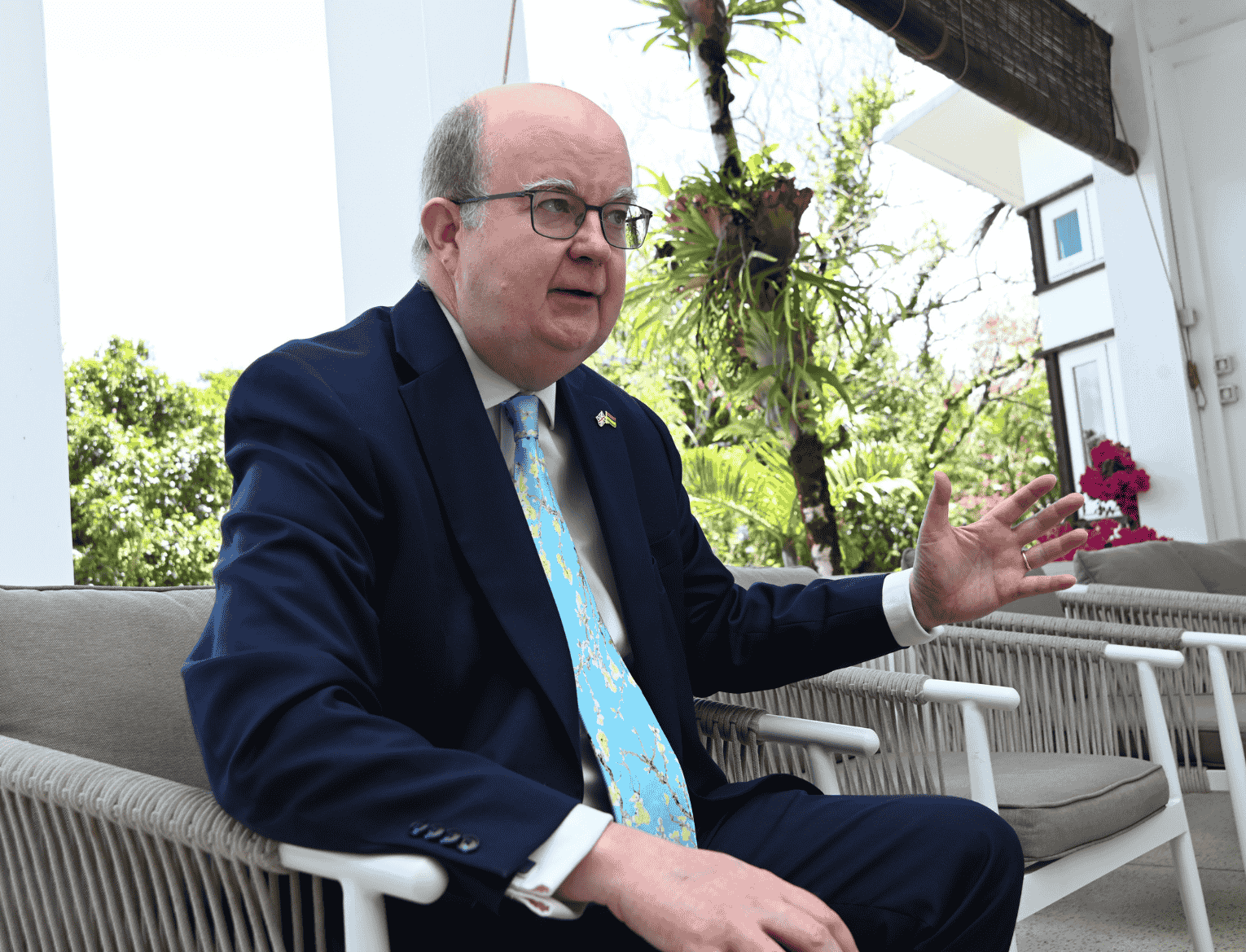
Paul Brummell, British High Commissioner to Mauritius 

  • “Ratification is proceeding positively because it’s a good agreement.”
  • “The agreement requires certain things to be done. It requires Mauritius to establish a marine protected area in the Chagos Archipelago. There is already one, but Mauritius has to set up its own.”
  • “FATF requirements change, so it’s important to be up to speed with them.”
  • “It’s in all of our interests that Mauritius has a robust system and performs superbly at the FATF evaluation in 2027.”
  • “We have two specialists embedded within the Mauritian Finance Ministry working on the development and the use of the Climate and Sustainability Fund.”

In his first interview since taking up his post in Mauritius, British High Commissioner Paul Brummell outlines the renewed impetus in UK-Mauritius relations, centred on the implementation of the Chagos Archipelago treaty signed earlier this year. He describes the agreement as a significant step towards strengthening bilateral trust and cooperation, while identifying finance, climate action, education, and digital trade as areas of shared interest. Paul Brummell also emphasises the UK’s support for Mauritius in maintaining a robust regulatory framework ahead of its 2027 FATF evaluation, and in building a partnership that aligns economic growth with environmental sustainability and good governance.

Editor-in-Chief: Rudy Veeramundar | Photographer: Manoj Nawoor 

You have served in different regions – Asia, Eastern Europe, the Caribbean – and you’re now here, in the Indian Ocean. How have these various postings shaped your worldview? 

It’s a good question, and I think it goes back to why I joined the Foreign and Commonwealth Office, as it then was all those years ago. I did a degree in geography, and the reason for this study was because the world had always fascinated me. After my degree, I wanted to work in an organisation that involved not just travel, but actually living overseas, understanding different cultures, and I think that is really at the heart of what diplomacy is about. Of course, you’re representing the United Kingdom, you’re representing your own country, you’re representing its interests and you’re furthering its interests. But in order to do that, you need to understand and really appreciate the country where you’re living. When I was doing my geography degree, I always remember the words of an American geographer called Carl Sauer, who said locomotion should be slow, the slower the better, and that really kind of spoke to me. You do need to understand a country, understand where it’s coming from, understand its traditions and its positions and what it wants to achieve. Through that understanding you can then develop the partnership with the United Kingdom that helps both.

I guess that during your studies, you must have heard about Mauritius…

Absolutely! The Star and Key of the Indian Ocean.

Did you expect that you would be working in Mauritius down the line? 

Within the Foreign Commonwealth and Development Office, you have to bid for every job. It is a competitive internal bidding procedure. There’s lots of competition. I saw that Mauritius was coming up and thought this would be a wonderful place to live and work, and a very important bilateral relationship to help to develop. I was very keen to get it. But of course, you can’t predict that at the start of a career. I’ve worked in a whole range of different environments. I spent a long time in Central Asia. I’ve worked with transition countries in Central and Eastern Europe. And I’ve worked in the Caribbean. I spent four years as British High Commissioner in Barbados, and there are some resonances between Barbados and Mauritius, both Commonwealth countries, both countries with a very high dependence on sugarcane, both of whom have diversified into areas like tourism and financial services. But there are a lot of differences as well, and I’m coming to appreciate and understand those differences.

If there is one lesson you’ve learned so far in your career, what is it?

I think what is really important is adapting to the host society. You need to take an approach of humility rather than hubris. I think the warning of G.K. Chesterton, when he was confronted with a fence, is worth bearing in mind. He said to never try and take that fence down until you fully understand why it was put up in the first place. It’s an important lesson that in developing our relationships, in working out how best to further our partnership with Mauritius or with the host country that I’m based in, it’s really important to understand that host country.

How has the learning been so far? 

I’ve been here for three months, and I’ve been learning a great deal. I’ve found Mauritians extremely welcoming, very keen to give me lots of perspectives about their beautiful country. I’ve received loads of advice, everything from the best ‘dhol puri’ on the island to the best beaches. I’m certainly not short of advice and information.

Let’s come to our diplomatic relationship now. What are your immediate priorities in strengthening the ties between the UK and Mauritius? 

There was a really important development before I arrived in May, which was the signature by our two Prime Ministers of an agreement on the Chagos Archipelago. That makes working with the government of Mauritius to implement that treaty an immediate, obvious and important priority. It needs to be ratified by both countries, and the ratification process is ongoing. That will be a really important step in the bilateral relationship. Accompanying the signature of the Chagos Agreement was the signature by our two Foreign Ministers of a strategic partnership framework, and that actually, in many ways, sets out a set of priorities for me and for the High Commission going forward, because it identifies four key priority areas in which we’ll be working: Maritime security and countering illegal migration, Environment and conservation, Growth, trade and investment, and Institutional reform and governance. So, those are the key areas I’m going to be focusing on going forward.

The interesting part for you, I guess, is that, as opposed to your predecessors, you are coming at a time when the Chagos chapter is unfolding positively.

I’ve been really struck since I arrived by the strength of the relationship between the UK and Mauritius. We’re both Commonwealth countries, we share very many values, there is a 40,000-strong Mauritian diaspora in the UK, and we have very close links in education. The Judicial Committee of the Privy Council is the highest court of appeal for Mauritius. Our relations are hugely strong and very positive. But obviously, the dispute over the Chagos Archipelago has put a shadow over that for a long time in terms of the bilateral relationship. The signature of the deal in May really offers a new opportunity.

Mauritius is often described as a bridge between Africa and the wider Indian Ocean. How do you see this position aligning with the UK’s global strategy post-Brexit?

The UK government has made clear that we’re going to make a new approach to Africa, recognising the impressive rate of economic growth and political developments. It needs a new partnership, and Mauritius, as a part of the African continent, is very much a key part of that story. But we’re also conscious that Mauritius has very close ties to South Asia, particularly India. My Prime Minister, Keir Starmer, was in India earlier this month, working on a new strategic partnership. He met Mr Modi (Editor’s note: the Prime Minister of India) and had a very productive visit. So again, our work with Mauritius can be part of that story as well. We see Mauritius as a very important country in terms of our priority relationships both with Africa and with South Asia.

From the financial services perspective, do you see Mauritius as an IFC bridging Africa and the Indian Ocean?

Absolutely. The Financial Services Centre in Mauritius is very important. I’m conscious that historically, it developed particularly through a double taxation agreement with India, but it has diversified. I met with Minister Jyoti Jeetun, the Minister for Financial Services. We had a good discussion about the perspectives of the centre, and she has emphasised, for example, the role of the centre in supporting growth and investment in Africa, which is a high priority for us. Mauritius has a great role to play. I’m also really pleased to see the presence of a lot of UK companies, from British banks to other financial companies within the Financial Services Centre, here, supporting that process.

Can we expect to see more British presence in this particular sector?

That’s something I would absolutely encourage. It also depends on decisions to be made by Mauritius itself in terms of building up that centre, but I think that would be great news for all.

Education and people-to-people exchanges have always been pillars of our relationship. How can this be leveraged to support trade ambitions?

Bilateral relationships between two countries are about people. They’re about people getting together, sharing knowledge, sharing information, working together to do good stuff. Mauritians in the UK are hugely well-placed. As I said, there are 40,000 or more Mauritians in the UK as absolute ambassadors for the Mauritius-UK relationship. We have many Brits living and working here in Mauritius doing wonderful things. Just to give one of many examples I could give, I visited Rodrigues just a few weeks ago and I met with two Britons. One of them, Jack, has been working for many years in Rodrigues, in a really grassroots activity, supporting initiatives in education and building livelihoods for disabled people. It’s wonderful work. That sort of activity from people in every walk of life is what really builds the foundation of a relationship and gives us a springboard to do great stuff together.


“Too few or too many STRs can weaken the system designed to protect us all.”


In an interview earlier this year, the U.K. Trade Envoy referred to the UK’s trade strategy, which was described as reconnecting with the world and doing trade differently. Could we have your views on this?

I indeed read the interview. It’s a really challenging and important time for global trade. There is a lot of uncertainty around. There are a lot of conflicts in the world. There have been a range of moves towards protectionism. So, it’s a challenging time for world trade. The UK has always maintained that free and fair trade is the right path. I think we could hardly say anything else, given that the UK’s growth and development in the 19th century was born of free trade. It’s quite telling that under our new trade strategy, which was launched in June this year, we’ve established a new Ricardo Fund to help unblock regulatory barriers to trade. The name refers to David Ricardo, the great champion of neoclassical economics and free trade. That really is at the heart of what we are doing. Because of concerns over all sorts of challenges in the global order at the moment, this is going to be achieved best by trade partnerships. That’s what we’re working on. I mentioned the partnership we’ve signed with India. We also have an existing economic partnership agreement with Eastern and Southern Africa, including Mauritius. That’s a great document. We want to work together with Mauritius to do all we can.

We are working with the authorities here in Mauritius to develop a reinvigorated strategic trade partnership. We will be identifying mutually agreed centres to which it just makes sense to give the bulk of our focus and attention.

In terms of the government-to-government attention, it does make good sense to focus on a smaller number of areas, and I think some of those really jump out. Financial services, we’ve already met about. Education is a really key area of work, and  there are a lot of opportunities in areas like life sciences and renewable energy.

Would digital trade and renewable energy be the most promising ones down the line?

It’s a really good question. I think there are a lot of areas of opportunity. I’ve been very favourably struck, since I arrived, by the strength of the existing collaboration in higher education. One thing that has been very gratifying to see is the value that so many Mauritians place on UK higher education. Many Mauritians are graduates of UK universities. It’s lovely to see the continuing interest in study in UK universities. Of course, that’s an option which is not affordable to all. What’s been equally gratifying is to see the imaginative range of transnational education partnerships that have been developed. These range from the very visible campus of Middlesex University here in Mauritius – which is playing a great role for students from Mauritius, but also for the wider region, including many students from across Africa – to a whole range of different transnational education partnerships. That’s a really strong area.

In terms of renewables, we’re really conscious that we’re almost on the threshold of the COP30 meeting in Belém in Brazil, and Mauritius will be submitting its NDC 3.0. That will include a big commitment to transitioning more towards renewables and green energy. The UK has a lot that we can do in support of that, and we’re really interested and keen to work with Mauritius along that agenda.

But you mentioned other areas. Digital trade is absolutely a developing area and there’s a lot we are talking about. I’m really looking forward to those conversations.

One of the main topics that we are talking about is mobilising private capital and creating enabling frameworks that are central to the UK’s new model. So how can the High Commission work with Mauritius to attract investment into priority sectors?

There are a whole range of offers and opportunities. There is UK Export Finance itself, which has a real appetite to invest in the right projects. There are also specific initiatives. One that we’re working on very intensively is around climate finance. We have two specialists embedded within the Mauritian Finance Ministry working on the development and the use of the Climate and Sustainability Fund, how to bring in blended finance options to increase the firepower of the Fund and enable it to support and finance more projects to mitigate the effects of climate change.

In a recent speech, you described illicit finance as a defining challenge of our age and the gateway to corruption. How much is the fight against illicit finance a priority for the UK, and how does this shape your mission in Mauritius?

It’s really important. It is an area of work which almost by definition has to be done through international collaboration, because criminals know no boundaries. Illicit finance is about monetizing the ill-gotten gains of crime, and that so often involves international flows. It requires us to work together. London has one of the most vibrant global financial centres, and Mauritius is developing an important regional financial centre, so we have to work together in terms of combating the threats posed by illicit finance. The threats also directly impact on every Mauritian. They fuel all sorts of challenges, whether these are challenges around drugs or other forms of crime.

We’ve seen the UK government bringing in experts to train Mauritian staff at the Financial Crime Commission (FCC) and the Mauritius Revenue Authority (MRA)… 

Indeed, I think it’s an important and very positive area of work. We are, for example, working in practical and detailed ways with the FCC in upskilling work on asset recovery.

This is such an important work because the challenges are forever changing. Nothing stands still in illicit finance. There are new challenges every day. To keep on top of the criminals, it’s really important that the teams have permanent upskilling.

How do you assess Mauritius’ progress since its delisting from the FATF grey list? 

The speed at which Mauritius reversed the grey listing was really impressive. The next FATF review is in 2027. Requirements change, so it’s important to be up to speed with them. What will be really important to demonstrate is practical results. I’m sure the assessors will be looking at things like how many assets have been seized and which criminals have been brought to justice. These sorts of things will be important. Showing that there is not just a framework on paper, but also results delivery, will be central to it. And that’s why the UK, along with other partners, are working with Mauritius to support you through this process, because it’s in all of our interests that Mauritius has a robust system and performs superbly at the FATF evaluation in 2027.

We’re, for example, working with institutions on those law enforcement areas. We’ve got other partners. I know that the European Union has a lot of big projects around regulatory reform, for example. This is about donors working together with partners to support Mauritius through this process.

What do you see as challenges in the financial services sector for Mauritius?

It goes back to my point about change. The challenges of dealing with illicit finance is that the methods of the criminals are constantly evolving, so the nature of the challenge is different. It’s different year on year, so we have to get up to speed with that.

For example, in cryptocurrencies, lots of new challenges emerge, and through working together, sharing best practice, we’re better able to tackle these. My government, in fact, my Deputy Prime Minister, has just recently announced that we’re holding an illicit finance summit in London next year. It will be a good opportunity to share, at the global level, some of these perspectives on how to tackle the new challenges around illicit finance.


“The more transparent beneficial ownership data is, the more investigative media can uncover and expose hidden networks.”


What role should the private sector, civil society, and even the media play in ensuring that Mauritius maintains its reputation as a trusted Financial Services Centre? 

I think it’s a really important question because it has to be a joint effort with all of the bodies that you’ve mentioned. I can give you a couple of examples, and one is the banks. One really important piece of documentation in the illicit finance ecosystem is the suspicious transaction report, the STR. The people at the banks and other institutions who file suspicious transaction reports have an absolutely crucial role to play in the system. What can tend to happen is one of two things: They’re a bit blasé, and not very many STRs are filed, or on the other hand, there’s a bit of over-caution, and almost everything is filed. Both of those are quite unhelpful to regulators. But if you get somebody who is really good in the bank or another financial institution, who often has a sixth sense for what looks suspicious and what doesn’t, these well-filed STRs can make a huge difference in the ability to combat illicit finance.

I think you mentioned the media as well. I’ve been really struck by a very big debate in the UK at the moment. We’re supporting work on transparency of beneficial ownership. That’s something we’re also encouraging here in Mauritius, because what we’re finding is that the more transparent beneficial ownership data becomes, then the more investigative media are able to come in and do a lot of the work around this. Their reports and their investigations are often absolutely instrumental in pointing to where the networks lie. It’s all an interconnected process.

The UK often speaks of a whole economic approach and of integrating trade, education, climate action and governance. How can this integrated model be unfolded in Mauritius? Can it happen? 

That’s in essence exactly what we’re trying to do with the strategic partnership framework identifying four priority areas. They also make sense in the context of what needs to be done following the signature of the Chagos agreement. They are around marine surveillance and countering illegal migration. The second area is around environment and conservation. The third one is around growth, trade and investment. The fourth one around institutional reform and governance.

They all link together. They’re all part of a whole, and I think you’re right that everything needs to be brought together in a holistic way.

From a green finance perspective, how do you see UK expertise supporting Mauritius in the transition?

As I mentioned, we’ve got a Climate Task Force set up with two members of staff permanently embedded within the Mauritius Ministry of Finance. We’re receiving a lot of external expert support. This work is exactly on helping Mauritius get the most out of the Climate and Sustainability Fund. It’s also about helping to provide blended instruments so that you get more bang for your buck. It’s not just focused on the public sector as we’re working very closely with the private sector, including the Mauritius Institute of Directors and other organisations on a whole range of initiatives, including making sure that the private sector contributions to Mauritius’ NDC are properly registered and recognised. It’s a really good area of collaboration, and we’re really keen to support it.

We know that you’ve just started your mandate as British High Commissioner to Mauritius but what would you like to see achieved by the end of your posting?

I think the first thing is the building block to the new relationship. There’s the ratification of the Chagos deal, the implementation around it… There are a lot of important areas to set up in order to implement the deal. Areas like maritime surveillance, marine protection, environmental conservation and the establishment of the trust fund for Chagossians. There is a great deal of infrastructure around that to set up a strategic partnership framework that is meaningful and delivers real economic benefit for the UK and Mauritius. But actually, it is wider than that. It is about delivering and supporting a real friendship between the UK and Mauritius. I want to see all of these non-government to government aspects of the relationship, the soft power which is at the heart of our understanding of each other. I want to see all of these flourishing and the outcome being a really warm, friendly, productive relationship between our two countries, which I think it has got all of the building blocks to be.

If there is one sector where the UK and Mauritius can make progress, what would it be and why?

It’s a really good question. I’m at an early stage in this. There are, as I say, loads of sectors that we’re doing great things together with, and it is almost invidious to identify one. But you’re putting me on the spot, so I need to do that. I would just observe, without probably elaborating on it much at this stage, that in all of the introductory conversations I’ve had with members of your government up to now, I think the area that has come up most frequently has been around fintech and digital trade. That seems to be an area where there is a lot of interest to lean into. That is one I will certainly focus on.

I have a last question. We’ve been talking and writing on the Chagos for years. What do we have to expect now? Do we have to be patient? 

So, the agreement is signed. It has the full support of both governments, which is a great step. It needs to be ratified, and you have all seen that the ratification process is proceeding in the United Kingdom. We’ve just had the third reading in the House of Commons, which was passed with a strong majority. Of course, it’s an important agreement. There are very important sovereignty and financial issues around the agreement. As you can expect, it’s politically controversial in the United Kingdom. There are a lot of views that have been expressed during the debates. But ratification is proceeding positively because it’s a good agreement.

There is a ratification process in the United Kingdom, and also here in Mauritius. Alongside ratification, there are a whole lot of other areas to focus on around implementation. The agreement requires certain things to be done. It requires Mauritius to establish a marine protected area in the Chagos Archipelago. There is already one, but Mauritius has to set up its own. That’s a really important step because the Chagos Archipelago has stunning biodiversity. It is a really important area environmentally. It is an area that deserves and needs to be protected. There’s a whole issue around maritime surveillance because Mauritius will have a larger EEZ, and therefore there are important issues around surveying it, making sure that you’re combating illegal fishing and so forth. There are important issues around the Chagossian community and potential for resettlement on islands other than Diego Garcia. There are a whole lot of areas to look at in terms of the implementation of the agreement.

That’s a very full agenda. But the really important thing is that the two governments are working very positively together towards that common agenda.

Skip to content