Back to Bizweek
SEARCH AND PRESS ENTER
Latest News
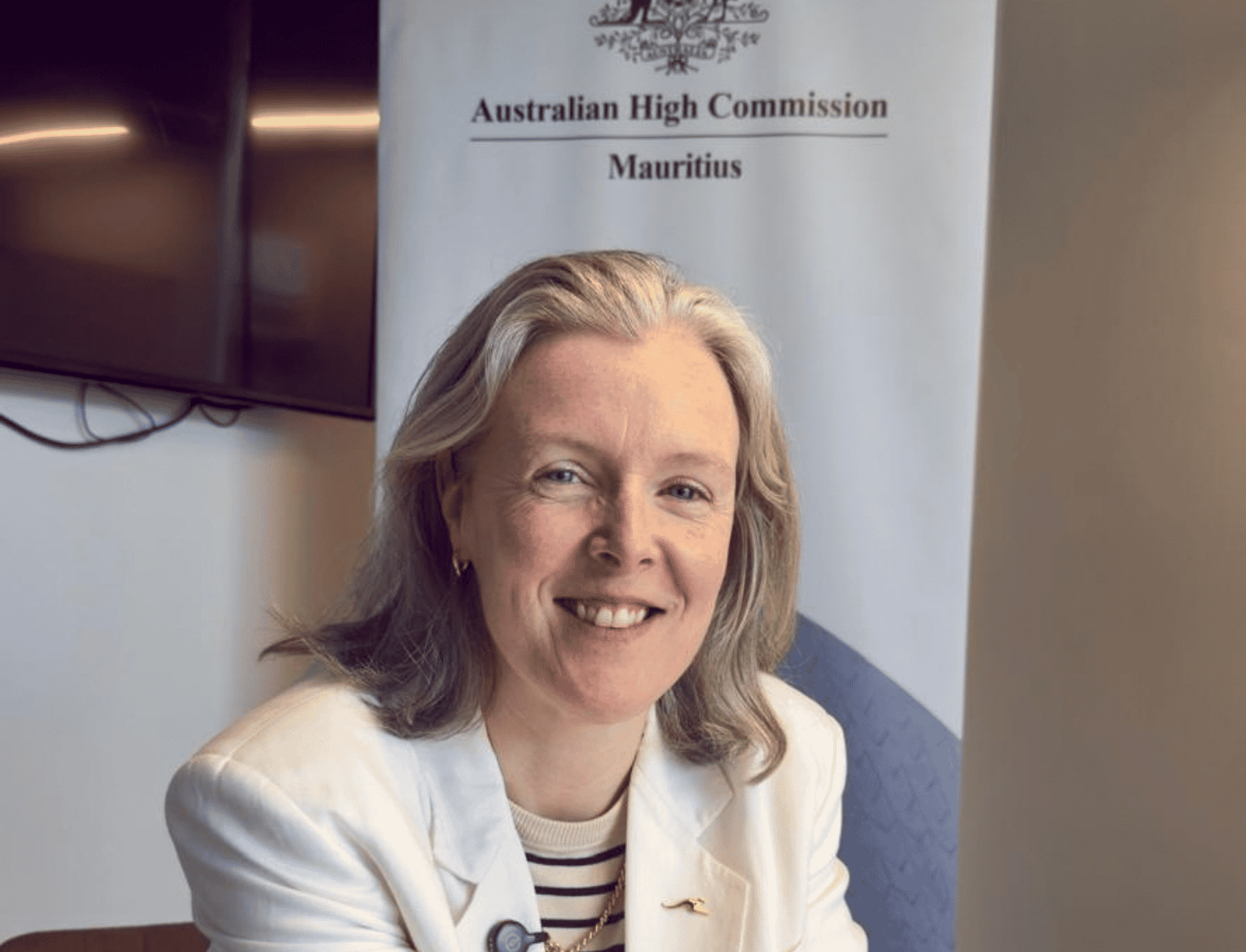
“People could become climate refugees because their countries may no longer exist”

Kate Chamley, High Commissioner of Australia to Mauritius

Mauritius and other Indian Ocean island states are on the front line of climate change, says Australian High Commissioner Kate Chamley. In this interview with Bizweek, she discusses coral bleaching, community participation in environmental research, university partnerships and the obstacles to accessing climate finance. She also explains Australia’s support for stronger coordination among small island developing states ahead of COP31, its role in the negotiations and the implications of its agreement with Tuvalu.

Rudy Veeramundar

How does Australia view the environmental and climate challenges facing Mauritius and the wider Indian Ocean region? Where does climate cooperation fit within Australia’s partnership with Mauritius?

Australia absolutely recognises that Mauritius and the other Indian Ocean island states are on the front line of climate change. Whenever I meet ministers, but also Mauritian people, they talk about the visible effects we are seeing: sea-level rise, coastal erosion, extreme weather events and pressures on marine ecosystems.

We held an event at the Gymkhana on reefs, coral and marine ecosystems. They are visibly under pressure, and I think that is on everyone’s mind.


“More dependable, predictable and accessible climate finance is required.”


Climate cooperation is a central pillar of our partnership with Mauritius. It reflects our shared interest in building resilience, protecting the ocean and working together on sustainable development, so that this region remains stable, peaceful and prosperous for everybody who lives in the Indian Ocean.

You describe the reefs as visibly under pressure. How serious is the situation, based on what you have seen, read and heard during your time in Mauritius?

In my own encounters with Mauritius’s natural beauty, you only need to go out in a glass-bottom boat to see that the coral is really under strain. There have been different bleaching events. Australia has been affected by those as well.

At a recent event, we looked at a study, and I showed a video of research taking place in the Whitsundays. The Whitsundays and Mauritius are at roughly the same latitude. In that part of Queensland, in northern Australia, we have the Great Barrier Reef, the largest coral reef ecosystem in the world.

Over the past 10 to 15 years, it has experienced many bleaching events. Australian scientists are doing a great deal to try to restore the reef and rebuild coral that has sadly died. But it is very challenging.

There are coral restoration projects under way here in Mauritius too. We also have marine partnerships between institutions such as the Mauritian ministry responsible for agriculture and the blue economy and the University of the Sunshine Coast, working on marine biodiversity and its preservation.

There are other partnerships as well. The University of Mauritius and the University of Western Australia have worked closely on these issues in the past.

These are the kinds of connections the High Commission helps to establish by bringing people together. The work on coral reefs is so important, both for maintaining biodiversity and because the tourism industry depends on these ecosystems. It is very important to protect them.

We discuss these issues, but awareness often seems concentrated around conferences, environmental observances or COP meetings. Should there be more sustained awareness of what is happening and of the projects addressing it?

Yes, I think there should. But it is difficult when governments and communities are busy delivering services and people have very busy lives.

People who engage with the natural environment are more likely to have these issues on their minds. We are coming into the period of good weather in Mauritius, when many people will be going to the beach. That makes the environment more immediate to them.

One of the things I spoke about at the event on Wednesday night was community participation projects in Australia. One very interesting example is a project I described in connection with our Commonwealth Scientific and Industrial Research Organisation (CSIRO).

There are fixed holders along the coastline where people can place their phone or camera and take a photograph. Citizens are encouraged to upload those images to an app. Over time, the images are collected to show the effects of coastal erosion and how the coastline is changing.

It is a very engaging approach. Anybody can take the photograph, and it brings awareness of issues such as the effects of climate change.

There are similar projects involving underwater images. People working in tourism, scientists, fishermen and women, divers and tourists can take photographs during their activities and upload them. Together, those images capture changes in biodiversity.

It builds a bank of visual research that is very useful to scientific organisations. I would love to see a project like that in Mauritius, because it encourages community engagement. People become interested, they participate and they become more aware of what might be happening. They can relate to it.

What initiatives is Australia supporting to help Mauritius and other Indian Ocean countries strengthen their climate resilience and negotiating capacity?

We have a very important regional event coming up. It fits into Australia’s involvement in COP31 this year. Türkiye is hosting the conference, but Australia is playing a very important supporting role, and our minister responsible for climate change will lead the negotiations.


“The IORA Blue Carbon Hub is a practical way for Australia to support Mauritians and other countries in the IORA family.”


We have also undertaken to work with the Pacific islands, which are our nearest neighbours, to support them in projecting a strong and common voice at COP31.

We are leading up to the pre-COP in the Pacific, hosted by Fiji, Tuvalu and Australia, with the involvement of their prime ministers. There is a leaders’ event, as well as a ministerial meeting. That is an important part of how Australia is supporting the negotiations this year.

For the Western Indian Ocean, our support initially focused on training in climate negotiations. We worked very closely with the United Nations, particularly UNITAR (United Nations Institute for Training and Research) to deliver training for climate experts in the governments of Mauritius, Seychelles, Comoros and Madagascar.

That training then led to national climate dialogues in Seychelles, Madagascar and Comoros. We have worked with our UN partners and the Indian Ocean Commission to organise a regional dialogue, which, at the time of this interview, is due to take place the following week.

But it is broader than this region. It is bringing in small island developing states from other parts of Africa and the Caribbean, as well as participants from the Pacific.

The purpose is to learn from one another about how to communicate their vulnerabilities and the actions needed to help small island developing states adapt to and mitigate climate change, with a strong focus on oceans.

We are very excited about it. I think it will be a fantastic event and the first of its kind in the region. It is about sharing and learning from one another.

It is through island states having a voice, and a common voice at COP, that we can get these messages across to the wider world. Australia has been very keen to support that work.

Given developments on the diplomatic front over the past two years, how challenging is it to make those messages heard?

I think it is challenging, because we are living through a difficult time. The amount of conflict in the world and some of the challenges facing the global economy take up space and time in international discussions.

At the time of this interview (Editor’s note: Friday 25th of September), the United Nations is meeting in New York. There are so many topics being discussed, from the protection of humanitarian personnel to the future of the multilateral system itself.

Climate change is also part of that discussion. It is one of the great challenges of our time.

For small island developing states in particular, being able to cut through all that debate and amplify their voices on climate is something Australia wants to support. It is hugely important, because island countries are so vulnerable. It is an existential problem.

Australia works with island countries in both the Pacific and the Indian Ocean. Pacific island states appear to have a more coordinated voice. Is that your assessment, and what explains the difference?

I think that is right. It is certainly what people in this region tell me. The factors contributing to it are partly geographic and partly cultural.

The Pacific islands are sovereign countries, each with its own government, but they are very well networked. They call themselves the Pacific family.

For quite some time now, particularly in the face of climate change, they have been coordinating and working together through mechanisms such as the Pacific Islands Forum, and other mechanisms in the climate sphere, to form a common voice and find ways to amplify it.

When you look at African small island developing states, you have countries in the Indian Ocean, but also countries on the western, Atlantic side, such as Cabo Verde and São Tomé and Príncipe. Geographically, they are more dispersed. I see that as one of the principal challenges.

It is one of the reasons we wanted to bring the regions together, so they can share, learn and discuss.

Through the climate negotiation training and the national dialogues, we have heard very common themes about how small island developing states in the Western Indian Ocean are being affected by climate change.

The Indian Ocean Commission and the UN are very supportive. We wanted to open up that discussion and bring in voices from other regions, so that everybody can learn and share.

Australia’s involvement in COP31 this year has been about amplifying the voices of small island developing states. That is why we are so excited about the regional dialogue.

Access to climate finance is a recurring issue in these dialogues. Where do things stand, and what needs to change?

In the lead-up to COP31, Australia has also been running a process with small island developing states across the world to receive their comments on access to climate finance.

That work is ongoing, and we will work with small island developing states to present it at COP31.

I think access is challenging. When I speak to people in the relevant ministries who are working to secure climate finance, they explain that it is not an easy process.

Small island developing states have small governments. There might be only one or two people working on these issues, but putting proposals together requires a whole-of-government effort.

They have to coordinate with many different areas of government, but also with industry, the private sector and communities. It is challenging.

One way Australia supports this effort is through funding for the Commonwealth Climate Finance Access Hub. Australia is funding a couple of advisers who help member countries in our Commonwealth family prepare proposals and access finance.

We fully acknowledge that more dependable, predictable and accessible climate finance is required. It is something we hope to take to COP31 and secure action on.

How do you see Mauritius and Australia deepening cooperation in renewable energy, marine research and environmental technologies?

That cooperation is ongoing. We have a close bilateral relationship and various mechanisms through which we work together in these areas.

Research partnerships are particularly important. I mentioned some earlier, including cooperation between our universities. That is fundamental.

Australia and Mauritius are both members of the Indian Ocean Rim Association (IORA). Australia is very active in supporting the IORA Blue Carbon Hub, which is based in Perth.

It is an important mechanism through which Indian Ocean countries, including Mauritius, and particularly their researchers, can undertake research to strengthen the protection and management of critical coastal and marine ecosystems.

That includes questions such as: how do we protect our mangrove forests? How do we protect our seagrass meadows? Mauritius has expansive seagrass meadows in its joint management area with Seychelles.

The IORA Blue Carbon Hub is a practical way for Australia to support Mauritians, as well as other countries in the IORA family, in undertaking that important work.

How is Australia preparing for COP31, and what will its priorities be?

For us in Australia, it is about elevating the priorities of small island developing states.

As the country leading the COP negotiations, Australia will work to build consensus and make progress across all the negotiating issues. We want practical ways forward in implementing the Paris Agreement, so that we can work towards reducing emissions.

That is fundamental. We need to reduce the rate at which the planet is warming. That is the whole point of the process.

Those will be priorities for our chief negotiator at COP31.

COP26 is still frequently cited in speeches, projects and presentations. With COP31 approaching, how can countries make progress on those earlier commitments? What will Australia’s message be?

Our priorities for COP31, as President of Negotiations, are to work with countries to build consensus and make progress across all the negotiating issues.

We have a special role in amplifying the voices of small island developing states and bringing awareness to COP of the challenges they face. We also want practical outcomes on climate finance.

In its diplomacy, Australia tries to achieve its objectives by being pragmatic, focusing on real-world outcomes and being transparent.

That is the approach our lead negotiator is taking into COP31, so that we can achieve practical outcomes and, as you say, take the outcomes of COP26 forward.

You have spoken about elevating the priorities of small island developing states. What does that mean in practical terms?

It means bringing awareness to the unique vulnerabilities that small island developing states face, which can threaten their very existence.

That is also why part of the pre-COP will be held in Tuvalu. Tuvalu is absolutely under threat. It is a very small country, and some of its islands face the risk of being completely underwater.

Australia has signed an agreement called the Falepili Union, which gives people from Tuvalu the option to migrate to Australia. In the context of the risks facing the country over the coming decades — I think around 50 years — it gives its citizens the option of another place to live.

It is the first agreement of its kind in the world. In a way, we are talking about people who could become climate change refugees, because they may no longer have a country they can live in. Tuvalu may well not exist in its present form in the next 50 years.

I think it is a practical way in which Australia is looking to contribute and work with Pacific island countries, and other small island developing states, to give people options.

Ultimately, the populations of small island developing states want their countries to continue to exist. Of course they do. The situation facing a country such as Tuvalu is what everybody wants to avoid.

That is why Tuvalu has been chosen as an important location for the forthcoming pre-COP leaders’ event.

Skip to content