Back to Bizweek
SEARCH AND PRESS ENTER
Latest News
“U.S. provided over $1 million in International Military Education and Training” 

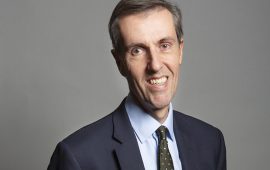
Henry Jardine, U.S. Ambassador to Mauritius 

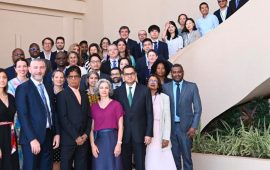
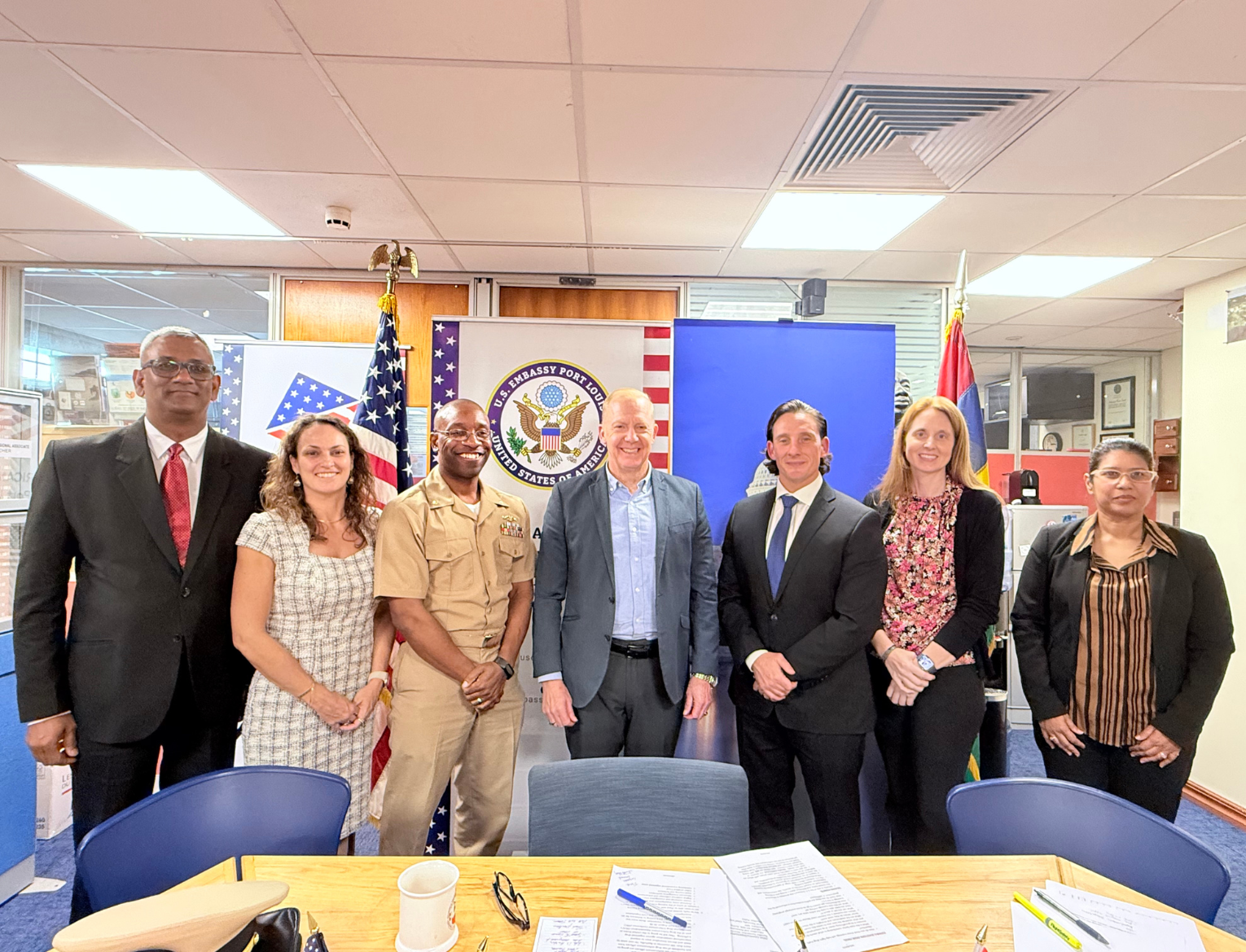
The U.S. Embassy in Port Louis stressed its growing collaboration with Mauritius in law enforcement, security, and capacity-building during a press briefing on Thursday. The event highlighted training programmes, international exchanges, and joint investigations. It also marked the end of FBI Supervisory Special Agent Leah Tanner’s 18-month tenure in Mauritius.

R.V. 

U.S. Ambassador Henry Jardine opened the press briefing by stressing the importance of U.S.-Mauritius collaboration. “We have the entire team from the embassy here that’s working on issues related to law enforcement, as well as security cooperation. This press meeting also marks the end of Leah Tanner’s (FBI Supervisory Special Agent) tenure in Mauritius. We want to talk about what she has accomplished, but also more broadly about the work we’re all doing here,” he said.

Ambassador Jardine underlined the scale of U.S. support over the past year. More than 800 Mauritian officials have benefited from training in various security and law enforcement-related programmes supported by the United States. A further 21 participants attended international training sessions in the United States and regionally, including at the International Law Enforcement Academy in Botswana.

Through the Office of Security Cooperation, we have provided over a million dollars in International Military Education and Training, with a focus on maritime security and disaster response,” he explained. He also noted that these initiatives extend to joint operations and specialised training, including forensics and investigations, reflecting the consistent engagement between the two countries.

The ambassador also highlighted upcoming opportunities: “Two Mauritian law enforcement officers are going to join hundreds of top law enforcement officials from more than 100 countries in Nashville, Tennessee, next week, to meet and discuss innovative ways to expand international cooperation against organized drugs. In September, three more law enforcement officers will travel to Botswana for courses on cybercrime and child exploitation investigations.

He emphasised that U.S. assistance was not limited to technical training but also sought to strengthen institutional resilience and governance. “This is reflective of the variety and consistent engagement we continue to do here in Mauritius. It is a global problem that requires global cooperation. We commend our Mauritian partners and look forward to strengthening this important relationship,” Ambassador Jardine concluded.

FBI’s Role in Mauritius

FBI Supervisory Special Agent Leah Tanner reflected on her assignment, which she described as one of the most rewarding of her career. “My role has been very broad, but much of it has been capacity building. I worked closely with the FCC, MPF, MRA, FIU, and the DPP’s office — sitting with them, going through cases, identifying links to the U.S., and exploring opportunities for joint investigations,” she said.

Leah Tanner explained that her work went beyond classroom training. She spent considerable time mentoring investigators and prosecutors directly, offering guidance on cybercrime, financial crime, and asset recovery cases. She also facilitated connections between Mauritian institutions and U.S. agencies to speed up information exchange and ensure smoother cooperation on cross-border investigations. “We found many areas where we will continue working, even after I leave. We have other colleagues from the FBI who will continue to provide support, so this is not the end but a continuation of the path we’ve built together,” she added.

She described the openness of her Mauritian counterparts as central to the success of her posting. “We have a really good path forward, thanks to our partners working so closely with me and opening their doors so that we could find ways to continue to work together,” she noted.


“Financial crime is fast evolving in complexity. It is important for us to have a collaborative strategy with international partners.” — Nandita Suneechur, FCC. 


Security and Defence Cooperation

Jared Lucero, Regional Security Officer at the U.S. Embassy, described his responsibilities: “I am in charge of the safety and security of the embassy and the diplomats, but also of the law enforcement relationship with Mauritius. My job is to bring in professionals such as Leah, the DEA, and others, to ensure collaboration against transnational organized crime and make both Mauritius and the U.S. safer.”

Lieutenant Commander Muhammad Turqan, Chief of the Office of Security Cooperation, added: “My office is responsible for all Department of Defence-executed security assistance in Mauritius. This spans maritime security, disaster response, and even health programmes, focusing on training, combined operations, delivery of services, and equipment.”

Mauritian Perspectives

Nandita Suneechur, Director of the Education and Preventive Division at the FCC, emphasised the significance of the partnership. “Financial crime is fast evolving in complexity. It is important for us to have a collaborative strategy with international partners, and one of them is the FBI,” she said. She credited Tanner’s mentorship for improving prosecutions, asset recovery, cybercrime expertise, and investigative practices. “The FBI has been with us throughout, and we are very thankful to the U.S. Embassy and Leah Tanner. We look forward to this continued partnership.”

Chief Inspector Shezad Nazeerally, head of the Combating Trafficking in Persons Unit at the Central CID, also expressed gratitude. “I thank the U.S. Embassy for enhancing cooperation in law enforcement and capacity building, and Leah Tanner for her immense contribution,” he said. He explained that his unit tackles sexual exploitation, child labour, and child trafficking cases, while also leading awareness campaigns. “I work very much on the three E’s — to educate, engage, and enforce — so that the community can combat human trafficking collectively.” Nazeerally also highlighted his recent participation in the International Visitors Leadership Program (IVLP) in the United States.

Ongoing Partnership

Beth Creason, Public Affairs Officer at the U.S. Embassy, noted the “vast range of training and opportunities that our colleagues have put together, both abroad and here in Mauritius.”

Ambassador Jardine closed the session by reaffirming U.S. commitment to assisting Mauritius: “This is reflective of the consistent engagement we continue to do here in Mauritius. It is a global problem that requires global cooperation. We commend our Mauritian partners and look forward to strengthening this important relationship.”

Skip to content