Back to Bizweek
SEARCH AND PRESS ENTER
Latest News
Turning climate commitments into action

Panel discussion

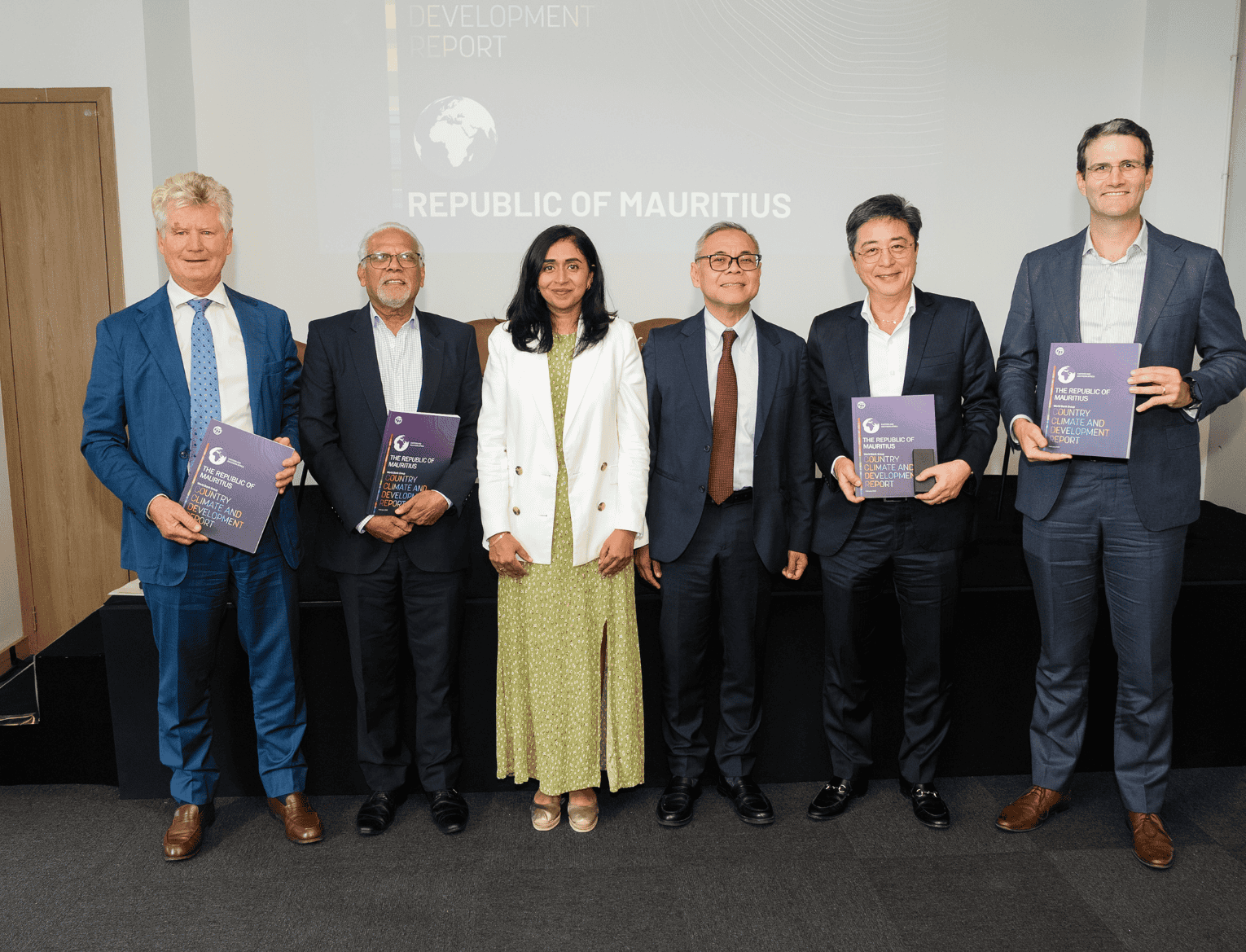
At the launch of the Climate and Development Report for Mauritius, private sector leaders made it clear that climate urgency can no longer remain at the level of intentions. While dialogue between the public and private sectors remains strong, execution must match ambition. They also demonstrated how the private sector has embedded sustainability into its core strategy and highlighted the need for policy clarity and faster delivery to unlock investment.

Shareenah Kalla

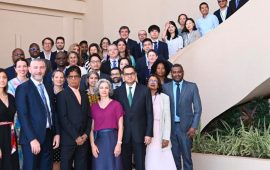
The launch of the Climate and Development Report for Mauritius, organized by the World Bank Group in collaboration with the Ministry of Finance and the Ministry of Environment, Solid Waste Management, and Climate Change, featured a discussion panel where representatives of the private sector debated their role in accelerating the transition towards a more sustainable economy. The panel was composed of Philippe Espitalier-Noël, Chairman of Business Mauritius, Jean Michel Ng Tseung, Chief Executive of MCB Group, Guillaume Dalais, Group CEO of CIEL, and Raj Makoond, Program Director at Eclosia.

Quality dialogue

Philippe Espitalier-Noël was the first to explore the event’s theme: “How to accelerate and scale up climate action solutions in Mauritius: role and expectations of the private sector.” He reiterated Business Mauritius’ long-standing commitment to public-private sector dialogue and reflected on how this experience has unfolded so far in relation to climate action. 

From his perspective, dialogue between the private and public sectors has been fundamental to the country’s development and to pushing the boundaries of its potential. “I don’t think we have much difficulty aligning in terms of priorities, understanding priorities, or articulating a certain level of strategy,” he insisted.

He reminded the audience that Business Mauritius has 1,200 members, and that 70 volunteers, in its Sustainability Commission, are actively engaged in driving the agenda. For some time now, Business Mauritius has integrated sustainability priorities into its business practices, regularly submitting proposals to the government through various committees, as well as during the preparation of the national budget. “I think this helps us mobilize our minds on the essentials of what needs to be articulated to move us forward,” Philippe Espitalier-Noël explained. 

However, for the Chairman of Business Mauritius, the real challenge lies in execution and implementation. To address the imbalance in skills and capacities that still need to be developed, he suggested that certain international institutions could help transfer the necessary expertise.

The need for speed

Philippe Espitalier-Noël emphasized that while there is much talk about the need to accelerate, the reality, in terms of action, does not reflect that urgency. “We see many projects and some of them in areas we discussed this morning, whether it’s clean energy production, water management, improved water catchment, waste treatment, or recycling… Many of these topics have already been identified and examined. Yet initiatives that were flagged years ago have not necessarily been implemented,” he explained. 

One example of that lack of implementation, he noted, was that the construction of a dam in the South of the country, which had already appeared in the AFD master plan for water catchment in Mauritius more than 20 years ago, had still not come to fruition.  

“For me, as the Minister said this morning, it is important that we find a way to talk together about the need for speed, and perhaps invent something I use internally, which is a ‘say/do’ ratio,” he added, noting that years of delay, where clear priorities have been identified but not executed, come at a very high cost.

Sustainability strategy at CIEL

Guillaume Dalais, Group CEO of CIEL, emphasized that the private sector is increasingly integrating climate action into its strategies and daily operations. CIEL’s stated purpose – “For a world we can all be proud of,” and one of its five business principles being dedicated to championing sustainable practices for long-term value creation both reflect that integration. 

In 2020, CIEL launched a sustainability strategy running until 2030, with a clear roadmap across its business clusters. The strategy is built around three pillars, one of which is “Activate Environmental Response,” where climate action plays a central role. Some of the key targets include Energy Transition by achieving 80% renewable energy by 2030, Water Efficiency by committing to a 7% reduction in water consumption within the textile and hotel clusters, Waste Management by reducing waste sent to landfill by 50% by 2030, and emissions by cutting Scope 1 and 2 emissions by 50%.

To show how CIEL integrates sustainability across its projects, Guillaume Dalais mentioned Ferney Forest Living, where we embed these principles directly into the product through sustainable farming, reforestation, and related initiatives.


“Investing now protects both lives and the economy, with potential payback in less than a decade.”


He also gave an example of how sustainability can enhance productivity within a company. At CIEL, they invested in the Higg Index platform, which has been used for over 10 years to monitor environmental and social impacts in the textile sector. Guillaume Dalais also noted that CIEL has consistently ranked among the best performers in this category. “Customers—what we call the great A-customers, like Ralph Lauren—when they look for suppliers, they check your Higg Index score. Naturally, they choose the best-scoring suppliers, and that creates market opportunities for us,” he explained. 

The Maize Protocol

Raj Makoond, Program Director at Eclosia, highlighted the enormous contribution of the private sector to the Mauritian economy. He shared striking figures: 80% of GDP comes from the private sector, and 75% of total investment is private sector driven. 

As Program Director, he explained that Eclosia has been working to measure its carbon footprint. With the support of an international team between 2021 and 2022, the group built in-house capacity to track emissions. “Today, our carbon footprint for the whole group in Mauritius is around 995,000 tons of CO₂ equivalent,” he said.

He added that each company within the group has now developed the capacity to measure its own footprint, which is crucial. From this baseline, they can propose mitigation strategies and concrete actions to reduce emissions, ensuring that sustainability is embedded across operations.

​Several projects are ongoing at company level. For example, they have embarked on a major project to produce electricity from solar energy, and are expected to produce about 18 megawatts within the next 8-9 months. Another project concerns maize production in Madagascar, which is currently 100% artisanal, with very low productivity. To address this, they developed the Maize Protocol, which provides visibility on price and demand, along with some pre-finance to attract investors. The goal is to shift towards industrial-scale maize production, reducing reliance on imports from Argentina and enabling Madagascar to supply Mauritius and Réunion. This initiative would significantly lower Scope 3 CO₂ emissions by cutting freight-related emissions and improving traceability, though important risks remain that need to be managed.

Eclosia is also working collectively on the Blue Economy, with the Odyssée (ODC) Foundation serving as a hub for research and development, supported by private partners and the University of Mauritius. Their broader strategy is to maintain sustainability across energy, supply chains, and R&D, while maintaining a coordinated, yet decentralized approach. A dedicated steering committee and sustainability teams support each company, enabling capacity building and the ability to measure and track their own carbon footprint and progress.

Access to finance

For his part, Jean-Michel Ng Tseung, Chief Executive of MCB Group, highlighted the crucial role of banks in Mauritius in supporting climate adaptation and mitigation. He pointed to the World Bank’s estimate of $4.2 billion in investment needs by 2050, stressing that the cost of inaction could mean a 4% drop in GDP and severe impacts on industries like hospitality. For him, the business case is clear: investing now protects both lives and the economy, with potential payback in less than a decade.

He explained that financing will need to be frontloaded, with about $1.5 billion required between 2026 and 2030, translating to roughly $340 million per year. Banks, including MCB, have the capacity to mobilize this funding, alongside insurance companies, pension funds, and public investing. 

I would like to remind you that green bonds have also got a fiscal advantage because, by virtue of a Finance Act enacted some time back, they are actually tax-free,” he added.

Intervening, Philippe Espitalier-Noël explained that while large corporations can access such instruments, SMEs face challenges and need support through de-risking strategies. He stressed that money is not the main obstacle and that the focus should be on policy, licensing, and capacity building to ensure effective implementation. 

Both speakers agreed that risks are not yet accurately priced, with data and modelling still immature, but collaboration with insurers and global partners is helping banks refine their approach.

Unlocking investment

So, if the question is what quick wins the government could realistically deliver within the next 12 to 24 months to accelerate private sector investment in climate action, Raj Makoond’s response is that the most urgent step is to move from frameworks to execution, ensuring accountability, transparency, and genuine stakeholder engagement so that projects do not suffer long delays. 

He stressed that predictability and clarity in policy are essential to give investors confidence, and that will unlock the financing ecosystem, making long-term projects bankable and attractive to private capital. Without this, strategies risk remaining aspirational rather than actionable, and the private sector will hesitate to commit resources.

At the end of discussions, Raj Makoond pointed to the potential of sustainability-linked bonds tied to clear KPIs such as renewable energy, water efficiency, and gender balance to channel investment. He suggested that Mauritius could position itself as a laboratory for sustainable finance in Africa, anchored by the Climate Sustainability Fund, provided the government delivers on execution and creates the right enabling environment.

Skip to content