

Back to Bizweek
SEARCH AND PRESS ENTER
Latest News

- 18/09/2023
La MCCI Business School lance l’Innovation Imperative
Leverage agile frameworks to provide a robust synopsis for high level overviews. Iterative approaches to corporate strategy foster collaborative thinking to further the overall value proposition. Organically grow the holistic world view of disruptive innovation

- 29/10/2023
Mauritius may be small in size but it is a leading economic force
UK Prime Minister’s Trade Envoy to Mauritius was back in the island in the first week of October, and answered our questions on important topics such as the Strategic Trade Partnership (STP) with Mauritius, the

- 01/11/2023
Le Groupe CIEL affiche une augmentation de ses bénéfices pour le premier trimestre
Le Groupe CIEL affiche une augmentation de ses bénéfices pour le premier trimestre Le Groupe CIEL a annoncé des bénéfices en hausse pour le premier trimestre clos le 30 septembre 2023. Le chiffre d’affaires s’est
- 01/11/2023
Ensuring efficient market conduct supervision has been at the forefront of the Bank of Mauritius’ agenda”
Ensuring efficient market conduct supervision has been at the forefront of the Bank of Mauritius agenda On 22-23 November 2023, FinCoNet (the International Financial Consumer Protection Organisation) held its Annual General Meeting (AGM), hosted by

- 13/11/2023
Embracing sustainability is not an option, but a business need!
Embracing sustainability is not an option, but a business need! A conference focused on sustainability and climate change is scheduled to take place in Mauritius from October 26 to 27. The CEO of Spaanda, the

- 16/11/2023
Le Groupe Newrest inaugure une unité de production à Maurice
Leverage agile frameworks to provide a robust synopsis for high level overviews. Iterative approaches to corporate strategy foster collaborative thinking to further the overall value proposition. Organically grow the holistic world view of disruptive innovation

- 17/11/2023
La MCB sacrée Best Private Bank in Mauritius 2023
Leverage agile frameworks to provide a robust synopsis for high level overviews. Iterative approaches to corporate strategy foster collaborative thinking to further the overall value proposition. Organically grow the holistic world view of disruptive innovation

- 18/11/2023
AI is changing the game
AI is changing the game As AI continues to revolutionize various sectors, it’s crucial to stay updated with its advancements. The pervasiveness of AI is undeniable and it carries immense potential. However, it also presents
- 22/02/2026
- Cover Story
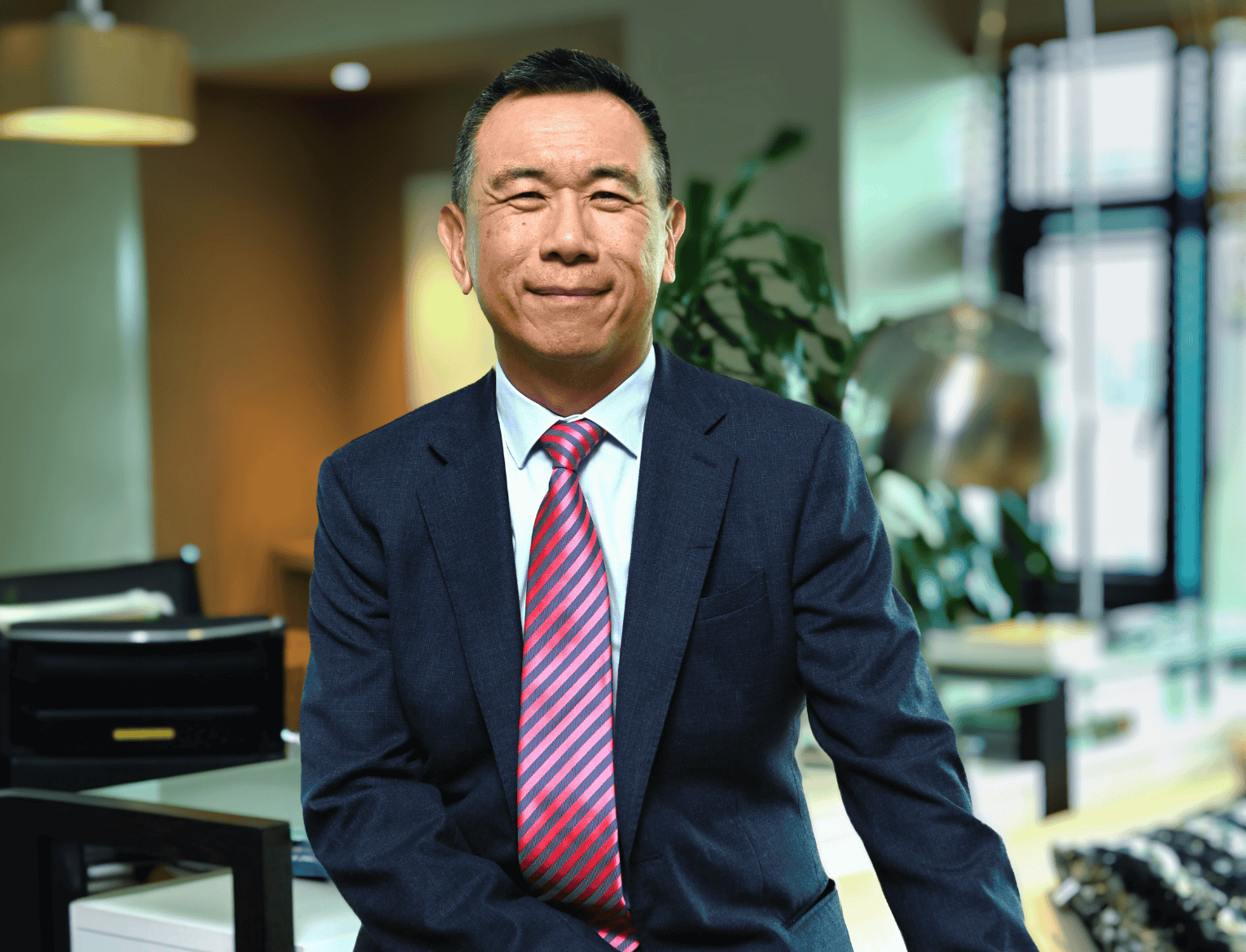
Ben Lim, Managing Partner of Andersen in Mauritius
Global finance is going through a period of geopolitical fragmentation, technological acceleration and rising capital demands. In that environment, professional services firms are reassessing governance models and growth strategies. Andersen’s listing on the New York Stock Exchange reflects that shift. In this interview, Ben Lim, Managing Partner of Andersen in Mauritius, discusses the firm’s evolution, the role of artificial intelligence, and the implications for smaller financial centres. He argues that in a world marked by instability, distance and political stability can become strategic advantages — provided Mauritius strengthens its ecosystem and maintains institutional credibility.
Text: Rudy Veeramundar
Photographer: Manoj Nawoor
Andersen Group’s listing on the New York Stock Exchange comes at a time of structural transformation in global financial services. How do you interpret this move?
The listing must be understood within the broader structural shift taking place across global financial services, accounting and advisory firms. For decades, professional services operated primarily under partnership-led governance models. These partnerships were not listed entities. Capital was internally generated, ownership was restricted to partners, and governance structures were relatively straightforward. That model worked in an environment where growth was organic, technological change was incremental, and capital requirements were limited. Today, that environment no longer exists. We are witnessing consolidation across the sector, increased private equity involvement, and a growing number of firms exploring public listings. The reason is simple: the industry now requires substantial and continuous capital investment.
The most significant driver of this capital demand is artificial intelligence and digital transformation. AI is not merely a tool — it is redefining workflows, client service delivery, compliance processes, risk management and data analysis. Firms that fail to invest meaningfully risk falling behind competitors who are integrating AI into every layer of their operations.
Traditional partnerships often do not have sufficient capital reserves to fund transformation at the required scale. As a result, firms are rethinking governance and ownership structures. We are seeing a shift from purely partner-led models toward broader stakeholder governance, where external investors — whether through private equity or public markets — play a role.
The NYSE listing reflects that evolution. First, it enhances visibility and credibility. Being listed on a major exchange signals transparency, governance strength and long-term ambition. It positions Andersen not as a legacy brand, but as a forward-looking global platform.
Second, and more importantly, it provides access to capital. Innovation — particularly in AI infrastructure, data platforms, cybersecurity and process automation — is capital-intensive. Access to public markets gives the firm greater financial flexibility to invest in technology, expand geographically and attract top-tier talent. We debated internally whether to pursue private equity funding. Many investors expressed interest. However, relying exclusively on private equity can constrain long-term strategic autonomy. A public listing provides a broader capital base and greater strategic optionality. The listing should therefore be seen not as a financial event in isolation, but as part of a governance transformation within professional services. The sector is moving from a traditional partnership model toward capital-enabled, technology-driven global platforms. In that context, the NYSE listing is both a response to structural change and a proactive step to remain competitive in an increasingly capital-intensive and technology-led industry.
What challenges are you referring to?
The primary challenges relate to technology disruption, human capital restructuring, and competitiveness. First, artificial intelligence is fundamentally altering how work is performed in financial services. A significant portion of traditional entry-level and process-driven work — data gathering, reconciliations, compliance checks, document review — can now be automated. If firms fail to invest in AI integration, they risk becoming structurally inefficient compared to competitors who operate with enhanced speed, lower cost bases, and greater analytical capability. This is not about incremental improvement. It is about survival in a new operating model.
“The NYSE listing positions Andersen as a future-ready, capital-enabled global platform.”
Second, the challenge extends to human resources. The traditional pyramid structure of professional services firms — with a large base of junior staff performing manual tasks — is being reshaped. As automation replaces repetitive work, firms must rethink recruitment models, training frameworks and career pathways. The skills required tomorrow will be more analytical, strategic and technology-driven. If firms do not adapt their talent strategy alongside their technology investment, they will face both cost pressures and relevance risks.
Third, there is the challenge of capital intensity. Digital transformation requires sustained investment — in AI platforms, cybersecurity, data infrastructure, regulatory technology and system integration. Traditional partnership structures often lack the capital depth to fund this transformation at scale. Without adequate funding, firms risk falling into a cycle of underinvestment, reduced competitiveness, and declining market positioning.
There is also a competitive dimension. Other industries are moving ahead rapidly. Technology firms, fintech platforms and even non-traditional players are entering areas historically dominated by professional services. If financial services firms do not evolve at the same pace, they risk being disintermediated. Ultimately, the challenge is about not lagging behind in a world where change is accelerating. Firms that hesitate may find that the market has moved on without them. In that sense, the transformation is not optional. It is structural and irreversible.
Is the NYSE listing part of this same logic?
Yes, very much so. The decision to list on the New York Stock Exchange is directly aligned with the broader structural transformation taking place within professional services. It is not an isolated financial decision; it is a strategic response to a changing industry model.
As discussed, the sector is moving away from purely partner-funded structures toward capital-enabled platforms capable of sustaining large-scale technological investment. Listing provides access to a deeper and more diversified pool of capital than traditional partnership financing would allow.
Artificial intelligence, cybersecurity, digital infrastructure and global platform integration require ongoing and significant funding. Competing at a global level means investing continuously, not periodically. Public markets provide that financial flexibility.
Beyond capital, listing enhances governance and transparency. A publicly listed firm operates under stricter disclosure standards, regulatory oversight and shareholder accountability. In today’s environment, clients — particularly multinational corporations and institutional investors — increasingly value governance credibility. Being listed on a major exchange like the NYSE reinforces institutional trust.
There is also a visibility dimension. A listing signals long-term ambition. It positions the firm not only as a professional services provider but as a global enterprise with scale and strategic intent. In competitive international markets, perception matters.
We carefully evaluated private equity as an alternative source of funding. While private equity offers capital, it can also introduce shorter-term return expectations and concentrated ownership structures. A public listing allows broader participation and greater strategic autonomy.
In essence, the NYSE listing is a natural extension of the same logic driving AI investment and governance reform. The industry is becoming more capital-intensive, more technology-driven and more globally competitive. Access to public markets is therefore part of ensuring that the firm remains relevant, resilient and forward-looking in this evolving landscape.
Where are you investing specifically in AI?
Our investment in AI is focused less on experimentation and more on integration. There is a common misconception that artificial intelligence is synonymous with tools like ChatGPT. In reality, AI is far broader. Chat-based interfaces represent only a small fraction of what AI can do. The real transformation lies in embedding AI into operational processes, compliance frameworks, data analytics and decision-making systems. Our primary focus has been on process optimisation and productivity enhancement.
For example, we invested in agentic AI solutions for KYC and compliance procedures. This system, developed by a Silicon Valley firm, fundamentally changed how we conduct due diligence. Previously, a full KYC review — including sanctions screening, media checks, world-check verification, and false positive analysis — could take an entire working day. Today, the same process can be completed in under five minutes, including a structured recommendation. That is not incremental improvement — it is operational transformation.
Beyond compliance automation, we are investing in data analytics platforms that enhance risk assessment and advisory services. AI allows us to extract patterns from large datasets, improve forecasting models, and provide more strategic insights to clients.
Another critical area is workflow integration. The most difficult part of AI implementation is not deploying a tool; it is integrating that tool across multiple systems to ensure seamless functionality. AI must communicate with accounting systems, document management platforms, regulatory databases and client interfaces. Without proper integration, efficiency gains remain limited.
We also invest in advisory-level AI applications — tools that support scenario modelling, financial structuring analysis, and transaction due diligence. To ensure these investments are effective, we work with international AI consultants from the United States and India. They assess our operational pain points and propose customised solutions tailored to our structure.
These investments are significant. But the cost of not investing would be far greater.
Ultimately, our AI strategy is about building a more efficient, responsive and future-ready organisation — one that can deliver higher value to clients while operating with greater precision and speed.
Could you briefly explain Andersen’s journey to this point?
To understand Andersen’s journey, one must go back to its origins. The Andersen name traces back to Arthur Andersen, which was once one of the largest and most respected accounting firms in the world. At its peak, Andersen Worldwide stood at the top of a global structure that included Arthur Andersen (audit and accounting) and Andersen Consulting. Andersen Consulting later separated from the audit practice and eventually became Accenture — today a global consulting powerhouse with a market capitalisation approaching USD 200 billion. That evolution alone illustrates the scale and influence of the original Andersen platform.
However, the Enron scandal in the early 2000s marked a turning point. The collapse of Enron led to the disintegration of Arthur Andersen as an audit firm. Andersen Worldwide ceased to exist in its original form.
What followed was a rebuilding process. Twenty-three former partners repurchased the Andersen name and relaunched the firm, initially focusing on tax services. Importantly, the new Andersen deliberately chose not to re-enter the audit business. Instead, it concentrated on tax, advisory, valuation, accounting and consulting services — areas where it could rebuild credibility and technical strength. Over time, the firm expanded geographically, re-establishing a global presence through a member-firm model. The objective was to restore the Andersen brand based on integrity, technical excellence and strong governance — often referred to internally as the ‘Andersen Way.’
The recent listing on the New York Stock Exchange represents the next phase of that journey. It signals not only institutional maturity but also a strategic shift toward a more capital-enabled, technology-driven global platform. In essence, Andersen’s journey has been one of collapse, reconstruction and reinvention — evolving from one of the world’s largest accounting firms, through crisis, to a modern global advisory platform positioned for the next era of professional services.
Beyond visibility and capital raising, what ultimately triggered the decision to list?
While visibility and access to capital were important considerations, the deeper trigger was strategic positioning for the next phase of the industry’s evolution. Professional services are no longer operating in a stable, incremental growth environment. The sector is becoming more technology-driven, more globally competitive, and more capital-intensive. Remaining relevant requires scale, speed and the ability to invest continuously — not only in AI, but also in cybersecurity, digital infrastructure, talent development and geographic expansion.
The listing reflects a recognition that the traditional partnership model has limitations in this new context. Internal capital accumulation is often insufficient to fund transformation at the pace required. Moreover, growth today is not only organic — it may involve acquisitions, platform investments, and global integration. Those ambitions require financial flexibility.
There was also an important governance dimension. Becoming a publicly listed company strengthens institutional credibility. Public markets impose higher standards of transparency, accountability and discipline. In an environment where clients are increasingly sensitive to governance and reputational risk, that credibility becomes a competitive asset.
Another decisive factor was strategic independence. While private equity funding was an option — and there was considerable interest — private equity typically operates with defined exit timelines and concentrated ownership. A public listing allows for broader shareholder participation and greater long-term strategic autonomy.
Finally, there is a cultural element. The objective was not merely to grow larger, but to institutionalise the firm for the long term — to ensure continuity beyond individual partners and leadership cycles. Listing supports that institutionalisation by embedding governance structures that transcend personalities.
In essence, the decision to list was driven by the need to future-proof the organisation — to secure the capital, governance framework and strategic flexibility required to compete in a rapidly transforming global professional services landscape.
Is the Mauritian financial services sector advanced in AI adoption?
Not yet — at least not uniformly. Mauritius is at the early stages of AI adoption in financial services. Some firms have begun experimenting with AI tools, but there remains a significant gap between experimentation and full-scale integration. Across the sector, you see a spectrum of adoption. A few forward-looking firms have started investing in automation, data analytics and AI-driven compliance processes. Others, however, have only begun to explore AI in a limited way — often equating artificial intelligence with chat tools or basic automation. This reflects a broader misconception that AI is synonymous with consumer-facing applications like ChatGPT, rather than a deep ecosystem of intelligent systems that can transform back-office operations, risk management, client engagement and strategic planning.
What distinguishes advanced adopters from the rest is not simply having an AI tool, but embedding AI into core business processes. For example, at Andersen, we have integrated AI into our KYC and compliance workflows. What once took a full day — manually reviewing sanctions lists, world checks, media reports and false positives — can now be completed in under five minutes with a risk-based recommendation. This is not trivial: it frees up professionals to work on higher-value analysis and strategic advisory, while dramatically reducing operational risk and cost.
“The cost of not investing in AI is far greater than the cost of investing.”
Such advanced integration is still rare in Mauritius. Most firms are at an early or exploratory stage. Part of the reason relates to resources: AI implementation is capital-intensive and requires specialised expertise. Firms that have international exposure or partnerships with global technology consultants — as we do with specialists from the United States and India — are generally further ahead. They have external support to diagnose operational pain points and design AI solutions tailored to their infrastructure.
Another factor is awareness. Many local firms still view AI through a narrow lens, focusing on superficial applications rather than systemic transformation. A true AI strategy involves aligning technology with business objectives, data architecture and governance frameworks — and that requires leadership, vision and investment.
That said, the broader environment is evolving. Awareness is increasing, and early adopters are beginning to demonstrate value. This creates a learning curve for the rest of the sector.
In summary: Mauritius is not yet an advanced AI adopter in financial services, but it is on the journey. Some firms are leading the charge, while others are just beginning to explore possibilities. The pace of adoption will ultimately depend on how quickly firms prioritise integration, align capital with technology strategy, and invest in the human skills needed to govern and manage AI-enabled systems.
Global finance is undergoing geopolitical realignment. How does this affect Mauritius?
Global geopolitical realignment affects Mauritius in two ways: it raises the risk profile of some competing jurisdictions, while increasing the relative value of stability, distance and credibility — areas where Mauritius can position itself strongly. First, conflict and geopolitical tension are reshaping how investors, multinational firms and high-net-worth individuals think about location risk. Proximity to conflict zones, trade chokepoints or potential retaliation risks can quickly shift from being an advantage to becoming a liability. In that context, Mauritius benefits from geographic distance and relative insulation. In today’s environment, being far from major flashpoints can be a strategic advantage — particularly when business can be conducted remotely through technology.
Second, this realignment reinforces the importance of political stability and security. Financial centres ultimately depend on trust in institutions, the rule of law, regulatory consistency, and the safety of people and assets. Mauritius generally scores well on stability indicators and is perceived as a relatively safe jurisdiction. That perception matters more when global uncertainty rises.
Third, technology has changed the equation. Thirty years ago, distance was a handicap. Connectivity was limited and it was harder to attract international talent. Today, tools such as Teams and Zoom have reduced the operational importance of physical proximity. Global work can be managed across time zones, and many activities can be delivered from Mauritius without compromising service quality.
This creates a window of opportunity. In a world where clients and investors are reassessing risk, Mauritius can strengthen its positioning — but it must do so deliberately. The country needs to continue building credibility, improving ease of doing business, and deepening its financial ecosystem so that stability is matched by capability. If Mauritius can combine geopolitical ‘distance advantage’ with a more sophisticated range of services, it can attract a larger share of international business in a more fragmented and risk-sensitive global landscape.
What opportunities does this context create for Mauritius?
The current global context creates a real opportunity for Mauritius — but only if we position ourselves correctly. As I mentioned, in a world marked by geopolitical uncertainty, being far from conflict zones is an advantage. Stability and security are increasingly important factors for investors, multinational groups and high-net-worth individuals. Mauritius benefits from that perception of distance and political stability.
But that advantage alone is not enough. The real opportunity lies in transitioning from what we historically were — an offshore financial centre — into a fully-fledged, sophisticated international financial centre. When we started, Mauritius operated more like other offshore jurisdictions such as the BVI, Cayman Islands, Jersey or Guernsey. Over time, we have evolved. But we are not yet at the level of Singapore, London, Hong Kong or Dubai.
A true international financial centre offers a complete ecosystem. Today, a client may come to Mauritius for certain services, but still needs to go elsewhere — to Singapore, Hong Kong or Dubai — for others. That is where the opportunity lies. We need to become a one-stop shop.
That means developing:
- Investment banking capabilities
- Private banking
- Custodian banking
- Asset management
- Family offices
- Stronger capital markets
- More sophisticated financial instruments
If a client can obtain everything in Mauritius, the jurisdiction becomes far more attractive.
There is also an opportunity for Mauritius to position itself as a capital-raising platform for Africa. Many African issuers face challenges when trying to access European capital markets due to perceived risk. Mauritius, being geographically close to Africa but operating under a stable and credible framework, can play that intermediary role. We also need to rethink our migration and talent strategy. If we attract high-net-worth individuals and experienced professionals to live and work here, we create critical mass. Once you build critical mass, investment follows.
Another opportunity lies in diversifying beyond management companies. For too long, the focus has been concentrated in certain areas. Instead of many players doing the same thing, we need more players doing different things across the financial services value chain.
So, the opportunity is clear: global realignment increases the value of stability and distance — which we have. Now we must build depth, sophistication and strategic clarity. If we deepen our ecosystem, improve ease of doing business, and define clearly what type of financial centre we want to become, Mauritius can strengthen its position significantly in this new global environment. We cannot remain static. The opportunity exists — but it requires deliberate action.
How do we get there?
We get there by being deliberate and strategic. We cannot simply say we want to become a sophisticated international financial centre without defining how. The first step is to look carefully at the different sub-sectors that make up financial services. It is not one single block. You have corporate services and management companies, which are under the Financial Services Commission. Then you have capital markets. Then you have banking — both commercial and private banking. Then asset management, insurance, custodians, family offices…
“Being far is an advantage for Mauritius.”
For each of these segments, we need a clear strategy. Take capital markets, for example. We have the Stock Exchange of Mauritius. But what else can we develop? What additional instruments can be listed? Can Mauritius position itself as a capital-raising platform for Africa? Can we become a bond issuance platform for African sovereigns or corporates? If African issuers are turned down elsewhere due to perceived risk, Mauritius can step in — but only if the framework is right.
Then look at banking. Today, we mainly have commercial banks. How many private banks do we have? How many international investment banks? If you compare Mauritius with Singapore or Dubai, you will see the difference in depth. We need to attract more specialised institutions.
This brings us to another key point: critical mass. It is sometimes a chicken-and-egg situation. Banks and financial institutions want to see sufficient business and talent before they relocate. But talent and business also follow institutions. So, we need to create the right incentives to attract both.
Migration policy plays a role here. If we attract high-net-worth individuals, experienced professionals and investors to live and work in Mauritius, we create critical mass. Once you have that, more services develop naturally.
We also need to improve ease of doing business. If processes are slow, if opening a bank account takes too long, if administrative procedures are cumbersome, investors will hesitate. Digitalisation and efficiency are not optional — they are necessary.
Another important element is coordination. When negotiating international agreements or treaties, it should not be limited to one ministry. We must ensure that different sectors of the economy benefit. Financial services should also leverage those agreements.
In short, we get there through:
- A clear strategic vision
- Sector-by-sector development plans
- Deepening the ecosystem
- Attracting talent and capital
- Improving efficiency and digitalisation
- Strengthening coordination across government and regulators
We cannot become Singapore or Dubai overnight. But we can define our niches and build systematically. The opportunity is there. The question is whether we act decisively enough to seize it.
You mentioned migration policy as being connected to financial services…
Yes, it is absolutely connected. If we want Mauritius to evolve into a more sophisticated international financial centre, we cannot ignore the question of critical mass. Financial services is a people-driven industry. You need talent, expertise and scale. Let me give you the example of Singapore. Twenty years ago, Singapore’s population was significantly smaller than it is today. The government adopted a very clear policy to attract foreign professionals and investors to live and work there. They granted residency and work permits to thousands of skilled individuals. Over time, that created scale. With scale comes depth. With depth comes institutions. And once institutions are present, more business follows.
It is a virtuous cycle.
“We are one notch above non-investment grade. That is too close for comfort.”
In Mauritius, we sometimes treat migration as a sensitive topic. But if we are serious about developing the financial services sector further, we must be realistic. Our domestic population is limited. If we want more private banks, more asset managers, more family offices, more specialised service providers, we need people. It is sometimes a chicken-and-egg situation. Banks and financial institutions will not relocate if there is insufficient business. But business will not expand if the right expertise is not available. So, migration policy becomes a strategic lever. We are already seeing movement. More occupation permits are being issued. High-net-worth individuals are coming. That is positive. But we need to think more strategically about how to build critical mass.
At the same time, we must not forget our diaspora. Many young Mauritians leave to gain experience abroad. That is not necessarily negative. But we should create incentives for them to return after gaining exposure. The diaspora is a valuable resource. If you look at Singapore, its growth did not happen by accident. It was policy driven. If Mauritius wants to compete at that level, we must be equally deliberate.
So yes, migration policy is directly linked to the future of financial services. Without scale and talent, we cannot deepen the ecosystem. And without deepening the ecosystem, we cannot become a fully-fledged international financial centre.
Has the sector shifted from tax-driven structuring toward transparency and regulatory alignment?
Yes, very clearly. The landscape has changed significantly over the years.
When I started my career, tax was the primary driver in many structuring decisions. Jurisdictions were often assessed mainly on tax efficiency. At that time, concepts such as “double non-taxation” were not widely debated. It was simply part of how international structuring operated. But over the past 10 to 15 years, the environment has evolved substantially. Today, multinational corporations and institutional investors are much more sensitive to reputational risk. The reputational cost of being associated with aggressive tax planning or opaque structures can far outweigh any potential tax savings. So, the focus has shifted.
Tax is still relevant, but it is no longer the only or even the primary consideration in many cases. Other factors now carry significant weight. Clients look at governance. They look at transparency. They assess the regulatory framework, the quality of supervision, and the credibility of institutions. Ease of doing business, safety and security, political stability, and the availability of independent directors and proper compliance infrastructure — all of these elements matter. The industry has also moved from a simple “tick-the-box” compliance approach to a more risk-based framework. Regulators expect substance, proper governance, and real economic activity. You cannot rely purely on formal structures anymore. You must demonstrate credibility.
For Mauritius, this means that maintaining strong regulatory standards and alignment with international norms is critical. The global environment has become more demanding. Jurisdictions that fail to adapt risk being marginalised. So yes, there has been a clear shift. We have moved from a tax-dominated model toward one where transparency, governance and regulatory alignment are central to competitiveness.
How exposed is Mauritius to sovereign rating risks?
Mauritius is very exposed. We are currently just one notch above non-investment grade, with a negative outlook. That is too close for comfort. When you are at that level, any deterioration in fiscal performance or economic indicators can quickly result in a downgrade. And a downgrade would have real consequences.
First, borrowing costs would increase. The sovereign rating directly influences the cost at which the government can raise funds internationally. If the rating falls below investment grade, lenders demand higher returns to compensate for perceived risk. Second, it would affect the banking sector. Local banks’ ratings are closely linked to the sovereign rating. If the country is downgraded, banks are likely to be downgraded as well. That would impact their ability to operate competitively, particularly in cross-border transactions, including in Africa.
Right now, Mauritius benefits from being one of the very few investment-grade jurisdictions in Africa. That gives our banks and financial institutions a competitive edge when dealing with regional counterparts. If that status is lost, we risk being lumped in the same category as many other African markets. The differentiation would diminish. There could also be currency implications. A downgrade can put pressure on the exchange rate. It may lead to capital outflows or increased volatility, which then affects inflation and overall economic stability.
So yes, the exposure is significant. There have been positive comments regarding reforms, but rating agencies are waiting to see tangible results. Announcements are not enough. What matters is implementation and measurable outcomes. We cannot afford complacency. Maintaining investment-grade status is essential — not only for government borrowing but for the credibility of the entire financial services sector. If we were to be downgraded, the ripple effects would be felt across the economy. That is why fiscal discipline, structural reforms and policy consistency are critical at this stage.
We are at a sensitive point. The margin for error is limited.
What structural reforms are most urgent?
One of the most urgent reforms is improving ease of doing business. We have not shown sufficient progress in that area. There are still too many administrative bottlenecks, too much bureaucracy, and processes that take longer than they should. For example, how long does it take to open a bank account? That should not be a complicated or prolonged process, especially in a jurisdiction that wants to position itself as an international financial centre. In many countries today, digital solutions allow accounts to be opened efficiently with proper verification systems in place. We need to move in that direction.
Digitalisation is critical. We cannot speak about becoming a sophisticated financial centre while maintaining outdated administrative procedures. Efficiency, speed and clarity are essential for investors. If processes are cumbersome, clients will look elsewhere.
Another urgent reform is the transition from a “tick-the-box” approach to a genuinely risk-based regulatory framework. We cannot remain in a purely compliance-driven mindset. We must strengthen substance, governance and supervisory effectiveness while ensuring that regulation remains proportionate and efficient. Coordination across institutions is also important. When policies are introduced, they must consider feedback from the private sector, from consumers, and from international clients using Mauritius. Adjustments and fine-tuning are part of any reform process. Strategy is not static; it requires continuous recalibration.
At a broader level, we must clearly define what we want to become. Structural reform cannot be implemented in isolation. It must align with a clear long-term vision. If we want to transition fully into an international financial centre, then reforms must support capital market development, private banking expansion, asset management growth and ecosystem deepening.
If we do not address these areas decisively, we risk losing momentum at a time when global conditions actually present opportunities for Mauritius.
Vision 2050 consultations are ongoing. From a financial services perspective, what should be prioritized?
The first priority is clarity of vision. Before discussing reforms, incentives or sectoral expansion, we must answer a fundamental question: what do we want Mauritius to become? If you do not know where you are going, any road will take you there. So, we must define clearly the type of financial centre we aspire to be. We cannot be everything for everyone. That is unrealistic. We need to identify our niches and build depth in those areas.
For example, do we want to position ourselves primarily as a gateway for African business? Do we want to focus on family offices and high-net-worth individuals? Do we want to strengthen asset management, insurance, private banking, or capital markets? These choices require prioritisation.
Once that strategic direction is clear, reforms can be aligned accordingly.
If we aim to become a fully-fledged international financial centre, then we need to develop the full ecosystem — investment banks, private banks, custodians, asset managers, family office structures — so that clients can access all services within one jurisdiction.
We also need to think about scale and critical mass. Without sufficient talent, expertise and population depth, it is difficult to sustain a sophisticated financial ecosystem. So, talent attraction and migration policy become part of the strategy.
Another priority should be capital market development. Can Mauritius become a capital-raising platform for Africa? Can we develop bond markets and new instruments? These are strategic questions that must be addressed within Vision 2050. At the same time, governance and regulatory credibility must remain central. The global environment is more demanding. Transparency and substance are no longer optional.
If we define our destination clearly and align reforms with that objective, Mauritius can strengthen its position significantly. But without clarity of purpose, structural reforms risk becoming fragmented and less effective.
How can financial services contribute more directly to national economic development?
Financial services is a high value-added sector, and that is precisely why it is so important for Mauritius. If you look at the historical evolution of our economy, we started with sugar. Then we developed textiles. Then tourism. In those industries, you needed large numbers of people working across factories, mills or hotels for families to sustain themselves. The economic model was labour-intensive.
Financial services are different. It is a sector where one individual in a household can generate significant income because the value added per professional is high. You do not need an entire family working in the same industry for it to be economically transformative. The productivity per employee is much higher. That is why financial services can play a strategic role in national development. Mauritius has limited human capital. We do not have a large population. So, we must focus on sectors where skills and expertise generate high economic returns. Financial services fits that model.
The sector contributes through high-quality employment, foreign exchange earnings, professional services development, knowledge transfer and linkages with legal, accounting, technology and administrative sectors. But to maximise that contribution, we must continue investing in skills and retraining. The nature of financial services is evolving — especially with technology and AI. We need to recalibrate and upskill our workforce so that Mauritians can move into higher-value roles.
Financial services also contribute indirectly. When the sector grows, it supports other parts of the economy — real estate, education, hospitality, professional services and infrastructure. If we deepen the ecosystem — by attracting family offices, private banks, asset managers — the spillover effects increase. These institutions require lawyers, compliance professionals, IT specialists, support staff…. The multiplier effect can be significant.
So, financial services can contribute directly to national economic development by generating high-income employment, strengthening our position as a regional hub, and enhancing overall economic resilience. For a small island economy with limited natural resources, building a sophisticated financial services sector is a logical and strategic choice.
What about brain drain?
Brain drain is often seen as purely negative, but I think we need a more balanced perspective. It is natural for young professionals to leave Mauritius to gain international experience. In fact, that exposure can be very valuable. Working in places like London, Luxembourg or Singapore allows them to build technical skills, professional discipline and global networks. The problem is not that they leave. The real issue is whether they return.
We need to create incentives and opportunities for Mauritians abroad to come back after gaining experience. That is where policy and strategy become important.
Our diaspora is an asset. Many Mauritians overseas are not fully aware of the opportunities emerging locally. Sometimes, the only news they receive is personal or family related. They may not know which sectors are developing, which firms are hiring, or how the financial services landscape is evolving. We should engage them more proactively. For example, when investment roadshows are conducted abroad, why not dedicate time specifically to meeting the Mauritian diaspora? Raising awareness could make a difference.
At the same time, we must ensure that the environment in Mauritius is attractive enough to bring them back — in terms of career prospects, compensation, work culture and quality of life. Interestingly, while some young Mauritians leave, many experienced professionals and high-net-worth individuals from abroad are looking to relocate here. I see both sides. Younger professionals go out for exposure, while older professionals seek stability and lifestyle advantages. Mauritius offers a quality of life that is difficult to replicate elsewhere. Stability, safety, environment — these are real advantages.
So, brain drain is not irreversible. If we structure things properly, it can become “brain circulation.” People leave, gain experience, and eventually return with stronger expertise.
The key is to ensure that when they look back at Mauritius, they see opportunity — not limitation.
Rwanda and other African countries are emerging competitors. Should Mauritius be concerned?
Competition is natural, and we should not ignore it. Countries like Rwanda and Kenya are positioning themselves actively. They have strong relationships with the City of London and are promoting themselves as financial and business hubs for Africa. So yes, competition exists and will continue to intensify. But competition should not create panic. It should create discipline.
Mauritius has certain structural advantages. One of them is stability. For a financial centre to prosper, security and predictability are essential. Investors need to feel that their capital, operations and people are protected. Geography also matters. Some jurisdictions may be growing quickly economically, but if they are located in regions with higher geopolitical or security risks, that factor must be considered. Stability and distance remain strengths for Mauritius.
That said, we cannot rely only on our past reputation. We need a unified national strategy. When Mauritius negotiates international agreements or major deals, it should not be limited to one ministry. We must ensure that different sectors, including financial services, benefit strategically. For example, if there are agreements that include provisions relevant to financial services, we must leverage them properly. Other countries are doing this very effectively.
We also need to deepen our ecosystem. The more complete and sophisticated our financial services offering becomes, the stronger our competitive position will be.
So, should we be concerned? Yes — in the sense that we must remain vigilant and proactive. But I believe Mauritius can remain ahead provided we continue to adapt, strengthen our infrastructure, improve efficiency, and position ourselves strategically.
Competition is not a threat if it pushes us to improve. The real risk would be complacency.
Looking ahead, what are the top strategic priorities?
The first priority is to recognise that the environment is evolving very fast. We are no longer operating in the same context as ten or even five years ago. There is a clear shift taking place globally — in regulation, in technology, in geopolitics, and in client expectations.
So, the first priority is adaptability. Both the institutions that promote Mauritius — such as the Economic Development Board — and the regulators — the Bank of Mauritius and the Financial Services Commission — must remain aware of these shifts. When the environment changes, new opportunities emerge, but only if we are prepared to respond.
Secondly, we must develop new products and frameworks. For example, digital assets and crypto-related activities are part of the evolving financial landscape. We need a stable and well-thought-out strategy in that area. Not speculation, but structured and credible frameworks. If we want to attract innovation, we must provide regulatory clarity and stability.
Another priority is strengthening our family office and private wealth offerings. We already have certain licensing structures, but we should assess whether they are competitive enough. If we can attract family offices to operate from Mauritius, the entire ecosystem benefits — legal services, asset management, banking, compliance and advisory.
We also need to deepen the overall ecosystem. That means encouraging more specialised players to establish themselves in Mauritius — whether in private banking, asset management, capital markets or advisory. The more complete the ecosystem, the more attractive the jurisdiction becomes.
Security and stability must also remain central. A financial centre cannot prosper without a secure and predictable environment. That is fundamental.
And finally, coordination is key. Strategic development should not happen in isolation. Regulators, policymakers and the private sector must align their objectives. Reforms must be coherent and forward-looking.
If we focus on these areas consistently, Mauritius can strengthen its long-term resilience and competitiveness.
Finally, when people think of Andersen, what should they remember?
I would like them to remember the ‘Andersen Way.’ For those of us who worked in the original Andersen organisation, that phrase means something very specific. It refers to a culture — a culture of technical excellence, discipline, integrity and professionalism.
In the past, Andersen was one of the largest accounting organisations in the world. When I left, we were 650 people with 35 partners in one office alone. At that time, even among the so-called “Big Six,” Andersen stood out for its standards and internal culture. The strength of Andersen was never only its size. It was the way things were done. There was a very strong emphasis on technical quality, on doing the right thing, on professional rigour. That culture created trust.
After the collapse following Enron, the brand disappeared for a time. But when 23 partners bought back the name and relaunched it, the objective was not simply to revive a brand. It was to revive that culture. Today, Andersen does not do audits. We focus on tax, advisory, consulting and related services. But the underlying philosophy remains the same — high standards, strong governance, and long-term thinking.
So, when people think of Andersen, I would like them to remember professionalism, credibility and the Andersen Way — not just a name, but a culture that values integrity and excellence above all else.