

Back to Bizweek
SEARCH AND PRESS ENTER
Latest News
- 18/09/2023
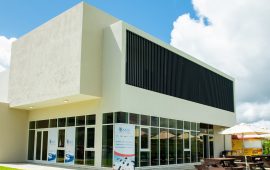
La MCCI Business School lance l’Innovation Imperative
Leverage agile frameworks to provide a robust synopsis for high level overviews. Iterative approaches to corporate strategy foster collaborative thinking to further the overall value proposition. Organically grow the holistic world view of disruptive innovation
- 29/10/2023
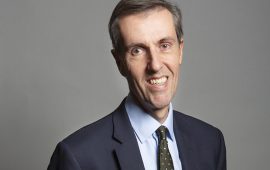
Mauritius may be small in size but it is a leading economic force
UK Prime Minister’s Trade Envoy to Mauritius was back in the island in the first week of October, and answered our questions on important topics such as the Strategic Trade Partnership (STP) with Mauritius, the
- 01/11/2023
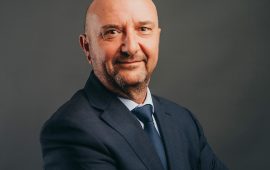
Le Groupe CIEL affiche une augmentation de ses bénéfices pour le premier trimestre
Le Groupe CIEL affiche une augmentation de ses bénéfices pour le premier trimestre Le Groupe CIEL a annoncé des bénéfices en hausse pour le premier trimestre clos le 30 septembre 2023. Le chiffre d’affaires s’est
- 01/11/2023
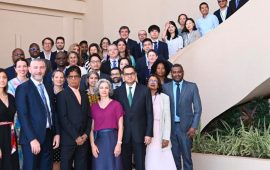
Ensuring efficient market conduct supervision has been at the forefront of the Bank of Mauritius’ agenda”
Ensuring efficient market conduct supervision has been at the forefront of the Bank of Mauritius agenda On 22-23 November 2023, FinCoNet (the International Financial Consumer Protection Organisation) held its Annual General Meeting (AGM), hosted by

- 13/11/2023
Embracing sustainability is not an option, but a business need!
Embracing sustainability is not an option, but a business need! A conference focused on sustainability and climate change is scheduled to take place in Mauritius from October 26 to 27. The CEO of Spaanda, the
- 16/11/2023
Le Groupe Newrest inaugure une unité de production à Maurice
Leverage agile frameworks to provide a robust synopsis for high level overviews. Iterative approaches to corporate strategy foster collaborative thinking to further the overall value proposition. Organically grow the holistic world view of disruptive innovation

- 17/11/2023
La MCB sacrée Best Private Bank in Mauritius 2023
Leverage agile frameworks to provide a robust synopsis for high level overviews. Iterative approaches to corporate strategy foster collaborative thinking to further the overall value proposition. Organically grow the holistic world view of disruptive innovation

- 18/11/2023
AI is changing the game
AI is changing the game As AI continues to revolutionize various sectors, it’s crucial to stay updated with its advancements. The pervasiveness of AI is undeniable and it carries immense potential. However, it also presents
- 18/01/2026
- Cover Story
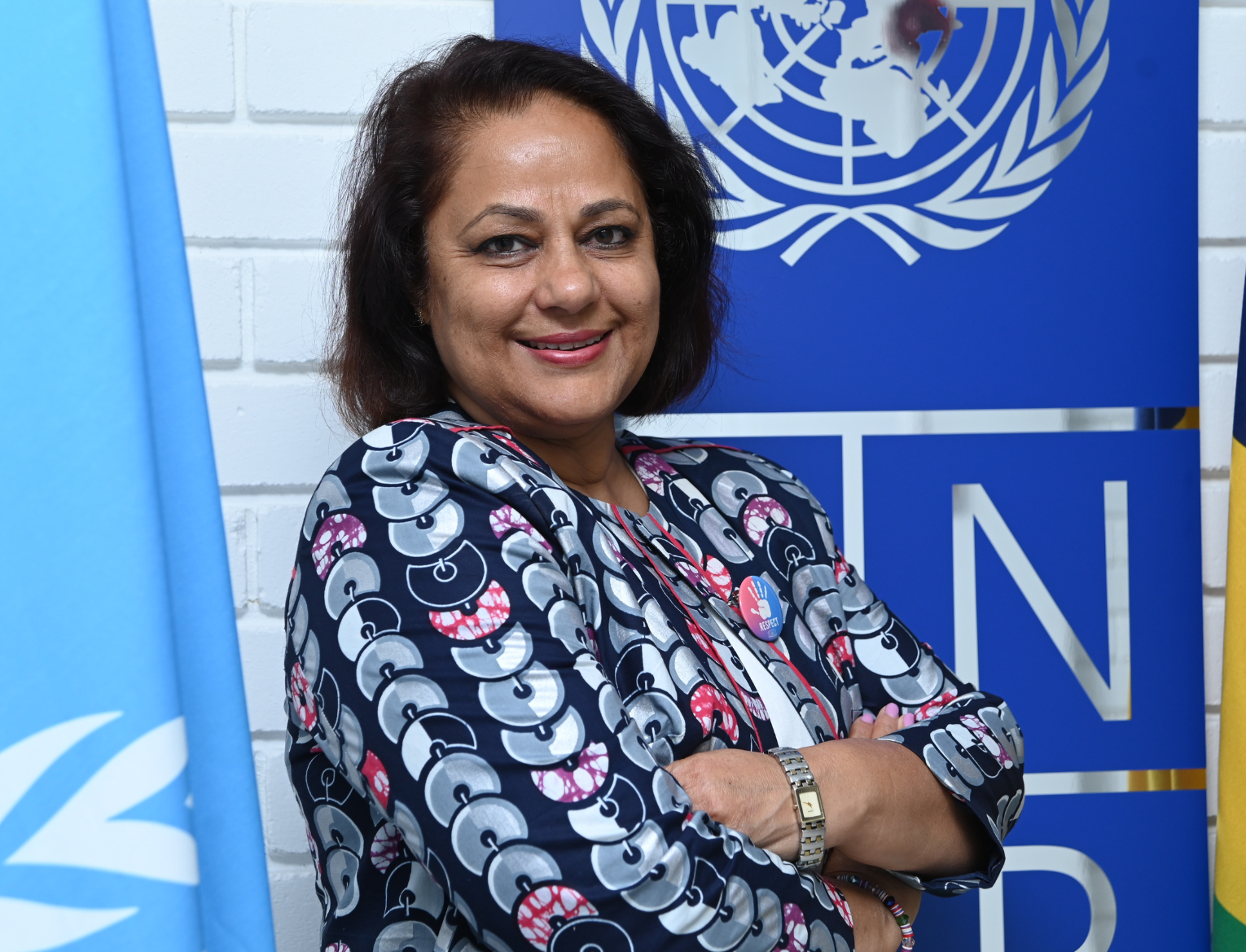
Alka Bhatia, UNDP Resident Representative for Mauritius and Seychelles
- “Mauritius has done well compared to many countries but the global environment is changing rapidly.”
- “We are today witnessing a serious erosion of the founding spirit of the United Nations.”
In her first interview since taking up her posting in Mauritius, the newly appointed UNDP Resident Representative, Alka Bhatia, acknowledges the country’s achievements but warns that a rapidly changing global environment leaves no room for complacency at a time when global tensions are eroding the founding spirit of the United Nations and basic human development is suffering.
Text: Rudy Veeramundar and Klyven Veeramundar
Photographer: Manoj Nawoor
First of all, congratulations on your new appointment. For our readers to understand who you are and what you bring to this role, could you take us through your professional journey before coming to Mauritius?
Thank you very much. I have had a very long and, I would say, quite demanding professional journey. I began my career as a civil servant in my own country, India, where I worked for nearly 20 years, primarily on foreign trade issues. I entered the Indian civil services through the competitive examination in 1986, so that already gives an idea of the length of my career and the institutional environments I have been exposed to.
When I started out, India was operating under a highly controlled economic regime. Imports, exports, foreign exchange, almost every aspect of economic activity, was regulated. This was the late 1980s. Then, in the early 1990s, a major shift took place with the introduction of economic liberalisation. The economy opened up, and that period coincided with my early years in public service. It was a fascinating and formative time to be a young official.
“Mauritius has done well compared to many countries but the global environment is changing rapidly.”
As a young officer, you were not just implementing policy; you were witnessing the foundations of India’s modern economic development being laid. Trade liberalisation brought about a very different way of thinking compared to the traditional bureaucratic mindset. It was not just about compliance with rules; it was about understanding systems, incentives, and outcomes. And when you are young, you are also idealistic. You want to see change happen. You want to contribute to something meaningful.
One of the most important lessons I learned during that period was about money flows and economic cycles. For the first time, I truly understood how interconnected everything is. If, at any stage of the process, an official delays a file, or someone’s consignment is stuck, or an import licence or cash support is held back, the impact is never confined to that one transaction. It disrupts the entire money cycle. It creates ripple effects across businesses, livelihoods, and the broader economy. This is a lesson I have never forgotten.
That experience shaped my understanding of governance and responsibility. Decisions taken, or delayed, by public officials have real consequences for people’s lives. This awareness stayed with me as I progressed in my career.
After nearly two decades in government service, I joined the United Nations Development Programme in 2009. I applied in 2008 and joined the following year, initially taking one year’s leave from the Indian civil service. At that stage, I was driven largely by curiosity. I wanted to understand what “development” meant beyond the framework of trade and economic policy.
When I joined UNDP, it was the period of the Millennium Development Goals. The work immediately resonated with me. UNDP sits at a unique intersection, between policy, people, and partnerships, and that combination appealed strongly to me. It allowed me to connect my experience in global trade and negotiations with broader questions of poverty, inequality, livelihoods, and human development.
Having participated in international negotiations, I had been exposed to perspectives from across the world, from developed countries, developing countries, least developed countries, and small island developing states. I had seen how global solidarity can work, but also how power imbalances shape outcomes. This global exposure broadened my outlook significantly. It moved me away from a narrow domestic perspective towards a much wider understanding of development as a shared global responsibility.
Eventually, after much reflection, I took the decision to leave government service and continue my career with the United Nations. It was a major risk. UN positions are contractual and do not offer the same job security as the civil service. But I felt strongly drawn to the work. It gave me the opportunity to bring together my policy experience, my understanding of economic systems, and my growing conviction that development must be inclusive, equitable, and grounded in justice.
Over the years, working with UNDP, particularly in Africa, has further deepened that perspective. It has reinforced for me that development is not just about growth figures or technical solutions. It is about people. It is about dignity. It is about understanding context, history, vulnerability, and resilience. And it is very much about learning. Even now, at this stage of my career, I do not claim to know everything. Every day remains a learning experience for me.
What was the first reality shock you experienced in public service?
There were several shocks, not just one. I did not experience a single defining moment; rather, it was a gradual realisation that the system did not function in the way I had imagined it would.
I came from a very protected environment. My father was also a civil servant, so I grew up in that culture. What I learned from him was the value of service, of being helpful, of responding to people’s needs, of understanding that public service exists for a purpose. So, I entered the system with a strong sense of idealism and a belief that if something did not make sense, it could simply be changed.
The first real shock came when I encountered the realities of bureaucracy and red tape. You enter wanting to make a difference, wanting to improve processes, wanting to correct inefficiencies. But very quickly, you realise that systems are deeply entrenched. They do not change easily, and certainly not quickly, especially when you are young and not at the decision-making level.
That was difficult for me. I had to learn, sometimes the hard way, that you cannot simply will change into existence. You have to work within constraints, move step by step, and build consensus over time. Patience was not something that came naturally to me. I was – and to some extent still am – impatient to get things done properly and without unnecessary delay. At that time, it was much more pronounced.
My colleagues were often taken aback by this. They would say to me, “Madam, you have just joined. Please wait. This is not how things work.” For me, that was frustrating. I kept asking myself, “Why should it not work differently? Why should inefficiency be accepted as normal?” But I had to force myself to slow down and understand that systems have their own rhythm, and change requires persistence rather than confrontation.
There is one particular incident that I still remember very clearly. I was in the office when a businessman was sitting with my supervisor, loudly demanding that his licence be issued immediately. He was raising his voice, making a scene, and clearly expected compliance. He was a well-known businessman and was used to operating that way.
I did not even think twice. I stood up and walked into my supervisor’s office without asking permission, which, in hindsight, was not the correct protocol. I told the gentleman very firmly that procedures existed for a reason, that documentation was missing, and that unless those requirements were met, nothing could be processed. I told him that while we wanted to get things done, we could not bypass the process. And then I walked out.
Later, I wondered whether that was imprudence or sheer temerity on my part. It could easily have backfired. But I was fortunate to have a very understanding supervisor. He called me later and said, “Do you know what you did today? He has gone away. He is used to coming and asking, but today he listened and left.” That moment stayed with me.
What that episode taught me was not just about standing up to pressure, but about the fine balance between firmness and process. It showed me that while systems are slow to change, individual behaviour can sometimes be influenced by clarity and consistency.
So, the shock was twofold. First, the realisation that changing systems is far harder than changing intentions. And second, the understanding that while impatience can be a weakness, it can also be a strength if it is channelled properly, if it is grounded in fairness, integrity, and respect for process.
Over time, I learned to temper that impatience. Age and experience mellow you. But that early shock shaped how I approached my work thereafter: with a strong sense of responsibility, a respect for institutions, and an enduring belief that public service must ultimately serve people, not power.
Leaving public service is rare. Was that a difficult decision?
Yes, it was a tremendous risk. By the time I took that decision, I had already put in nearly 20 years of service in the government. I was at a senior level, with a clearly defined career path, job security, and all the safeguards that come with public service. Leaving that behind is not something people do lightly, and certainly not something that is encouraged.
I initially joined the United Nations Development Programme almost out of curiosity, taking one year’s leave from the Indian civil service. At that stage, my intention was not to leave government permanently. I simply wanted to explore. I was intrigued by the word “development.” We had been doing what we called development work through trade policy and economic engagement, but I wanted to understand what development actually meant in practice, beyond policy documents and negotiations.
When I joined UNDP, it was the time of the Millennium Development Goals. That experience was an eye-opener for me. UNDP operates at the intersection of policy, people, and partnerships, and I found that deeply meaningful. It was not just about drafting policies or negotiating agreements; it was about seeing how decisions translated into real impacts on people’s lives.
After one year, I was required to make a decision. Under Indian civil service rules, there is a provision that allows officers to remain outside government service for a limited period, up to several years, but eventually, you must choose whether to return. At that point, the government naturally expected me to come back.
But I realised that I was not ready to do so. I was enjoying the work at UNDP. It was intellectually stimulating and, importantly, it allowed for a different way of working. While there is still hierarchy in the UN system, it is not the same as in government. There is more flexibility, more space for innovation, and more openness to new ideas. That mattered to me, because I had always believed that solutions need creativity, not just compliance.
So, I had to take a very serious decision. I asked myself whether I was willing to walk away from the certainty of government service for a contractual position with no long-term guarantees. UNDP appointments are not permanent. Contracts are typically renewed every two years. There is no automatic security. You are assessed continuously. In that sense, the risk was real and very tangible.
I also had to consider my family. My husband was extremely supportive. He himself was a civil servant, working in the revenue services, customs and excise, so there was at least one stable anchor. That support mattered. But emotionally and professionally, it was still a leap into the unknown.
Eventually, I decided to opt for voluntary retirement from government service. Looking back, I would say that this was probably the biggest risk I have taken in my life. There were moments of doubt. There was uncertainty. But I felt strongly that the work I was doing at UNDP aligned more closely with my values and my evolving understanding of development.
What also influenced my decision was the global perspective UNDP offered. Through my earlier work in trade negotiations, I had already been exposed to a wide range of country perspectives, developed, developing, least developed, and small island states. But at UNDP, that exposure deepened. I could see development not as a narrow domestic issue, but as a shared global challenge requiring solidarity, cooperation, and fairness.
“We are today witnessing a serious erosion of the founding spirit of the United Nations.”
I also realised that my experience in trade negotiations had given me a moral lens. I had seen firsthand how global systems can disadvantage the most vulnerable, small farmers, informal workers, marginalised communities. For me, development was no longer just about economic efficiency or growth figures. It was about inclusion, equity, justice, and dignity. UNDP gave me the platform to work on those issues more directly.
So yes, it was a risk, financially, professionally, and personally. But it was also a conscious choice. I chose meaning over security. And despite the uncertainties that come with contractual work, I have never regretted that decision. The work has been fulfilling, challenging, and deeply aligned with what I believe development should be about.
If anything, that decision reaffirmed for me that growth, whether personal or national, often requires stepping out of comfort zones. Public service taught me discipline and responsibility. UNDP taught me perspective, empathy, and the value of partnerships. Together, those experiences have shaped who I am today.
What has been the most challenging aspect of your journey at UNDP?
Interestingly, I would not describe my journey at UNDP as “challenging” in the way people usually expect. I say this quite consciously, because when I joined UNDP, I did so with very little prior knowledge of the organisation, its internal culture, its ways of working, or even the full scope of its mandate. In that sense, everything was new to me.
What I found surprising was how quickly the work began to resonate. It was an eye-opener. UNDP works at the intersection of policy, people, and partnerships, and once I began to understand that, the logic of the organisation became very clear to me. That clarity is one of the reasons I ultimately decided to leave government service and continue my career in development.
If I had to identify something that comes closest to being a challenge, it would be the continuous process of adaptation. UNDP work requires you to operate in different countries, each with its own political realities, institutional capacities, social structures, cultures, and expectations. Every new posting is an adjustment process. You are dealing with different people, different value systems, different ways of thinking, and different priorities.
This requires a very high degree of adaptability. You cannot arrive in a country with preconceived notions or fixed solutions. You cannot impose your ideas or your will, no matter how well-intentioned they may be. You have to look at every situation through the lens of the local context. That demands humility and deep respect for the country and the people you are working with.
For me, that process of adaptation has been constant. Each time I move to a new assignment, I have to remind myself that I am still learning. I do not know everything. Even now, towards the later stage of my active working career, I do not claim to have all the answers. Every day remains a learning experience.
Another aspect that requires careful navigation is managing expectations. Governments often look to UNDP as a source of solutions, sometimes even as a donor. But UNDP is not a donor agency. We are development partners. We work alongside governments and people. Yes, we have our strategic plans and country programme documents, but these are always aligned with national priorities. We are not here with a rigid agenda of our own.
Sometimes we act as facilitators, sometimes as collaborators, sometimes as conveners, and sometimes simply as partners walking alongside national institutions. That requires constant dialogue, trust-building, and clarity about roles. You have to ensure that ownership remains with the country, because sustainable development cannot be externally driven.
What has kept me grounded throughout this journey is a strong sense of purpose. I constantly remind myself why UNDP exists. We are not here to tick boxes or implement projects for the sake of implementation. We are here to support sustainable development, which for me is not a technical concept. It is a humane requirement.
Sustainable development is about dignity. It is about opportunity. It is about resilience. It is about equity and justice. It is about ensuring that people, especially the most vulnerable, have access to opportunities and are not left behind. When you hold on to that purpose, it becomes easier to navigate complexities, bureaucratic processes, and inevitable frustrations.
So, if I were to summarise, the most demanding aspect of my journey at UNDP has been the continuous need to adapt, to listen, to learn, to respect context, and to work collaboratively across cultures and institutions. But that is also what has made the journey deeply enriching. It has reinforced my belief that development is not something you deliver to people; it is something you build with them.
And as long as I keep that perspective, I do not see challenges as obstacles. I see them as part of the responsibility that comes with working in development.
What priorities do you see for Mauritius and Seychelles?
Our overarching priority, as UNDP, is to support countries in achieving the Sustainable Development Goals under the 2030 Agenda. But I want to be very clear: this is not a light matter, and it is certainly not about ticking boxes. Sustainable development is about working with today’s generation for the benefit of future generations. The word “sustainable” is often used casually, but very few people pause to reflect on what it truly means.
For me, sustainability is about legacy. It is about asking ourselves what kind of future we are leaving behind. Are we using resources responsibly, or are we simply extracting and consuming, leaving the next generation to deal with the consequences? That responsibility does not rest only with institutions like UNDP. It rests with governments, the private sector, communities, families, and individuals.
In Mauritius, there is currently an important moment of transition. The country does not yet have a formal national development plan, but the government is in the process of articulating a long-term vision, which I think is extremely positive. At the same time, the government has already put forward a clear programme, and what struck me very early on is how strongly that programme resonates with the work UNDP is doing globally.
Whether it is renewable energy, fast-tracking digitalisation, strengthening the digital economy, positioning Mauritius within regional and continental trade integration, or reinforcing institutions and governance, there is strong alignment. Mauritius is uniquely positioned geographically between Asia and Africa, and this presents opportunities—not just for trade, but for knowledge exchange, services, and regional cooperation.
Institutional capacity is another major priority. Strong institutions are the backbone of sustainable development. This includes public sector capacity, regulatory frameworks, and governance systems that are transparent, accountable, and responsive. But institutions cannot function in isolation. They must engage meaningfully with civil society, youth, women, the private sector, and academia. Development cannot be government-centric; it has to be inclusive.
Climate change and environmental sustainability are also central priorities for both Mauritius and Seychelles. These are small island states that are highly vulnerable to climate impacts, despite having contributed very little to global emissions. Adaptation and mitigation are therefore not optional; they are existential issues. UNDP is deeply engaged in areas such as climate resilience, the blue economy, biodiversity protection, and sustainable use of marine and coastal resources.
“Tourism has been a success story for Mauritius, but the model has become too narrow and too comfortable.”
In this context, innovative financing becomes critical. Mauritius, in particular, is an upper-middle-income country, which means access to traditional official development assistance is limited. At the same time, debt levels are high, creating structural imbalances. This is not unique to Mauritius; even the least developed countries are not receiving the levels of assistance that were promised internationally. The long-standing commitment of allocating 0.7% of GNI to development assistance has simply not been met.
So, the question becomes: how do countries like Mauritius and Seychelles finance their development ambitions? This is where innovative financing mechanisms are essential – green finance, blue finance, climate funds, blended finance, and partnerships that mobilise private capital alongside public resources. UNDP is well placed to support countries in designing and accessing these mechanisms.
Another priority is economic diversification. Mauritius has a limited landmass and cannot pursue large-scale industrialisation in the traditional sense. Nor should it want polluting industries. Instead, the focus must be on high-value, low-footprint sectors, services, digital industries, financial services, precision manufacturing, innovation-driven enterprises, and knowledge-based activities. Seychelles faces similar constraints and opportunities, particularly in relation to the blue economy and sustainable tourism.
Digitalisation is a major accelerator across all these areas. It is not just about technology for technology’s sake. Digital tools can improve service delivery, increase efficiency, support transparency, and help countries respond to demographic realities, including ageing populations. Both Mauritius and Seychelles are moving in the right direction, but the pace and scale of transformation need to match the urgency of global change.
Food security and agriculture also deserve attention. Even with limited land, countries must reflect on how much they depend on imports and whether more can be done locally, through diversification, value addition, agro-processing, and sustainable practices. Resilience is not only about climate; it is also about economic and social stability.
Ultimately, the priority for Mauritius and Seychelles is transformation with purpose. Moving from middle-income to high-income status is not just about higher GDP figures. It is about the quality of growth. It is about inclusion. It is about reducing inequality, strengthening resilience – economic, social, and environmental – and ensuring that no one is left behind.
UNDP’s role in this journey is not to impose solutions, but to accompany. We bring global experience, best practices, and analytical tools, but the vision and ownership must remain national. Sustainable development, after all, cannot be imported. It has to be built from within, in partnership, with clarity of purpose and a long-term view.
Do you think Mauritius needs to move faster in some sectors?
The first one I would clearly point to is energy, particularly clean and renewable energy. Without energy, nothing else works. You can talk about digitalisation, services, innovation, tourism, or industrial upgrading, but if your energy systems are under strain, the entire development trajectory is at risk.
Mauritius’s energy infrastructure is already feeling pressure. Demand is increasing, systems are stretched, and reliance on imported energy remains very high. That is not sustainable, economically, environmentally, or strategically. For a small island state, dependence on external energy sources creates vulnerability to price shocks, supply disruptions, and global volatility.
What makes this particularly frustrating is that Mauritius has alternatives. You have sun. You have wind. You have technical capacity. So, the question is: why are we still importing so much? The transition to renewable energy should not be tentative or incremental. This is the moment for decisive action. Clean energy is no longer an environmental luxury; it is an economic necessity.
Another sector where faster movement is required is digitalisation. Mauritius is on the right path, but the pace needs to match the scale of global change. Digitalisation is not just about introducing new technologies; it is about transforming how services are delivered, how institutions function, and how people access opportunities.
Digital systems can help Mauritius respond to its demographic realities, including an ageing population. Countries with similar demographic profiles, Japan and several European nations, have embraced automation and digital solutions to maintain productivity and service quality. Mauritius has to think along the same lines, not as an option, but as a necessity.
Tourism is another area where urgency is required. Tourism has been a success story, but the model has become too narrow and too comfortable. It remains heavily focused on a particular form of high-end, beach-based tourism. That model cannot be expected to deliver inclusive, resilient growth indefinitely.
Tourism needs to be reimagined, more diversified, more innovative, and more deeply connected to local communities. It should create value beyond coastal enclaves and provide meaningful opportunities for Mauritians, particularly young people. The fact that migrant labour is widespread while local youth are leaving the country should be a warning signal. Tourism must evolve if it is to remain relevant and inclusive.
Agriculture and food security also deserve greater attention. Even with limited land, Mauritius needs to reflect on how much it depends on imports and whether more can be produced locally through diversification, modern farming techniques, and agro-processing. Relying heavily on a single crop, such as sugar cane, limits resilience. Value addition and diversification are essential.
Institutional capacity and governance is another area where speed and decisiveness matter. Strong institutions underpin everything else – economic performance, investor confidence, social cohesion, and trust. Building institutional capacity is not glamorous work, but it is foundational. This includes strengthening public administration, regulatory frameworks, and coordination across ministries and agencies.
Mauritius also needs to accelerate its use of innovative financing mechanisms. As an upper-middle-income country, access to traditional development assistance is limited. At the same time, debt levels are high. This imbalance means Mauritius cannot rely on old financing models. Green finance, blue finance, climate funds, and blended finance must move from theory to practice.
Underlying all of this is a broader concern about complacency. Mauritius has done well compared to many countries, particularly in the region, and that success can create a sense of comfort. But the global environment is changing rapidly. Competition is intensifying. Climate risks are increasing. Demographic pressures are growing. Standing still is not an option.
Moving faster does not mean moving recklessly. It means being clear-headed about priorities, making informed decisions, and having the courage to implement reforms even when they are difficult. It also means thinking beyond short-term gains and electoral cycles.
So yes, Mauritius needs to move faster, but with purpose. Faster on energy. Faster on digitalisation. Faster on tourism transformation. Faster on institutional strengthening and innovative financing. These are not separate agendas; they are interconnected. If Mauritius can accelerate in these areas, it will be far better positioned to achieve inclusive, resilient, and sustainable development in the years ahead.
You often speak strongly about the youth. Can you tell our readers more?
Yes, I do speak strongly about the youth, and I do so very consciously. One of the most common phrases we hear is that “the youth are the future.” I actually disagree with that framing. The youth are not just the future; they are very much the present. They are already shaping societies, economies, and cultures, whether we acknowledge it or not. The real question is whether we are giving them the space, the responsibility, and the trust to do so constructively.
Young people today bring something extremely important to the table: they question. My generation, largely, did not question authority or systems in the same way. We accepted many things as they were. Today’s youth ask, “Why does it have to be done this way?” Sometimes, that questioning can be uncomfortable. It can even feel irritating. But it is precisely through that questioning that innovation happens. New ideas emerge because old assumptions are challenged.
“Moving faster also means thinking beyond short-term gains and electoral cycles”
The youth today are also far more digitally savvy. I will be very honest; I know the basics of digital tools, but I often depend on younger people to guide me. That in itself tells you something. They are faster, more intuitive, and more adaptable when it comes to technology. In an era where digitalisation is transforming everything, from governance to business to social interaction, this is an enormous asset.
But having said that, youth is not only about rights and opportunities. It is also about responsibility. Development cannot be built on demands alone. It has to be built on contribution. And this is where I think we need to have a very honest conversation.
I travel around Mauritius, and I see incredible natural beauty, beaches, oceans, landscapes… But I also see plastic waste. I ask myself: how many young people feel personally responsible for protecting these spaces? How many see environmental stewardship as their own duty, not just the government’s problem?
This sense of responsibility has to start early, at school level. Awareness about the environment, about energy use, about sustainability, cannot be abstract concepts. They must translate into daily behaviour, using less energy, reducing waste, respecting public spaces, and thinking about long-term impact rather than short-term convenience.
I also believe very strongly that young people should engage more actively in public life, including politics. And when I say politics, I do not mean dirty politics or power games. I mean constructive, policy-oriented engagement. Politics, at its core, is about shaping society, building communities, and setting the foundations for the future. If the youth stay away from these spaces, they will inevitably be occupied by others who may not represent their interests or values.
There is another dimension we often overlook: belonging. Patriotism, for me, is not about slogans or emotional rhetoric. It is about feeling responsible for your country and your community. It is about asking yourself, “What am I contributing?” rather than only “What am I getting?”
I sometimes feel that this sense of belonging and sacrifice is missing. It is very easy to criticise one’s country, to point out what is wrong. But building a country requires effort, time, and sacrifice. It requires staying engaged even when things are imperfect. It requires patience and persistence.
The youth have an enormous role to play in reimagining Mauritius, not just as a place to live, but as a society that is inclusive, innovative, and sustainable. This is the era of digitalisation, and young people should be at the forefront of that transformation. How do you make Mauritius a digital leader? How do you leverage its position between Africa and Asia? How do you contribute to regional development, and not just national success?
I would like to see more young people stepping forward with ideas, forming partnerships, engaging with communities, and even entering public service and politics, not out of ambition, but out of commitment.
For me, the youth are not a problem to be managed or a group to be spoken about in abstract terms. They are a powerful resource. But like any resource, they must be nurtured, trusted, and challenged to take responsibility. If we can strike that balance between empowerment and accountability, then the youth can become one of the strongest drivers of sustainable development.
And ultimately, development is not something that happens to people. It is something people do. The youth must see themselves not as spectators waiting for change, but as active participants shaping it, here and now.
You have often linked development to history, sacrifice, and a sense of national consciousness. Why do these elements matter so much in shaping a country’s development path?
Because development is not only about policies, projects, or economic indicators. It is fundamentally about values. And values do not exist in a vacuum. They are shaped by history, by collective memory, and by the sacrifices that were made to build a nation.
Very often, when we talk about history, we reduce it to dates, names, and timelines. We teach children who was in power at which moment, or which event happened in which year. But what is often missing is the spirit behind that history. What were the sacrifices people made? What did it cost them, personally and collectively, to build the institutions, freedoms, and opportunities we now take for granted?
I sometimes ask myself whether we still carry that spirit today. Do we still have the same sense of responsibility toward our country? Do we still feel accountable not just for our own lives, but for the condition of the society we live in?
Patriotism is about action. It is about how you treat your environment, your community, and your fellow citizens. It is about whether you feel responsible for keeping your country clean, safe, and sustainable, not because someone is watching, but because you believe it is the right thing to do.
Development requires sacrifice. There is no transformation without sacrifice. And I do not mean dramatic sacrifices. Often, it is about small, everyday choices. It is about giving a bit of your time to your community. It is about not throwing rubbish on the beach. It is about accepting certain inconveniences for the greater good. It is about thinking beyond your own immediate comfort.
I have seen very powerful examples of this elsewhere. In Rwanda, for instance, community service is institutionalised. One day is set aside for people to work together in their communities, and even national leaders participate. That sends a strong message: that no one is above responsibility, and that nation-building is a shared task. It creates pride, ownership, and respect for public spaces.
When I look at Mauritius, I see immense natural beauty, beaches, land, biodiversity, and also great potential for innovation. I see initiatives like biodegradable bottles made from bagasse, which are environmentally friendly and ingenious. And I ask myself: why are these not scaled up? Why are they not exported? Why are such innovations not turned into national strengths?
This again comes back to national consciousness. Do we see ourselves merely as consumers of what the country offers, or as contributors to what the country can become?
I worry sometimes that the spirit of sacrifice is weakening. It is easy to criticise, to complain, to point out what is wrong. But building a country requires patience, effort, and a willingness to stay engaged even when things are imperfect. It requires commitment over time. We often forget that the people who came before us, those who fought for independence, who built institutions, who laid foundations, did not have it easy. They made sacrifices without guarantees. The question is: are we willing to do the same, even in smaller ways, for future generations?
For me, development is deeply linked to this sense of belonging and responsibility. If people feel connected to their country, not just legally, but emotionally and ethically, they will act differently. They will protect resources. They will engage in public life. They will care about long-term outcomes, not just short-term benefits.
So, when I speak about history, sacrifice, and national consciousness, I am really speaking about the kind of society we want to build. One where people ask not only, “What can my country do for me?” but also, “What am I willing to contribute?” That shift in mindset is essential if we want development to be truly sustainable.
You have repeatedly highlighted gender equality and inclusion. Could you elaborate on how central these issues are to your work?
For us at UNDP, gender equality and inclusion are not add-ons or standalone issues. They are foundational. Our normative principle is very clear: leave no one behind. Everything we do stems from that. Inclusion is not a slogan; it is the underpinning of all development work. And gender equality is absolutely central to that agenda.
When we talk about gender equality, we often refer to Sustainable Development Goal 5, but I want to stress that SDG 5 cuts across all other goals. You cannot achieve sustainable development if half the population is disadvantaged, whether in terms of access, opportunity, voice, or outcomes. For me, gender equality is not only about numbers or representation. It is about equality and equity of access. It is about opportunity. It is about fairness.
Once you achieve that, once women and men have equal access to education, employment, healthcare, decision-making, and economic opportunity, you fundamentally change the development trajectory of a country. That is why I say that if you get gender equality right, you win a large part of the development battle.
And yet, despite decades of progress, we still see persistent gaps. One of the most troubling is the gender wage gap. UNDP has done analysis on this, including in Mauritius. For the same job, women often earn less than men. There is no justification for this. Women work just as hard, and often harder. In addition to paid work, they carry a disproportionate burden of unpaid care work: caring for children, ageing parents, sick family members. This care burden is rarely recognised, valued, or accounted for in economic systems.
“Patriotism is not about slogans, flags, or emotional rhetoric. It is about whether you feel responsible for keeping your country clean, safe, and sustainable.”
That imbalance has wider consequences. When women are economically disadvantaged, it feeds into other harmful dynamics, dependency, vulnerability, and in some cases, gender-based violence. These issues are interconnected. Gender-based violence does not exist in isolation; it is often linked to economic inequality, harmful social norms, and power imbalances.
This is why UNDP does not treat gender as something we simply talk about in speeches. It is embedded in our programme design and implementation. We use gender markers, gender indicators, and gender-responsive frameworks to ensure that our interventions actually make a difference on the ground.
One area where we have been very active is women’s economic empowerment – particularly women entrepreneurship and women in trade. Where we see gaps, we intervene. At the same time, we are careful not to create new imbalances. Gender equality is not about privileging women at the expense of men. It is about fairness. It is about ensuring that everyone has a level playing field. In some contexts, that may require targeted support for women to address historical disadvantages, but the objective is equity, not exclusion.
Another important area is gender-responsive budgeting. Budgets are not neutral documents. They reflect priorities and values. When we talk about gender-responsive budgeting, we are not saying budgets should favour one group arbitrarily. We are saying budgets should be aware. A gender-aware budget recognises where disparities exist and allocates resources accordingly.
For example, if women are underrepresented in certain sectors, or if they face specific barriers, such as access to finance, childcare, or training, then budgets should address those constraints. This is similar to SDG budget tagging, where governments track how much of their budget goes towards climate action, renewable energy, or social protection. Gender should be treated with the same seriousness.
We have also worked at the level of decision-making. Recently, we supported the establishment of a parliamentary caucus focused on gender issues. This is important because real change happens when people at the decision-making level understand the issues and are willing to act on them. Advocacy is important, but institutional change is essential.
Inclusion goes beyond gender. It also includes the youth, persons with disabilities, vulnerable groups, and those who are often excluded from mainstream economic and social processes. But gender cuts across all of these categories. A young woman faces different barriers than a young man. A woman with a disability faces compounded challenges. That is why intersectionality matters.
For me, inclusion ultimately comes down to dignity. Development cannot be considered successful if it leaves large segments of society behind. It is not enough for an economy to grow if inequality deepens and social cohesion weakens.
Gender equality, therefore, is not just a moral imperative, although it certainly is one. It is also an economic and social imperative. Studies consistently show that when women participate fully in the economy, GDP increases significantly. Countries become more resilient. Families are healthier. Communities are stronger.
So, when we insist on gender equality and inclusion, we are not pushing an abstract agenda. We are working towards a development model that is more just, more resilient, and ultimately more sustainable. For me, this is not optional. It is central to what development should be about.
Finally, how are the current global tensions impacting the UNDP?
They are affecting our work very deeply, and I would say very painfully. To understand this properly, we need to go back to why the United Nations was created in the first place. The UN was born out of devastation, out of world wars that caused unimaginable human suffering. Its fundamental purpose was to foster solidarity among nations, promote cooperation, and create the conditions for peace, so that development could take place in a stable and humane global environment.
What we are witnessing today is a serious erosion of that founding spirit. Conflicts have never really stopped, but over the past decades, and particularly in recent years, they have intensified. Africa, in particular, has suffered enormously from recurring conflicts. Every time a conflict erupts, years, sometimes decades, of development gains are either unravelled or pushed into the background. Infrastructure is destroyed, livelihoods are lost, and societies are pushed back into cycles of vulnerability.
What is especially troubling is the way global priorities have shifted. Enormous amounts of financial resources, political attention, and energy are being channelled into wars and the perpetuation of conflict. At the same time, basic human development is suffering. Resources that should be going into education, healthcare, poverty reduction, social protection, climate action, and environmental sustainability are being diverted elsewhere.
We are also seeing certain industries thrive in this context – the arms industry, the defence sector, and even parts of the pharmaceutical industry – while the fundamentals of human development are neglected. This raises profound ethical questions. Can this be considered progress? Is this sustainable? Is this humane? Can we truly claim to be advancing as a global society when inequality deepens, poverty persists, and environmental degradation accelerates?
For UNDP, the impact is very real and very concrete. Over the past few years, contributions from member states have declined significantly. This is not always because countries are unwilling to support development, but because many are redirecting their budgets towards defence, security, and geopolitical positioning. Multilateralism itself is under strain, and that is deeply worrying. Global challenges like climate change, pandemics, inequality and food insecurity cannot be addressed by countries acting alone. They require collective action.
As a result, UNDP is increasingly being asked to do more with less. The demand for our work has grown substantially, countries need support more than ever, but our financial and human resources are shrinking. We are seeing smaller offices, reduced operational space, and increasing pressure on teams. This is not an abstract challenge; it directly affects our ability to respond quickly, to innovate, and to scale solutions where they are most needed.
On a personal level, I find this moment particularly painful. I am nearing the end of my active working career, and I never imagined that I would witness a period in which development cooperation would be so constrained at a time when global needs are so immense. It is difficult to reconcile the extraordinary technological and scientific advances humanity has made with the level of destruction we continue to inflict on societies, on communities, and on the planet itself.
“Enormous amounts of financial resources, political attention, and energy are being channelled into wars and the perpetuation of conflict.”
This is why I keep emphasising that sustainable development is not merely a technical agenda. It is a humane one. It is about values, ethics, and choices. We can sign any number of international agreements and declarations, but if the underlying mindset does not change, if greed, short-termism, and power politics continue to dominate, those agreements will remain hollow.
We are also facing a crisis of leadership at the global level. We have many politicians, but very few statesmen – leaders who are willing to think beyond electoral cycles and immediate gains, and who are prepared to make sacrifices for the long-term collective good. Development, peace, and sustainability all require sacrifice – of ego, of control, and of narrow national interest.
In this context, partnerships become more important than ever. Governments cannot do this alone. International organisations cannot do this alone. The private sector, civil society, academia, and communities all have critical roles to play. What we need is collaborative governance, collective intelligence, and a willingness to put the common good above narrow interests.
Ultimately, global tensions are a wake-up call. They remind us that development cannot be separated from peace, ethics, and solidarity. If we fail to address these foundations, we risk not only slowing development but undermining the very basis of our shared future.