Back to Bizweek
SEARCH AND PRESS ENTER
Latest News

“MCB customers spent Rs 3.5 billion via cards and QR codes from 20 to 25 December”

Stéphanie Ng Tseung, Head of Payments at MCB

  • Black Friday spending reached Rs 1.9 billion, an 8% increase year-on-year
  • MCB customers carried out 17.3 million transactions using cards and QR codes between 1 November and December 2025
  • 93% of Black Friday online transactions were conducted on foreign platforms, compared with 7% on local sites. 
  • The most frequently used platforms included Temu, Netflix, Apple, AliExpress and Orange Money.
  • 67% increase in QR-code transactions, driven primarily by the interoperable MAUCAS QR system. 

Digital payments are becoming firmly embedded in everyday transactions in Mauritius. Presenting MCB’s 2025 payments review, Stéphanie Ng Tseung, Head of Payments at MCB, points to sustained growth in card, QR code and mobile-based payments, a gradual decline in cash usage, and evolving consumer and merchant behaviour – signalling a steady shift towards a more cashlite economy.

Digital payment habits among Mauritian consumers strengthened further in 2025, with data from the MCB Group showing sustained growth in card, QR code and mobile-based transactions, alongside a gradual but consistent decline in cash usage.

Presenting MCB’s annual review of payment trends, Stéphanie Ng Tseung, Head of Payments at MCB, said the figures confirmed a structural shift in consumer behaviour rather than a temporary post-pandemic adjustment.

The trend towards alternative means of payment to cash has clearly been confirmed in 2025,” she said. “This is something the MCB has been supporting for several years, both in terms of usage and acceptance, particularly among SMEs.

Festive Season Transactions: Growth, but at a More Measured Pace

Between 1 November and 31 December 2025, MCB customers carried out 17.3 million transactions using cards and QR codes, representing a 13% increase year-on-year.

During Black Friday, the number of transactions rose by 18% compared with 2024, while Christmas shopping and end-of-year purchases both recorded growth of 9%. The highest transaction volume was registered on 24 December, when 461,000 transactions were processed in a single day.

Stéphanie Ng Tseung underlined that growth in 2025 must be interpreted against an already elevated base. “2024 was a very specific context, with exceptional peaks,” she explained. “In 2025, growth continued, but in a more moderate and sustainable manner, starting from a much higher level.

Spending Patterns: Physical Stores Still Dominant

Despite the continued rise of e-commerce, in-store transactions remained dominant, accounting for 89% of Black Friday purchases, while online transactions represented 11%.

In value terms, Black Friday spending reached Rs 1.9 billion, an 8% increase year-on-year, with an average transaction value of Rs 1,809.

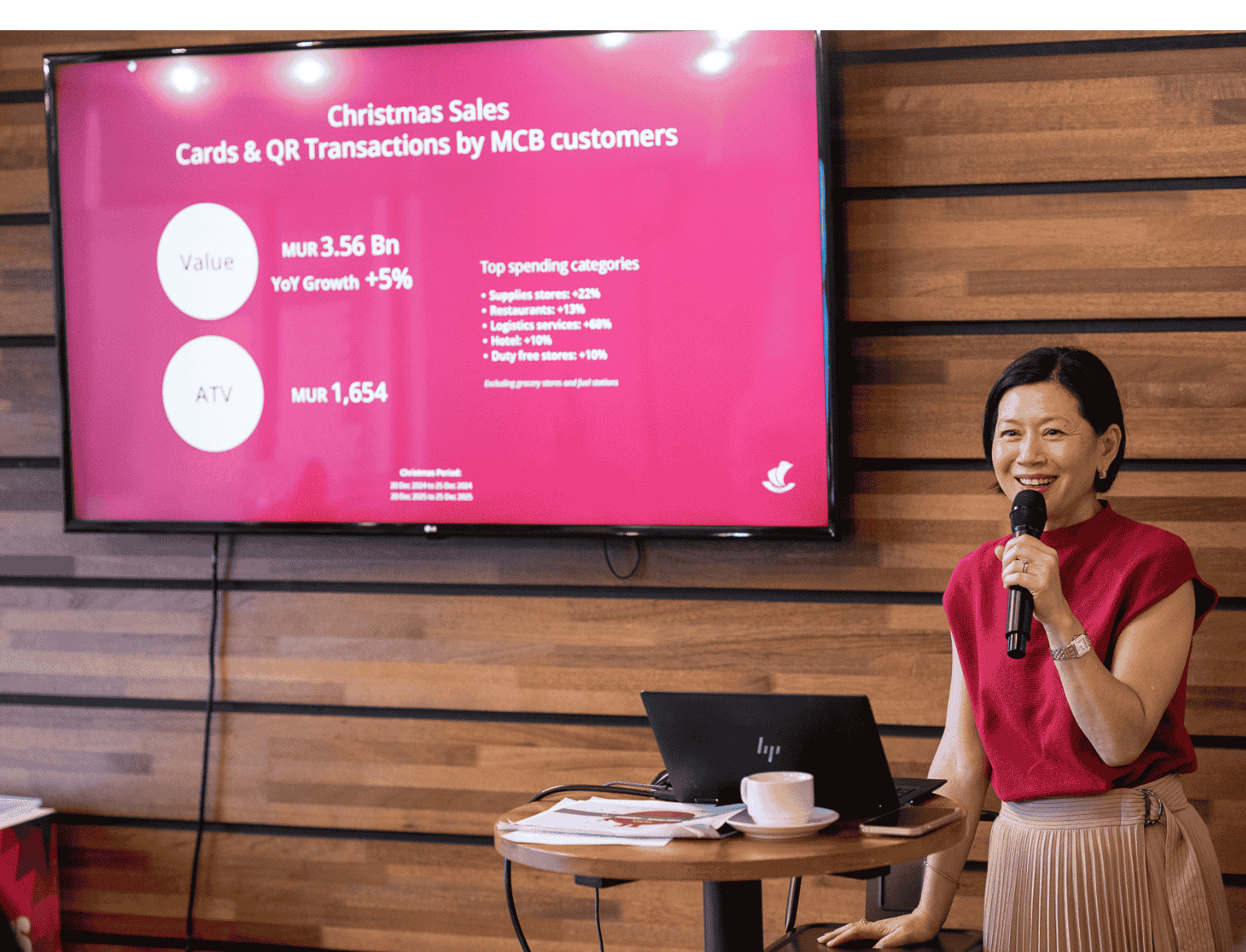
For the Christmas period, from 20 to 25 December, total spending via cards and QR codes amounted to Rs 3.5 billion, with an average transaction value of Rs 1,654. Retail stores and restaurants remained the primary spending categories, followed by logistics services and hotels.


“If we want to move towards a truly cashlite economy, we need to multiply payment acceptance points”


Online Shopping: Foreign Platforms Lead

When Mauritians do shop online, international platforms overwhelmingly dominate. Data shows that 93% of Black Friday online transactions were conducted on foreign platforms, compared with 7% on local sites. The most frequently used platforms included Temu, Netflix, Apple, AliExpress and Orange Money.

This is not really a surprise,” Stéphanie Ng Tseung observed. “We all see that foreign platforms are increasingly part of everyday consumption habits.

Travel Spending Continues to Recover

Card usage abroad continued to expand in 2025, reflecting the sustained recovery in international travel. France remained the most popular destination for MCB cardholders, followed by South Africa and the United Arab Emirates.

Average spending per cardholder reached Rs 57,000 in France, Rs 71,000 in South Africa, and Rs 52,000 in the UAE. Restaurants, hotels, duty-free stores and entertainment accounted for the largest share of overseas expenditure.

QR Codes and the Shift Towards a Cashlite Economy

One of the most notable developments in 2025 was the 67% increase in QR-code transactions, driven primarily by the interoperable MAUCAS QR system, introduced under the central bank’s Instant Payment System (IPS).

MAUCAS QR is a cornerstone of the digitalisation of payments in Mauritius,” Stéphanie Ng Tseung said. “It is interoperable, low-cost and plays a central role in building a cashlite economy.

By contrast, contactless card payments stabilised, registering a 4% increase, reflecting their widespread adoption following the Covid-19 period. Tap-to-Pay, introduced more recently, still represents just 1.4% of total transactions, though MCB expects usage to rise as customer familiarity increases.

We are still at the very beginning of Tap-to-Pay,” she noted. “With education and time, adoption should follow a similar path to contactless payments.

Merchant Acceptance Expands, Cash Usage Declines

By the end of 2025, nearly 18,000 merchants were accepting digital payments through MCB, either via cards or QR codes. Expanding acceptance remains a central focus, particularly among micro-enterprises and SMEs.

If we want to move towards a truly cashlite economy, we need to multiply payment acceptance points,” Stéphanie Ng Tseung said. “This is an industry-wide effort, not just the responsibility of one bank.

The expansion of digital acceptance is contributing to a measurable decline in cash usage. Among individual MCB customers, the proportion of transactions conducted in cash fell from 30% at the start of 2025 to 27% by year-end, a reduction of three percentage points.

Cash may appear free, but it has real costs and risks,” she said, citing security concerns, handling costs, transportation, storage and delays before funds are credited to accounts.

Instant Payments and Infrastructure

Stéphanie Ng Tseung described the Instant Payment System (IPS) as a major structural development for the Mauritian payments ecosystem.

IPS is a game changer,” she said. “It is interoperable, involves banks and non-bank participants, and is a key infrastructure for the country’s cashlite strategy.

Outlook for 2026

Looking ahead, she expects digital payment adoption to continue in 2026, albeit at a more measured pace. “QR payments will continue to grow, online transactions will expand further, cross-border payments linked to travel will remain strong, and Tap-to-Pay will move beyond its early stage,” she said.


“The trend towards alternative means of payment to cash has clearly been confirmed in 2025”


Fraud prevention against pseudo-merchants and social engineering scams

Fraud prevention featured prominently during the Q&A session, particularly in relation to social media transactions and peer-to-peer payments.

Stéphanie Ng Tseung identified two main risks: pseudo-merchants operating on social platforms, and social engineering scams, where victims are tricked into sharing sensitive information.

If someone asks for your PIN, OTP or card details, you should immediately know it is a scam,” she stressed. “No bank will ever ask for this inform

She also cautioned customers against returning unexpected transfers without verification. “If money appears in your account unexpectedly and someone asks you to send it elsewhere, this should raise immediate red flags.

MCB has strengthened security on its Juice app, including biometric verification for sensitive actions, to mitigate these risks. In December alone, the app recorded nearly 35 million logins and close to 13 million transactions, underscoring the importance of system resilience during peak periods.

Skip to content