Back to Bizweek
SEARCH AND PRESS ENTER
Latest News

“Public procurement can shape markets by creating consistent demand for sustainable products”

Rajesh Bhagwan, Minister of Environment, Solid Waste Management and Climate Change

  • EU-backed programme to implement circular economy roadmap.
  • “Citizens must become active participants, by buying less, reusing more, and rethinking consumption,” the minster of Environment said.
  • “A circular economy that neglects equity, dignity, and inclusion runs empty,” he added.

The four-year European Union-funded support programme to advance the implementation of the Circular Economy Roadmap will strengthen institutional frameworks, shape green public procurement, and advance resource efficiency in agri-food, construction, logistics, and waste management.

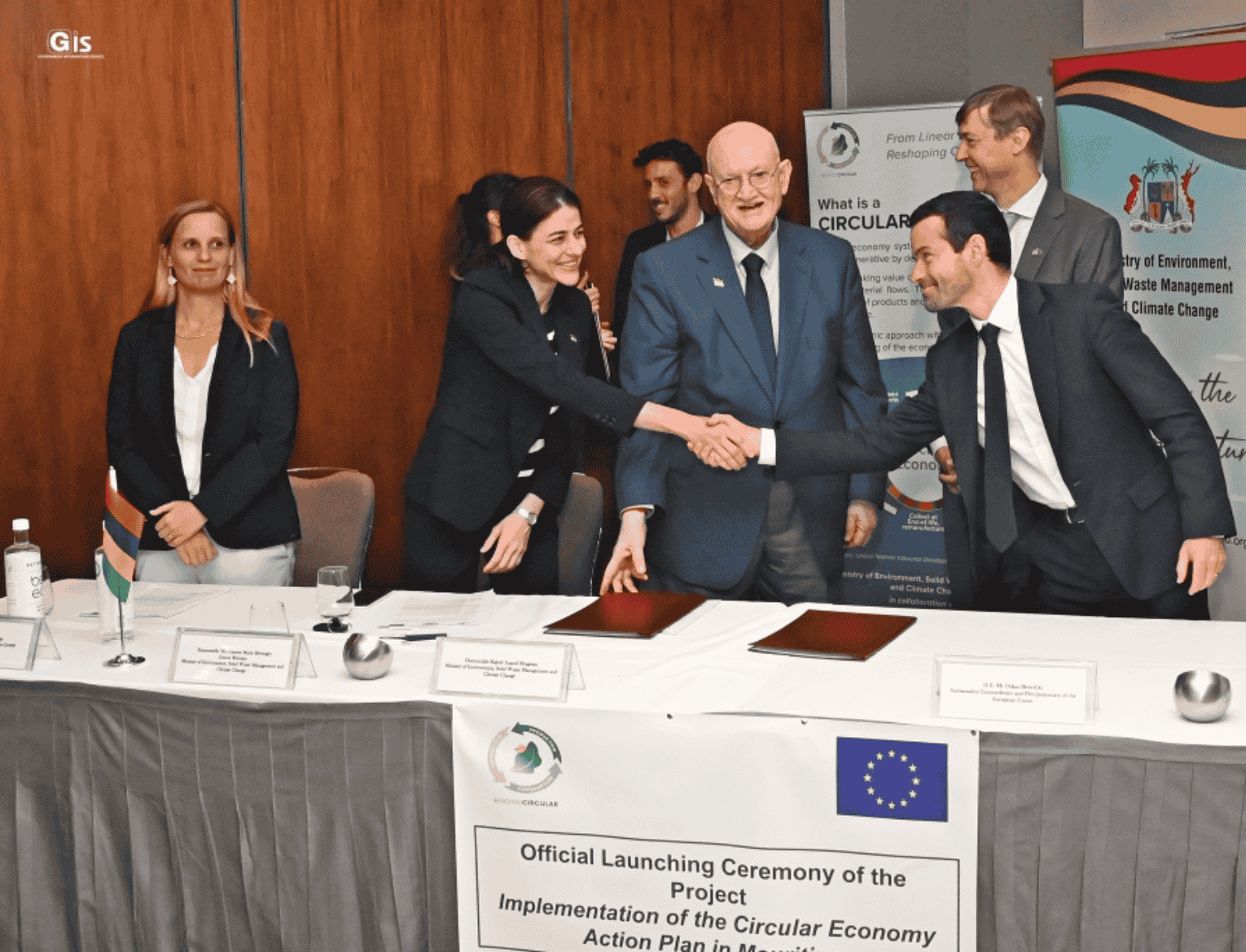
A European Union-funded support programme to advance the implementation of the Circular Economy Roadmap in Mauritius has been launched this week. The initiative, valued at Rs 175 million, is designed to translate national sustainability commitments into concrete actions by aligning government policy, private sector innovation, and community participation.

Speaking at the launching ceremony at the Hennessy Park Hotel, Rajesh Bhagwan, Minister of Environment, Solid Waste Management and Climate Change, said the collaboration marked a decisive step in the country’s transition to a greener and more inclusive economic model. “The European Union has been a meaningful partner in our quest for a sustainable development paradigm,” he said, highlighting the EU’s ongoing support in strengthening institutional frameworks and capacity building. “This programme will help convert strategy into practical measures capable of reshaping how we produce, consume, and manage waste.

Aligning policy and practice

The Roadmap and Action Plan for a Circular Economy in Mauritius, prepared with the technical support of the European Union and the United Nations Environment Programme (UNEP) Africa Office, identifies five key sectors as priorities for reform: agri-food, construction and real estate, consumer goods, mobility and logistics, and waste management. These sectors are viewed as critical entry points for embedding circular practices in production, consumption, and waste management.

The plan outlines 80 policy actions and projects backed by a governance framework that includes a Circular Economy Steering Committee co-chaired by public and private representatives, and several dedicated platforms for coordination. According to Rajesh Bhagwan, the framework will “keep the private sector at the centre of the transition process” and encourage innovation and entrepreneurship in circular business models.

Among the first tangible steps is the Source Segregation Programme, aimed at improving household waste sorting and recycling. It will provide three separate bins for recyclables, organic waste, and general waste, alongside the construction of two Integrated Waste Processing Facilities. A national communication campaign will be launched to engage citizens and foster behavioural change.

Green procurement and public sector leadership

Public procurement has been identified as a key lever for advancing sustainability. A Sustainable Public Procurement Framework for the construction sector is being developed to integrate environmental and social criteria into standard bidding documents. “Public procurement can shape markets by creating consistent demand for sustainable products and services,” Minister Bhagwan noted

He also announced the forthcoming Greening of the Public Sector Project, another EU-supported initiative to promote efficiency in government operations. The project, which will introduce a Green Charter and Action Plan, aims to improve energy use, mobility, building management, and digital processes within public institutions. The minister described the approach as a way for the state to “lead by example” and institutionalise sustainability across government functions.


“It is not enough to recycle materials; we must also repair inequalities.”


Strengthening capacity through technical assistance

The EU programme will be implemented with the support of Expertise France, which will work alongside the Ministry over a four-year period. The technical assistance package includes the development of a dedicated legislative framework on circular economy, a national communication strategy to build public awareness, and a framework to encourage the use of secondary materials in sectors such as construction and real estate.

A programme manager and administrative officer have already begun work in Mauritius, with two lead experts expected to join shortly. “The European Union’s support will help strengthen our policies, build capacity, and expand the space for circular practices across industries,” Minister Bhagwan said.

A global imperative

In the second part of his address, he placed the transition within a broader global context. He recalled that Earth Overshoot Day, this year, fell on 24 July, eight days earlier than in 2024, underscoring the pace at which humanity is consuming natural resources beyond what the planet can regenerate. Since 1970, global resource extraction has tripled, contributing to 90% of biodiversity loss and 55% of greenhouse gas emissions. “The throwaway economy is no longer sustainable,” he warned.

Mauritius’s updated Nationally Determined Contribution (NDC 3.0), approved by Cabinet and submitted to the United Nations Framework Convention on Climate Change (UNFCCC) ahead of COP30 in Brazil, integrates circular economy targets. Among these are diverting 30% of waste from the Mare-Chicose landfill by 2030, and 50% by 2035.

The Ministry is also finalising legislation to operationalise Extended Producer Responsibility (EPR), which will make manufacturers and importers accountable for post-consumer waste, starting with plastic packaging and electronic waste. Minister Bhagwan said the policy “places responsibility where it belongs, with those who design, import, and profit from products.

Inclusion and the human dimension

He underlined that the transition to a circular economy must remain inclusive and socially fair. “Citizens must become active participants, by buying less, reusing more, and rethinking consumption,” he said, adding that “a circular economy that neglects equity, dignity, and inclusion runs empty.

He drew attention to Junior Minister Joanna Bérenger’s recent initiative at the Beau-Bassin Women’s Prison, where sewing machines were donated to inmates as part of a rehabilitation and reuse project. The minister described it as a tangible example of circularity at both social and material levels: giving a second life to used fabrics while offering women an opportunity to “sew a new life for themselves.

Towards a new economic ethic

Minister Bhagwan also reflected on the broader purpose of economic reform. “It is not enough to recycle materials; we must also repair inequalities,” he said. He reaffirmed the government’s determination to place “life, not profit, at the centre of development” and expressed confidence that the partnership with the European Union will help Mauritius sustain its progress over the coming four years. “We thank the European Union for its relentless support and look forward to deepening this collaboration as we move towards a more circular and inclusive economy,” he concluded.

Skip to content