Back to Bizweek
SEARCH AND PRESS ENTER
Latest News

U.S. Embassy Chargé d’Affaires, Craig Halbmaier

“More American businesses are coming here for trade and investment”

U.S.–Africa Trade Dialogue 

  • “Become part of the existing trade ecosystems, build trusted partnerships and we will connect you to the American companies, ” says U.S.–Africa Trade Desk Vice President for Trade William Fanjoy.

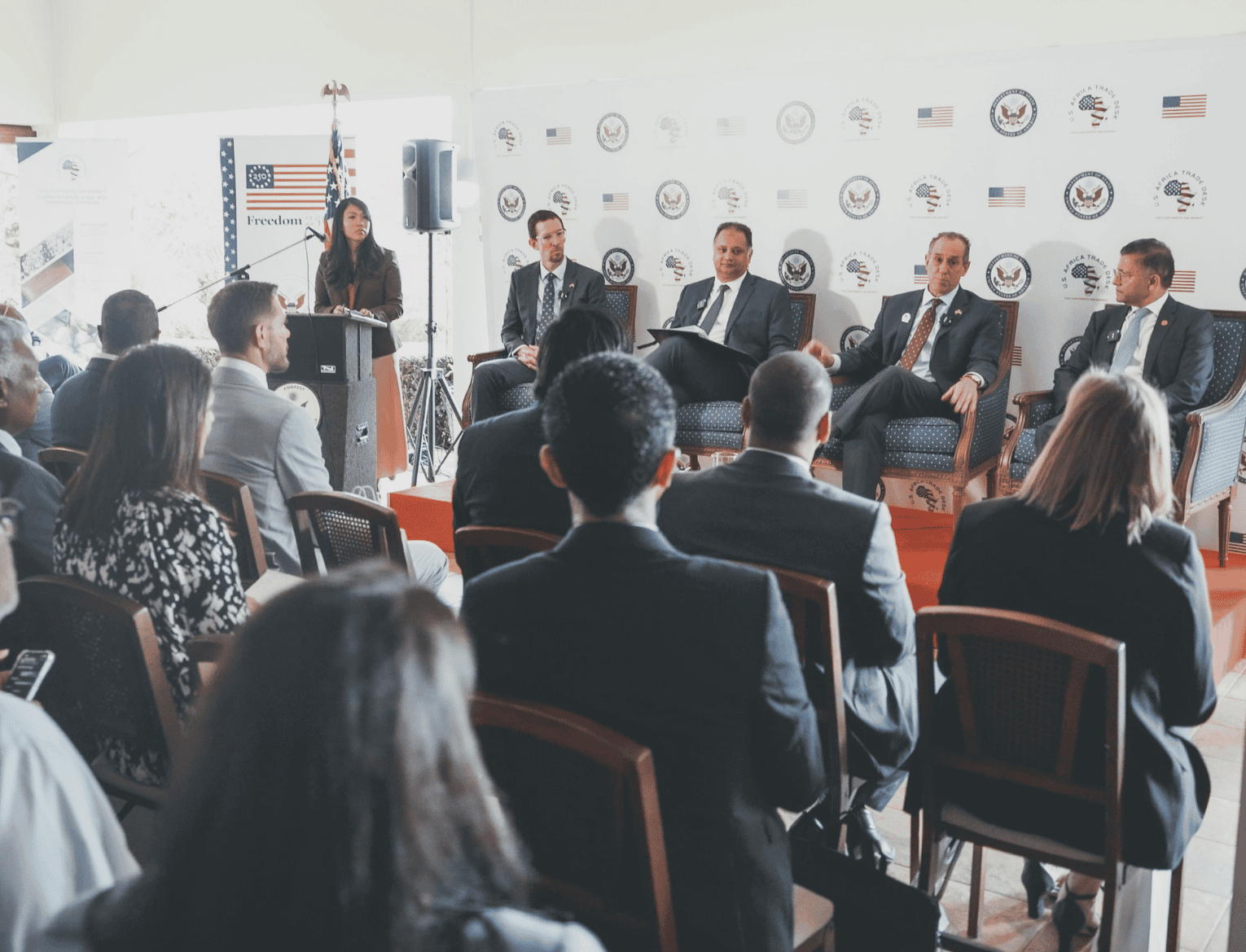
An expert panel discussion co-hosted by the U.S. Embassy and the U.S.-Africa Trade Desk on March 4 brought together sector leaders and trade specialists to examine the evolving trade relationship between the United States and Africa. The exchanges focused on the impact of AGOA, the role of Mauritius as a gateway for investment, and trade with the African continent, and the future of supply chains in a changing global economic environment.

A panel discussion was co-hosted by the U.S. Embassy and the U.S.–Africa Trade Desk on Wednesday, March 4, where they examined the future of U.S.–Africa trade relations, Mauritius’s role as a regional gateway and the challenges facing global supply chains. The event brought together U.S. Embassy Chargé d’Affaires Craig Halbmaier, Minister of Industry, SMEs and Cooperatives Aadil Ameer Meea, U.S.–Africa Trade Desk Vice President for Trade William Fanjoy, and ABSA Bank Mauritius Managing Director Ravin Dajee, who discussed how governments, financial institutions and the private sector can strengthen economic cooperation between the United States, Mauritius and African markets.

Building stronger bilateral economic ties

Opening the discussion, Craig Halbmaier highlighted the evolution of economic relations between Mauritius and the United States, and the institutional frameworks supporting this cooperation. He recalled that the two countries signed a Trade and Investment Framework Agreement (TIFA) in 2006, which has served as a platform for dialogue on trade and investment matters. “More recently, in the past few years, we have really been trying to turbocharge the relationship,” said Halbmaier.

He noted that initiatives such as the 2024 U.S.–Mauritius Business Summit have contributed to strengthening business links and attracting American companies interested in opportunities in Mauritius and the region. “We are seeing more and more American businesses coming here for opportunities for trade and investment.


“Companies do not want their supply coming from one location or one country.”


Trade missions and sector-focused events organised across markets such as South Africa, Dubai and the United States have also helped expand cooperation in sectors including food, technology and energy. The Chargé d’Affaires also pointed to the upcoming U.S.–Africa Business Summit, which Mauritius will host in July, as an important milestone in advancing commercial relations. “This will be a great opportunity to bring even more senior U.S. delegations here and strengthen connections,” he explained. 

AGOA’s contribution to Mauritius’s export sector

Minister Aadil Ameer Meea emphasised the significant role played by the African Growth and Opportunity Act (AGOA), through the duty-free access to the U.S. market the preferential trade scheme has provided for Mauritian products, in the development of Mauritius’s export-oriented industries, adding that “the greatest beneficiary has been our textile and apparel sector.

Currently, 41 Mauritian enterprises export to the United States, employing approximately 21,000 workers, including around 10,000 women. Mauritius ranks among the top eight African exporters of apparel to the United States, supported by a vertically integrated industry that spans from spinning and fabric production to finished garments. Regional supply chains have also contributed to the sector’s development. Cotton sourced from countries such as Zambia can be processed and transformed into finished products within the region. 

Despite the benefits, the minister expressed concern about the limited duration of the latest AGOA renewal, stating that “the renewal for only one year creates business planning difficulties” as export orders are often placed several months in advance, making longer-term policy certainty essential for companies. 

To strengthen Mauritius’s competitiveness, the government is working on a new Industry Bill aimed at supporting industrialisation and improving export capacity, as “free trade agreements open doors, but industrial capacity allows you to walk through them.

Mauritius as a gateway to African markets

For William Fanjoy, Vice President for Trade at the U.S.–Africa Trade Desk – which acts as a matchmaker between U.S. suppliers and African buyers, facilitating trade transactions and building commercial networks – Mauritius represents an effective platform for companies seeking access to African markets. 

He noted that supply chain diversification has become a priority for companies, as “most of the time, they do not want their supply coming from one location or one country.” Mauritius, for example, is part of a broader regional production network that includes markets such as Madagascar, Lesotho and South Africa. 

For William Fanjoy, the success of trade initiatives often depends on the alignment between institutions, businesses and financial partners. “When you have the embassy, the ministry, the banks and the private sector working together, it creates the ecosystem needed for trade,” he explained. Collaboration and communication therefore remain essential. “There is no magic to this other than picking up the phone and talking to partners.” 

William Fanjoy went on to encourage African countries seeking to attract American investment to integrate into existing trade ecosystems and build trusted partnerships. “Become part of the ecosystem and we will connect you to the American companies.

“Mauritius banks help bridge the foreign exchange gap and facilitate trade transactions”

From the financial sector’s perspective, Ravin Dajee, Managing Director of ABSA Bank Mauritius, highlighted the strategic role played by Mauritius’s banking sector in facilitating trade and investment flows. Historically, Mauritius has served as a financial platform for international investment flows, particularly between India and global markets. As these dynamics evolve, banks are increasingly focusing on Africa. “Africa is clearly the next frontier,” he said. 

Mauritian banks indeed provide trade finance instruments such as letters of credit, foreign exchange solutions and financing mechanisms for companies operating across multiple African markets. 

Ravin Dajee also emphasised that the country’s investment-grade status enables banks to confirm letters of credit issued by banks in other African countries, thereby supporting regional trade. However, expanding cross-border trade also requires careful management of regulatory and financial risks. “Trust, governance and integrity in the process are essential to support sustainable trade,” he explained, adding that “Blockchain and digital technologies could make supply chains more efficient and transparent.” 

Competing in a changing global environment

Craig Halbmaier also addressed the broader geopolitical context of investment in Africa, noting that the United States seeks to promote open and transparent business practices. “We seek a level playing field and open competition,” he added. He also stressed that “when U.S. companies invest abroad, they employ local workers, transfer skills and strengthen local economies.

The U.S.–Africa Business Summit: “A deal-making platform”

Mauritius is now preparing to host the U.S.–Africa Business Summit in July, an event expected to attract approximately 3,000 participants. The previous summit held in Angola generated around $4 billion in deals and commitments. “This is a deal-making platform,” said the minister of Industry. 

Mauritius therefore fully intends to use the summit – which will focus on sectors such as renewable energy, artificial intelligence, digitalisation, manufacturing and innovative finance, while encouraging deeper integration into global value chains – to strengthen its position as a gateway for trade, investment and financial flows into Africa.

Skip to content