Back to Bizweek
SEARCH AND PRESS ENTER
Latest News

It is paradoxical to see foreign footballers on our billboards while our own geniuses remain in the shadows

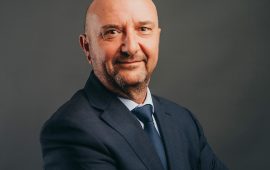
Gavin Poonoosamy, Founder & General Manager, Mama Jaz

Since the beginning of this month, the 11th edition of Mama Jaz has been resonating with Mauritians and the Mauritian diaspora. In this interview, Gavin Poonoosamy, its Founder & General Manager, speaks about the influence of the festival, which aims to create genuine social cohesion and reveal Mauritian talents. Although Mama Jaz stands as a beautiful showcase for the Mauritian destination, Gavin Poonoosamy believes that the synergy between the public and private sectors in the entertainment industry remains timid.

Shareenah Kalla

Today, Mama Jaz is an unmissable musical event. Tell us about the genesis of this project.

It all began in April 2016, with a first edition lasting one week. The idea was born during a conversation I had at the time with a friend, Jerry Léonide. He is a Mauritian pianist, a true virtuoso, who was based in France and touring extensively across Asia, the United States, and Europe. At that moment, he had been invited to Réunion and, since we had already collaborated, he suggested we set up a project for April 30, which was International Jazz Day.

In 2015, I was going through a somewhat complicated period, but at the same time, there was incredible energy in Mauritius. Festivals were blossoming everywhere: Porlwi, Festival Kreol, The Bridge, Kaz’Out, Dombeya, Eurêka Jam, Nou Le Morne, Reggae Donn Sa, Blues dans Jazz and the Ernest Wiehe Jazz Festival… It was total effervescence!


“We want to put humans back at the center, to value what people can create themselves.”


Looking at the calendar, I noticed that most events were concentrated between July and December. So, I chose April, the beginning of the austral winter, to provide a counterbalance and propose something calmer, more serene.

Since that first week in 2016, we have grown. In 2017, the festival expanded to a full month. The following year, the brand identity became more refined. We started working in a more targeted way, with fewer actions but greater quality, strengthening our ties with television and radio.

Mama Jaz is also one of the first musical concepts to embrace the digital shift… 

Indeed. 2020, with the first lockdown, was a real shock and an opportunity to turn towards the digital path. Deprived of live concerts, we had to reinvent ourselves to continue existing. Mama Jaz is somewhat like a cultural organ that contributes to the country’s immunity; we had to play our part. That’s when our audience exploded: we went from 10,000 people in one month to 900,000 thanks to digital.


“Our ambition is to create a true long-term strategic synergy to attract audiences from around the world, starting with our regional markets such as Réunion, South Africa, China, or India.”


In 2021, we reached listeners in about 70 countries, whether from the diaspora or tourists. Today, we are at our 11th edition. Mama Jaz is proud to be the only festival labelled “Made in Moris.” The festival has been inducted into the Hall of Fame of the Mauritius Research and Innovation Council. Mama Jaz is even recognized by the Ministry of Tourism for its cultural innovation.

Although the word “Jazz” is in our name, our vision is broader. We focus on creation, atypical improvisation, and pure performance. The goal is not to do a technical demonstration, but to galvanize the audience, to share vital energy.

Tell us more about this year’s edition, which has already set things ablaze since the beginning of the month. 

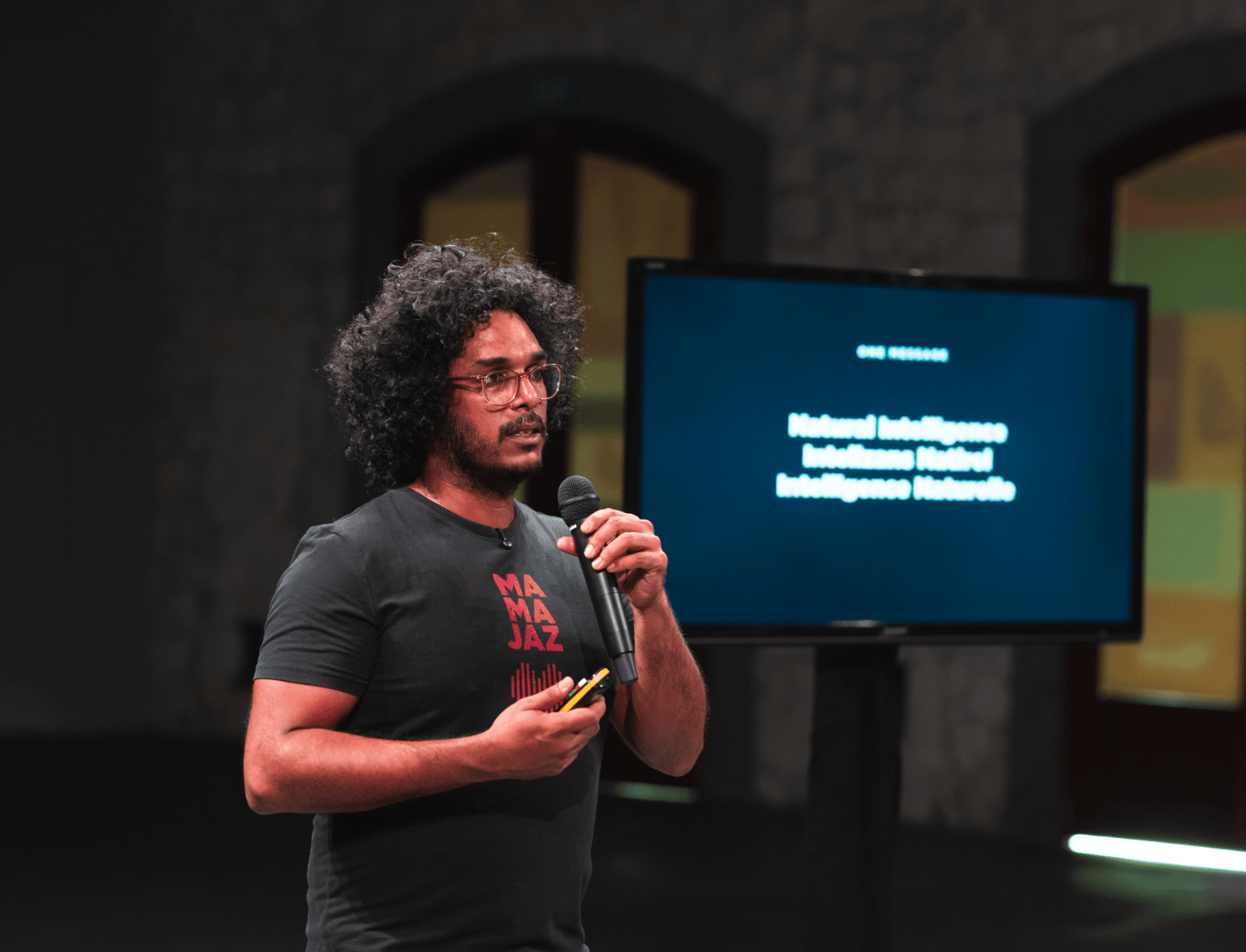
This year, our slogan is “Natural Intelligence.” It’s a nod to AI (Artificial Intelligence). For us, AI must remain a tool. We must not get lost in it, or let “autocorrect” end up dictating our thoughts. At Mama Jaz, we prioritize the organic, the human, and spontaneity.

Does AI not mix well with the musical world of Mama Jaz? 

It is essential to maintain autonomy and independence in relation to technological tools. Artificial Intelligence must be demystified. We often have either too romantic or too abstract a vision of it. For us within the festival, the goal is to remind everyone that everyone possesses their own strength, their own “natural intelligence.

While technological advances are tremendous opportunities, we also see drifts in music. For example, some use AI in ways that lose all connection with the instrument or musical execution. The machine is left to do everything, from writing lyrics to composing.

That form of expression does not interest us. We want to put humans back at the center, to value what people can create themselves. It is this message of self-confidence that we want to carry loud and clear.

Is Mama Jaz a profitable festival? 

When we talk about investment, we don’t look at Mama Jaz on a single edition, but over the long term. We speak of a vision spanning 100 years. Indeed, we are building a legacy that goes beyond the framework of an annual event.

We oscillate between prosperous years and more complex periods. For example, last year, for the 10th edition, our turnover was around 4 million rupees, while this year we are aiming for 2.5 million.

We adapt our investments to the social and economic context. In a climate of austerity or global instability, we remain cautious and harmonious. We are not in an aggressive marketing or advertising blitz. Our approach is more intellectual and musical; we want people to come to us out of conviction, not commercial pressure.

Your objective is to create social cohesion? 

Mama Jaz is also a multitude of formats to reach everyone. Mama Jaz unfolds in one-minute capsules on social networks and national television (MBC), where artists share humanist and solidarity messages. There is the grand concert format with moments of pure creation, often captured by national television to give maximum visibility to artists who do not always have their place in the Mauritian mainstream.

There is Mama Jaz at EDITH. It’s a mini “food festival” with good music, designed for families, where live and rare performances are highlighted. Then there is International Jazz Day, celebrated on April 30. Since 2016, we have orchestrated dozens of actions for this day. This year, we emphasize “Conscious DJing.” Our role is also to guide the public: wherever you are in Mauritius, we offer a “prescription” of live and authentic events. We support all forms of jazz, from standards to covers, but our heart beats for original creation.

What challenges does the creative and entertainment industry face in Mauritius? 

The question to ask is: does a real entertainment industry exist in Mauritius? It’s a complex question. Looking at access to information, a few years ago, about 12% of the population consumed the written press. This figure has dropped to 8%. On the other hand, with digital (WhatsApp and social networks), nearly 700,000 Mauritians are now connected to information.

The challenge, today, is no longer just access, but the validity and quality of information. In this constant flow, Mama Jaz positions itself as a benchmark of quality, authenticity, and the valorisation of human creative genius.

Does this industry receive enough support from the government? 

The relationship with state institutions remains complex and lacks systematization. While the National Arts Fund has been present in the past, public support is not sustainable. It often depends on the decision-makers in place and their ability to navigate parameters that are sometimes very political.

Despite the existence of various foreign cultural centers in Mauritius, there is a lack of a true “Mauritian Cultural Center” driven by strong political will to promote Mauritian identity. It is paradoxical to see foreign footballers on our billboards while our own geniuses remain in the shadows. What models are we offering our children?

Despite these obstacles, our approach remains guided by kindness and acceptance of social reality as it is. If we are condemned to remain a form of avant-garde, we accept it, as long as we continue to exist and create. We aspire to maximum solidarity, while respecting the diversity of tastes and current trends.

What we do is not only for Mauritius; it is an artistic contribution to the whole world. Our artists are incredible; they simply need working conditions and a social framework that facilitate their fulfillment.

Can Mama Jaz be considered a showcase for the Mauritian destination? 

We actively work with tourism authorities such as the MTPA and the Ministry of Tourism to make Mama Jaz a lever of attractiveness. Our ambition is to create a true long-term strategic synergy to attract audiences from around the world, starting with our regional markets such as Réunion, South Africa, China, or India.

I regret that there is not yet this continuous harmony between the State and cultural operators. There is a distance that hinders the development of a coherent communication policy for Destination Mauritius.

Thus, Mama Jaz is situated at the intersection of the private and public sectors. While we benefit from State support, it is not systematic and the process often remains laborious and complex.

Nevertheless, we maintain good relations with institutions. For example, the Police and Masa show flexibility and understanding in the face of the scale of a festival that lasts a month. The municipality of Port-Louis will support us in the near future, notably for logistics and signage. The MTPA and the Ministry of Arts and Culture show great energy, even if the context remains difficult, especially in the face of competition from destinations like Dubai, which capture part of the tourist flow.

Skip to content