Back to Bizweek
SEARCH AND PRESS ENTER
Latest News

“India is supporting the MGI in digitising its Indian Immigration Archives”

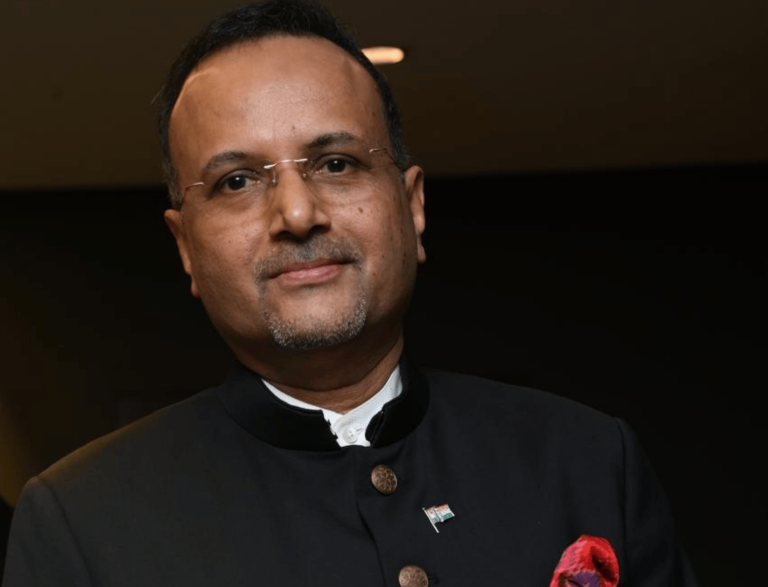
Anurag Srivastava | High Commissioner of India to Mauritius

At the 192nd anniversary of the arrival of Indian indentured labourers in Mauritius, High Commissioner Anurag Srivastava announced that Kolkata will host the 19th Pravasi Bharatiya Divas Convention in January 2027. His address at Aapravasi Ghat placed historical memory, cultural preservation and the engagement of younger generations at the heart of the enduring relationship between India and Mauritius.

Nearly two centuries after the first Indian indentured labourers disembarked on Mauritian shores, the steps of Aapravasi Ghat remain a powerful reminder of a journey that shaped the island’s economic, social and political destiny. Today (Monday 2nd November), India’s High Commissioner to Mauritius, Anurag Srivastava, returned to this historic site with a message that extended beyond commemoration: the legacy of indenture must be preserved, understood and transmitted to future generations.

Addressing the gathering on Aapravasi Day, which marked the 192nd anniversary of the arrival of indentured labourers in Mauritius, the Indian High Commissioner paid tribute to the resilience of those who crossed the Indian Ocean under difficult circumstances and whose descendants would become central to the development of modern Mauritius.


“This Ghat is therefore not only a monument to arrival. It is a monument to endurance.”


On 2 November 1834, the Atlas brought 36 Indian indentured labourers to the island. Hundreds of thousands followed over the subsequent decades, carrying with them languages, religious traditions, cultural practices and values that would gradually become embedded in Mauritian society.

For the High Commissioner, Aapravasi Ghat represents considerably more than the physical point of arrival of those early migrants. “This Ghat is therefore not only a monument to arrival. It is a monument to endurance.”

That endurance, he suggested, would ultimately become one of the defining forces behind the country’s transformation.

From the sugar fields to a diversified economy

He drew a direct connection between the sacrifices of indentured labourers and the economic foundations of contemporary Mauritius.

Their contribution, he observed, extended from the clearing of cane fields and the development of the sugar economy to the acquisition of small plots of land, the establishment of villages and the construction of schools, temples, mosques and community institutions.

These achievements were not confined to economic activity. Descendants of indentured labourers also participated, alongside other Mauritians, in the struggle for political representation, dignity and independence.

Anurag Srivastava situated this historical contribution within the broader evolution of Mauritius, from an economy dependent on sugar to one increasingly diversified into textiles, tourism, financial services and emerging sectors such as the digital and blue economies.

He also highlighted the enduring importance of education, thrift, family solidarity and community values, describing them as principles that helped shape the country’s development.

The address thus presented the history of indenture not simply as an account of hardship, but as a narrative of economic participation, social mobility and nation-building.

Preserving memory in the digital age

One of the most substantive elements of the High Commissioner’s speech concerned efforts to safeguard the historical records of Indian immigration and make them more accessible to Mauritian families.

India, he announced, is supporting the Mahatma Gandhi Institute in digitising its Indian Immigration Archives, with the objective of facilitating genealogical research and enabling families to trace their ancestral origins.

The initiative is accompanied by support for an oral history project designed to record the recollections of older generations before their experiences and memories disappear.

These projects reflect a wider recognition that historical preservation increasingly requires more than the conservation of physical monuments and documents. Digital accessibility and the recording of personal testimonies can play an important role in connecting younger generations with a past they may otherwise regard as distant.

The High Commissioner commended the work of the Aapravasi Ghat Trust Fund, the Mahatma Gandhi Institute, the Folk Museum of Indian Immigration, scholars and community organisations engaged in recovering and documenting the history of indenture.

He also underlined the importance of safeguarding living cultural traditions, including Geet-Gawai, Bhojpuri and other ancestral languages and practices.

For him, cultural transmission remains inseparable from historical remembrance. The preservation of songs, festivals and community traditions, he argued, allows the experience of earlier generations to remain part of contemporary Mauritian life.

Mauritius and the global history of indenture

The Indian High Commissioner also placed Mauritius within a wider international historical context. The system of indentured labour, often associated with the nineteenth-century “Great Experiment”, had consequences extending far beyond the island. Indian labourers subsequently travelled to destinations including Fiji, Trinidad, Guyana, Suriname and South Africa.

Mauritius therefore occupies a significant position in a history that connects communities across several continents. By highlighting this global dimension, Srivastava presented the preservation of the island’s indenture heritage as a responsibility extending beyond national borders.

The message was particularly relevant to younger Mauritians, whom he encouraged to recognise the relationship between their ancestors’ experiences and the opportunities available to them today.

“The courage and resilience of the Aapravasi is an inheritance. Like every inheritance, it must be passed on, or it is lost.”

Kolkata 2027: reconnecting descendants with the point of departure

The principal forward-looking announcement of the address concerned the 19th Pravasi Bharatiya Divas Convention, scheduled to take place in Kolkata from 7 to 9 January 2027. The gathering is one of India’s flagship initiatives for strengthening its relationship with communities of Indian origin around the world.

The choice of Kolkata carries particular historical significance for Mauritius. Formerly known as Calcutta, the city served as a major departure point for Indian indentured labourers travelling to the island during the nineteenth century.

Almost two centuries later, their descendants are being invited to return to the city not as migrants embarking on an uncertain journey, but as participants in an international gathering celebrating the achievements and connections of the Indian diaspora.

Anurag Srivastava encouraged strong Mauritian participation, particularly among younger generations, and indicated that the Indian High Commission would assist prospective delegates with registration and related arrangements.

The convention, traditionally associated with 9 January, also commemorates Mahatma Gandhi’s return to India from South Africa in 1915.

Strengthening ties with younger generations

Beyond the Kolkata convention, the High Commissioner outlined several initiatives intended to sustain connections between India and the descendants of Indian migrants. Among them is the Overseas Citizenship of India (OCI) scheme, under which Mauritius benefits from a special provision extending eligibility to people of Indian origin up to the seventh generation, subject to applicable requirements.

He also highlighted the Know India Programme, which allows young members of the diaspora to experience India’s history, institutions and contemporary development first-hand. Educational opportunities, including the Scholarship Programme for Diaspora Children and scholarships offered through the Indian Council for Cultural Relations, form another component of this engagement.

Taken together, these initiatives demonstrate how New Delhi is seeking to maintain its historical relationship with overseas communities through education, cultural exchange and institutional connections.

For Mauritius, they also offer opportunities to strengthen people-to-people relations with India at a time when the bilateral relationship extends across an increasingly broad range of economic and strategic sectors.

A shared past, a responsibility for the future

The broader message was that the economic and social achievements of modern Mauritius cannot be separated from the experiences of the generations that helped build it.

In concluding his address, Anurag Srivastava called for a renewed commitment to remembering those who climbed the steps of Aapravasi Ghat, sharing their stories with children and carrying forward the bonds between India and Mauritius.

For an island whose development has been shaped by migration, cultural exchange and the contributions of successive generations, the challenge is not simply to honour the past, but to ensure that its lessons continue to inform the future

Skip to content