Back to Bizweek
SEARCH AND PRESS ENTER
Latest News

“Imported labour is a stopgap, not a long-term strategy”

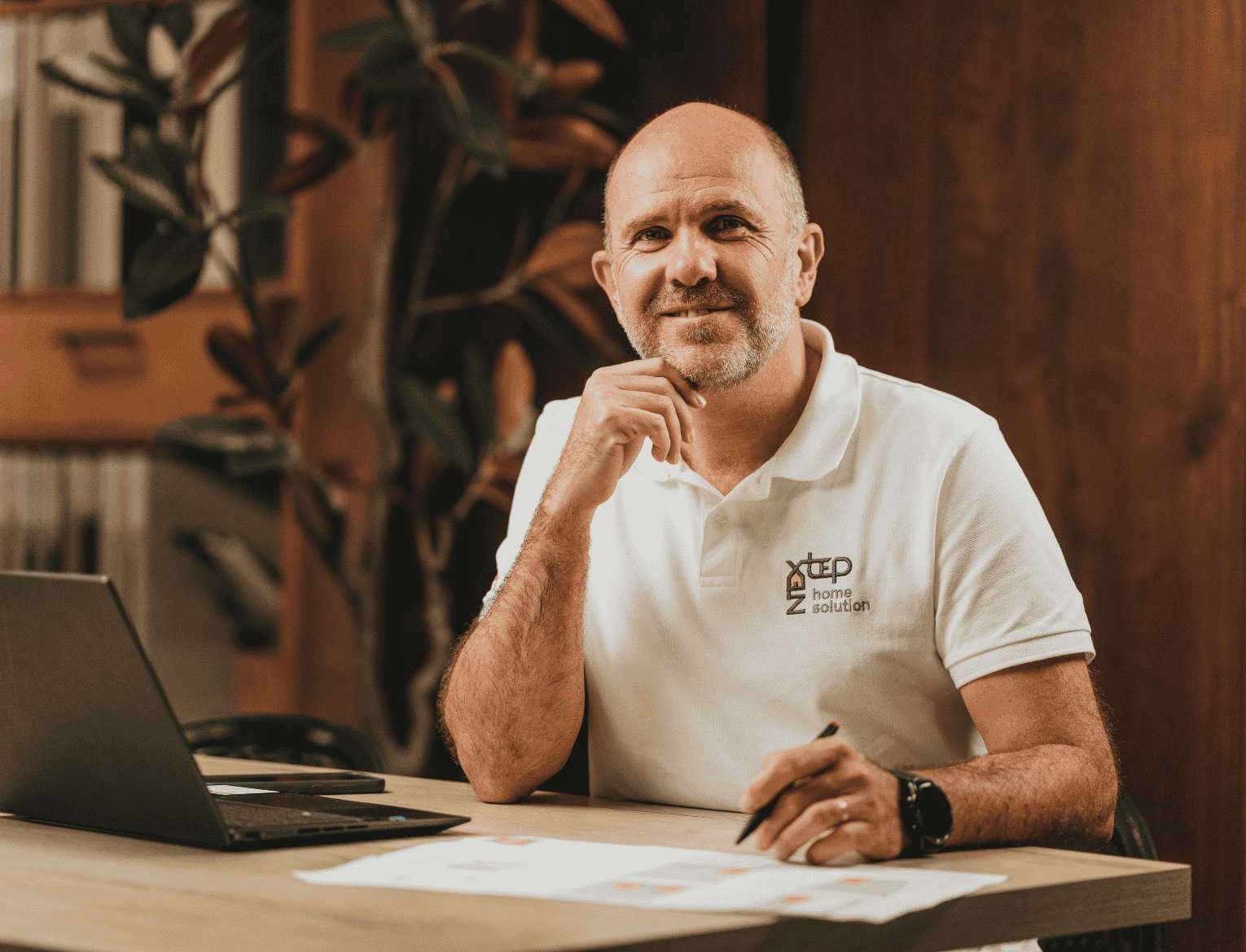
JOHN PIERREZ, GENERAL MANAGER OF NEXTEP

The construction sector is currently going through a phase of adjustment rather than a crisis, according to John Pierrez, General Manager of Nextep. The company has weathered the slowdown through diversification, while expanding into renovation, solar energy and other home solutions. Pierrez also highlights the challenges facing the industry, particularly rising costs and labour shortages. While the sector remains dependent on foreign workers, he argues that imported labour can only be a temporary solution.

Economists say the industry is currently going through a correction after the post-Covid boom. What is your assessment?

I agree, and I would go further. This correction was overdue and, frankly, healthy. 

Between 2022 and 2024, the sector grew at rates exceeding 6% in some quarters, a pace that was difficult to sustain once the post-Covid catch-up effect faded. National growth has already eased from close to 7% to around 3%, and construction contracted by roughly 4.3% in early 2025 following a 6.3% jump the previous quarter. That represents a market rebalancing rather than a collapse. Companies that built their entire model on volume from that initial boom are the ones feeling the pressure today. Nextep’s non-captive revenue has continued to grow throughout this period because we shifted early towards higher-value bundled services rather than chasing raw project volume.

How much additional pressure is the conflict in the Middle East putting on the construction sector?

It is a real headwind, though it acts as an amplifier rather than the root cause. Almost everything we import transits through shipping lanes affected by the conflict, meaning freight costs and insurance premiums have faced upward pressure, while lead times have lengthened. On top of a domestic market that was already normalising, that adds an extra layer of complexity. However, I would caution against using geopolitics as the primary explanation for a slowdown that has clear local roots, including rising interest rates, the end of Home Ownership support, and tighter household budgets.


“The slowdown has clear local roots, including rising interest rates, the end of Home Ownership support, and tighter household budgets.”


Material prices are also rising, with Statistics Mauritius projecting an increase of 6% per year. How is this affecting companies operating in the construction sector?

It compresses margins fastest for anyone who quoted a project six or twelve months prior to delivery. The gap between the price promised and the cost to supply represents real capital, and smaller, less resilient contractors absorb the brunt of it. It also changes buying behaviour. We now index more of our quotes, purchase further ahead where cash flow permits, and negotiate volume terms much more assertively than we did three years ago. Put simply, 6% annual material inflation rewards companies with buying power and financial discipline, while creating significant challenges for those operating without them. That consolidation is already becoming visible in the market.

The sector remains heavily dependent on foreign workers. Is this sustainable in the longer term?

It is a simple fact rather than an opinion. Around 80% of work and occupation permit growth over the past two years has gone to manufacturing and construction, with permit numbers rising by more than a quarter since 2023. I understand the rationale. There is a genuine skills gap, and as the local economy expands, young Mauritians are naturally drawn towards new service and tech-driven careers. Nevertheless, building a sector’s medium-term capacity primarily on imported labour is a stopgap, not a long-term strategy. At Nextep, we rely on skilled trade labour where necessary, but we deliberately invest more of our hiring and training budget into high-value roles where local talent can truly differentiate us, particularly in design, technical execution, and project management.


“We need a much stronger vocational and technical training pipeline, akin to the dual apprenticeship model used in Germany, built in direct partnership with industry.”


At the same time, others argue that the future of the sector still depends on Mauritian workers, but they need to be trained in new technologies. What is your view?

I fully agree, and the data speaks for itself. Youth unemployment stands at around 17% while the sector remains short of skilled hands. That points to a skills mismatch rather than a sheer labour shortage, and it is entirely fixable. We need a much stronger vocational and technical training pipeline, akin to the dual apprenticeship model used in Germany, built in direct partnership with industry. Nextep already runs on-the-job– training for installation and fit-out teams. The missing piece is a coordinated, sector-wide effort to elevate technical trades, such as tiling, cabinetry, and solar installation, and position them as attractive, modern career pathways.

How have these challenges affected Nextep specifically?

Like everyone in the sector, we feel higher input costs and a softer overall market. What has protected us is diversification, and the numbers back that up. Our non-captive revenue nearly tripled in two years, across the precise period the wider construction sector was contracting. That growth did not come from riding big new-build projects. It stemmed from shifting our mix towards bundled interior fit-out and renovation work, alongside launching new categories such as solar photovoltaics and individual wastewater treatment plants. The clear lesson for the sector is that companies structured around a single, project-driven revenue stream are currently the most exposed.

Could the sector’s next growth driver come less from large construction projects and more from B2C and renovation work?

It is entirely plausible, and in fact, it is already happening. Our own figures show it clearly. Fit-out and interior packages now account for nearly three-quarters of our non-captive revenue, whereas large one-off project business has become far more volatile, where a single contract can swing that line from several million rupees to almost nothing the following year. Renovation and B2C work involve smaller transactions, but it is steadier, less exposed to financing cycles, and driven by demand that exists regardless of whether a handful of large developments break ground this year or next.

How has the demand in the Mauritian market changed?

First, clients want smaller, faster, higher-quality renovation projects rather than large new builds. They are looking for a kitchen, a bathroom, or a full interior refresh delivered as a single turnkey package, rather than having to coordinate a dozen separate trades themselves. Second, there is genuine interest in efficient, sustainable homes, not as a luxury statement, but as a practical way to control long-term running costs when household budgets are under pressure.


“What has protected us is diversification, and the numbers back that up.”


Could sustainable or green construction become a new growth driver for the sector?

Sustainable materials and energy solutions represent a genuine, growing segment, offering a path to higher-margin, differentiated work at a time when commodity categories like basic tiling face severe price pressure. However, green construction only aids sector recovery if it is priced for the mainstream Mauritian household, rather than positioned purely as a premium, developer-only proposition.

You operate in coatings, renovation, and offer ecological products. Is there really a market for this in Mauritius?

Yes, and our performance proves it. Through Nextep Eco-Solution, we launched a complete solar photovoltaic offer in July 2025, and it has already generated a meaningful   revenue in its very first year. We also introduced the WPL Diamond DMS micro-wastewater treatment plant last June. That said, to be entirely transparent, eco-solutions still represent a modest share of total renovation spending today. The realistic growth trajectory for ecological products in Mauritius spans three to five years rather than happening overnight, and it hinges on keeping entry prices accessible instead of chasing only the luxury segment.


“Construction’s adjustment is a necessary correction within that broader picture, not a sign of systemic crisis.”


How has Nextep adapted its strategy to changing needs in the Mauritian market?

Deliberately so. We have evolved from being materials suppliers into a comprehensive home-solutions partner. Every addition was a direct response to actual shifts in Mauritian demand, specifically towards renovation, bundled turnkey delivery, and sustainability that delivers a clear return on investment.

With our solar photovoltaic range, for example, we focus heavily on democratisation and tailored energy efficiency. We conduct a precise energy audit over seven days at the client’s premises, using specialised monitoring tools to analyse consumption patterns before designing a customised system.

Similarly, to address the needs of homes in unsewered areas or during drought periods, our micro-treatment unit treats up to 97% of domestic wastewater, allowing it to be reused for non-potable purposes such as irrigation. It is compact, delivered and installed within a single day, requires no reinforced concrete slab, and comes with a 25-year structural warranty. That is how we respond to real market demands: by offering durable, easy-to-maintain solutions that make economic sense.

There is, however, a paradox: the cost of living is rising, household budgets are under pressure. So how do you explain the continued demand for interior renovation?

When budgets are tight, renovating an existing home is often far more economical than buying or building new. Pressure on household budgets therefore redirects demand towards renovation rather than eliminating it altogether. A well-targeted kitchen or bathroom renovation is increasingly viewed as a value-preserving investment rather than a discretionary luxury. Furthermore, at the higher end of the market, demand is driven more by diaspora and investor capital than local household budgets, which insulates a portion of our business from domestic cost-of-living pressures.

The Home Ownership Scheme provided support to the property market. What impact is its withdrawal having on the construction sector?

The scheme genuinely helped first-time buyers step onto the property ladder, and its phase-out, alongside other buyer support mechanisms, naturally creates a temporary adjustment for entry-level new builds. I fully appreciate that fiscal support frameworks evolve over time to reflect changing economic priorities. From our perspective, the renovation and interior fit-out segment remains less directly exposed than new developments. Looking ahead, there is certainly scope for collaborative, targeted incentives, perhaps focused on energy efficiency and home modernisation, that benefit both first-time homeowners and the broader market.

Broadly speaking, how do you see the Mauritian economy at the moment?

Fundamentally resilient, but normalising to a lower, more sustainable pace after two exceptional years. Unemployment sits at a two-decade low, inflation is contained around 3.5% to 3.7%, and key services including tourism, financial services, and ICT remain strong. Construction’s adjustment is a necessary correction within that broader picture, not a sign of systemic crisis. The real medium-term challenges are structural, namely high public debt, an ageing population, and the funding required for climate resilience. None of these issues are unique to Mauritius, but they do mean the next phase of growth must be driven more by productivity and less by the investment surges seen between 2022 and 2024.

Is Nextep looking towards the region?

I see regional expansion as the natural next step once a business model has been proven locally. We have built solid momentum in a short period, and Mauritius’s position in the Indian Ocean, with its strong trade and cultural links to Réunion, Madagascar and the wider East African coast, makes regional growth a logical next step for us. It mirrors how other established Mauritian players have expanded across the region. We are approaching this opportunity deliberately and in measured phases, but it is firmly on our strategic roadmap.

Skip to content