Back to Bizweek
SEARCH AND PRESS ENTER
Latest News

How Mauritius could move from a USD 17 billion towards a USD 100 billion economy

Panel discussion 

  • “We have reacted, but probably a little bit too late or a little bit not enough” – Shamima Mallam-Hassam, former Chairperson of Mauritius Finance. 


  • “A cable from Mauritius to Singapore or Malaysia could cost roughly USD 100 million to USD 150 million. That figure should be viewed against the larger ambition of moving the economy towards USD 100 billion” – Marcelo Aleman, CEO of Emtel Ltd.

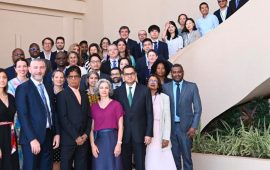
The Indian Business Council Mauritius organised a panel discussion titled “The War in the Middle East – Its Impact on Mauritius” on 29 April 2026, at Hennessy Park Hotel. Moderated by Kamal Hawabhay, Managing Director of GWMS Ltd, the panel – composed of Daniel Essoo, CEO of the Mauritius Bankers Association; Shamima Mallam-Hassam, former Chairperson of Mauritius Finance; Prof. Kiran Bhujun, Director of Tertiary Education and Scientific Research; and Marcelo Aleman, CEO of Emtel Ltd – examined how the war in the Middle East could affect Mauritius and whether the country can turn global disruption into opportunities for capital flows, business relocation, education, talent mobility and digital investment.


Kamal Hawabhay introduced the discussion by placing it at what he described as “a very critical moment in the world” and in the “destiny of Mauritius.” The purpose of the panel, he said, was to discuss in practical terms the specific implications of the conflict for the country. 

The discussion evolved around three broad themes. The first was to identify early signals and opportunities. The second was to examine the measures already introduced in Mauritius to facilitate movement, relocation and business activity. The third was to draw practical takeaways for investors, businesses, families, education institutions and technology partners. 

Early signals and opportunities


Kamal Hawabhay began the first round by asking whether there was already a real movement linked to the war in the Middle East. He said that whenever there is a war or a similar event, movement often follows: movement of people, movement of capital, movement of businesses and movement of operations. The central question, he said, was whether Mauritius was already seeing signs of such movement. If there was increased interest, he wanted to know where it was coming from, which sectors were involved, and what could happen next. 


“What has more value than oil nowadays? Data, and how information moves. And the world is connected, not through satellites, but through sub-sea cables.”


Shamima Mallam-Hassam: “The global financial system is being reshaped”


Shamima Mallam-Hassam began by saying that the world is no longer operating in a normal or stable order. From a global financial system perspective, she said, the issue is not only that the system is evolving; it is being reshaped. She placed the war in the Middle East within a wider context of global disruption. In her view, that war, the US-China dynamic and the war in Ukraine are not temporary events. They are changing the way business is being done and redefining where and how capital flows.


Supply chains, she argued, have already experienced major disruption. As a result, investors and businesses are now asking which jurisdictions can be trusted and which can intermediate capital safely. For Mauritius, she said, this creates a question of positioning: where does the country stand in this new environment?


The former Chairperson of Mauritius Finance argued that Mauritius has a strong value proposition, but that it suffers from a lack of visibility. When tensions began in the Middle East, she said, international discussion quickly turned towards Singapore and Hong Kong. More recently, GIFT City, in India, also came into the conversation. Mauritius, however, was not immediately part of that international reflex.


“When you look at what Mauritius has in terms of our offering, I think we have a very strong value proposition. Why has that not come to the mind of the people?” she asked.  


Shamima Mallam-Hassam indeed argued that Mauritius has several attributes that should matter in the present environment. It is geographically distant from tension zones and war zones, and it has rule of law, a regulatory framework, and a financial services industry that has been tried and tested for more than 30 years. 


The Mauritian brand is still that of a high-end “pretty tourist destination,” which is a major part of the challenge.


She explained that Mauritius has often been seen as a safe jurisdiction, but that safety has not always been emphasised in the country’s promotional campaigns. 


However, safety and stability alone are not enough. In times of uncertainty, businesses and investors also look at the speed and scale at which a jurisdiction can react. On that point, she felt that Mauritius had also fallen short.


“We have reacted, but probably a little bit too late or a little bit not enough. I still feel that there is opportunity, but we need to be more visible, and we need to be present.”


Daniel Essoo: “Deposits and people have already moved towards Mauritius”


Kamal Hawabhay then turned to Daniel Essoo, as banks are where capital flows become visible. He asked whether, from the banking industry’s perspective, there were any early signs of capital movement, regional enquiries or business interest that were not present a year earlier.


Daniel Essoo explained that the banking sector was indeed seeing movement. Before addressing financial flows, he gave two personal examples to illustrate the human side of the shift.

He said that about a month earlier, in a local supermarket in Mauritius, he met someone who had been in Dubai setting up an asset management business. That person told him that after the situation happened, he flew straight back to Mauritius. In the same supermarket, he then met a friend who had been heading a financial institution in the UAE, and who had returned to Mauritius three days earlier, with his family, after a frightening experience at the airport.


For the CEO of the Mauritius Bankers Association, these examples showed that the movement is not only about financial assets. It is also about people, families and personal safety. 


On financial flows, he said that soon after the conflict began, the Mauritius Bankers Association contacted member banks to assess both risks and opportunities. Several banks reported that deposits had moved towards Mauritius, which supported the idea that the island is seen as a safe haven jurisdiction. 


He talked of two waves. The first wave is made up of people who have come to Mauritius to wait for the troubles to pass, while still running their operations from here. The second is made up of people who are now considering moving funds or putting in place a plan B for their operations.


Daneil Essoo said that some may initially have thought the conflict would be short-term or localised. But because there are no clear signs of termination or resolution, businesses in affected territories are now beginning to consider what they should do if the situation lasts.

From the banking sector’s perspective, he said Mauritian banks have a strong reputation for transactional support. Member banks are receiving queries about the business environment in Mauritius and about how banks can accommodate business developments.


He also commended the authorities for measures introduced within weeks of the conflict. These included changes to the immigration regime, a concierge service, fast-track applications and some visas extended to two years to help people relocate.


“While we feel extremely sad about the situation and the disruption that it’s bringing, I think we must not be blind to the fact that Mauritius has things to offer for people looking for a safe alternative, and we are open for business,” he explained. 


Marcelo Aleman: “People do not automatically think of Mauritius as a business platform 


The discussion then moved to Marcelo Aleman. Kamal Hawabhay asked whether the CEO was hearing any signals from clients, partners or markets that Mauritius could become a digital base, operational base or stable alternative to other jurisdictions.


Marcelo Aleman said that although discussions were taking place, Singapore and Hong Kong tend to come first to mind because they are seen as ready, and because they are already positioned as business destinations. Mauritius, by contrast, is mostly associated, internationally, with tourism. The Mauritian brand, he added, is still that of a high-end “pretty tourist destination,” which is a major part of the challenge.

Singapore, for instance, although much smaller in size than Mauritius, has a GDP of more than USD 500 billion, compared with around a mere USD 17 billion for Mauritius. For the CEO of Emtel Ltd, the comparison shows the scale of the opportunity. For Mauritius to move 

from a USD 17 billion economy towards a USD 100 billion one, the country, he argued, already has one important ingredient, which is safety. Safety creates trust, and trust is essential for business. 


But that is only part of the equation. Another important ingredient is digital connectivity.

For Marcelo Aleman, when people look at what is happening around Iran and the Strait of Hormuz, they tend to think about logistics and oil flows. However, in his view, the more valuable resource today is data: “What has more value than oil nowadays? Data, and how information moves. And the world is connected, not through satellites, but through sub-sea cables.”


Many cables in the region, he explained, pass through sensitive areas such as the Strait of Hormuz, the Red Sea or along continental coastlines. Mauritius, he said, has only one safer cable route connecting it to Malaysia and India. If the country wants to position itself as a digital hub, it must therefore solve its connectivity issue, “which means more cables, more capacity.”


In his estimation, a cable from Mauritius to Singapore or Malaysia could cost roughly USD 100 million to USD 150 million. While that may seem expensive, he argued that the figure should be viewed against the larger ambition of moving the economy from USD 17 billion towards USD 100 billion.


If Mauritius has trust and connectivity, he said, it can become a base. Businesses could then relocate operations, real estate could shift from tourism-led development to business-led development, qualified workers could move to Mauritius, knowledge could spread, and new technologies could be adopted.


He referred to Singapore’s productive structure, including high-tech production, high-tech services, financial services and logistics, as an interesting model. Singapore also has a strong airport and port because it is close to a large and dynamic continent. Mauritius, he said, is at an earlier stage of that journey.


For Marcelo Aleman, even when the war ends, the mindset created by it could remain. Businesses may continue to think that such events can happen at any time. That, he said, gives Mauritius a unique opportunity to move quickly and position itself as a “Switzerland of data.”


Prof. Kiran Bhujun: “The higher education sector has been preparing for two years”


Kamal Hawabhay then turned to Prof. Kiran Bhujun, noting his international links with institutions and groups such as SADC, the African Union, OECD, the World Bank and other bodies. He asked whether international or educational institutions were considering Mauritius as a destination for operations, research or talent.


Professor Hawabhay explained that Mauritius has not seen “a plane full of people coming over,” in the last few years, but it has seen an increase in international students. Over the same period, Mauritian institutions have been sent abroad to market the country’s higher education offer, with the argument that Mauritius offers a safe and clean environment, blue skies, and a place where people can study, stay and continue working.


He also said that over the last two years, many international institutions had suddenly shown interest in working with the Mauritian higher education sector. He cited the Indian Institute of Management Sirmaur, which has a joint programme with the University of Mauritius and the University of Technology for an MBA in Hospitality and Tourism Management. He also mentioned the Indian Institute of Technology coming to Mauritius to carry out research.


The Professor also referred to the Addis Convention, which Mauritius ratified in 2019, for the recognition of qualifications within Africa. He said that this year, some countries started approaching Mauritius to activate the mechanism, so that their students could be recognised locally and sent here.


For Kamal Hawabhay, while the Middle East is one issue, Mauritius has been preparing for the past two years, and can now begin to benefit from that work. Still, he adds, signals are uneven across sectors, as Mauritius appears competitive in some, while others are still a work in progress.


Editor’s Note: Part II of the panel discussion will be featured in the next issue of Bizweek.

Skip to content