Back to Bizweek
SEARCH AND PRESS ENTER
Latest News
“EU Ambassador confident on the shift from linearity to circularity in Mauritius”

Circular Economy Roadmap and Action Plan

  • “Besides Government’s strong engagement, front-runners in the private sector are also very dedicated and already active, and this is reassuring,” EU Ambassador Oskar Benedikt stated.
  • “We simply cannot sit back knowing that this year, by 24th July, we had already consumed all the resources that Earth could have generated in a year.”

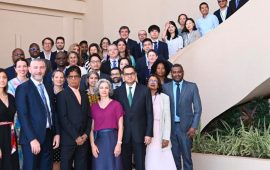
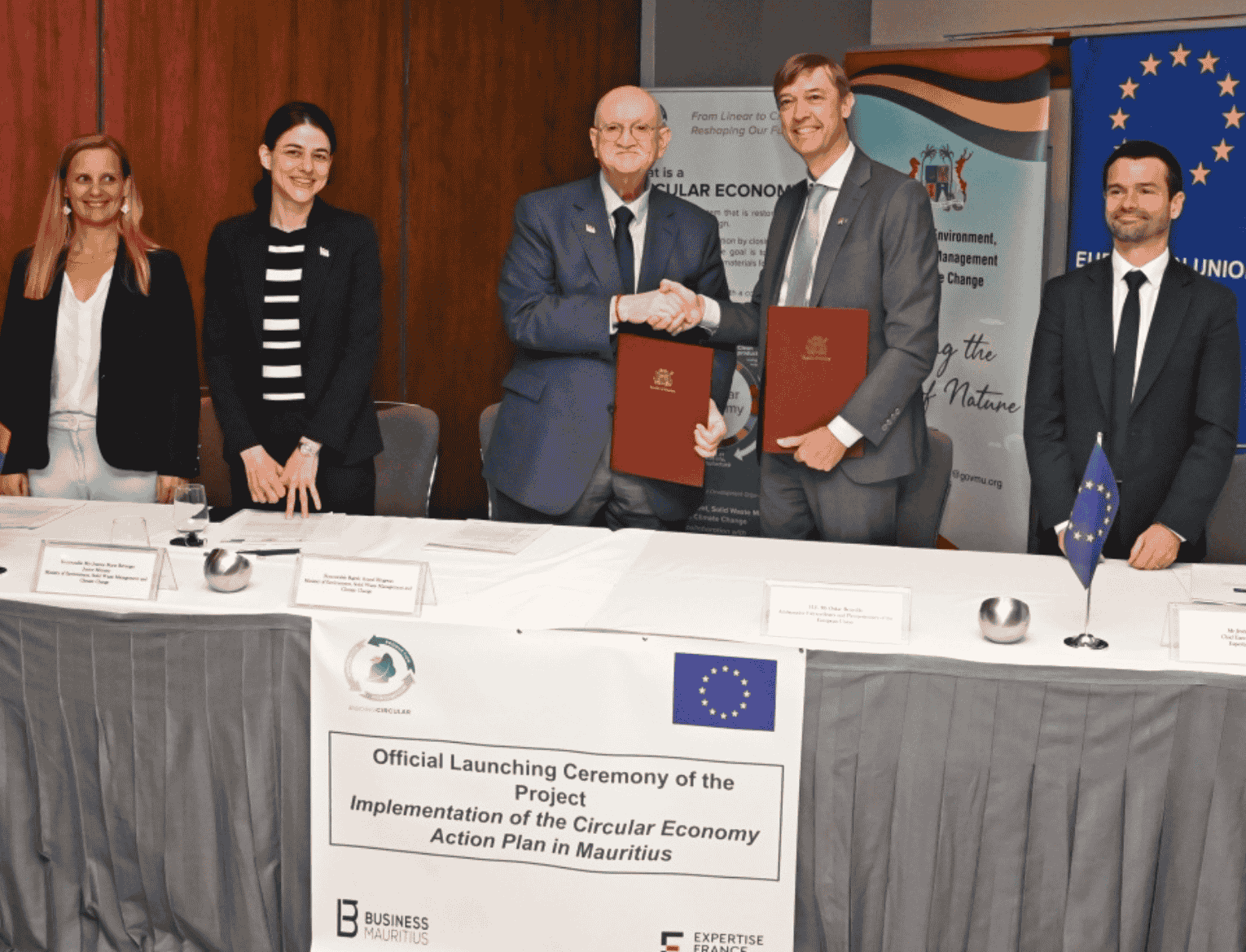
At the launch of the EU-financed programme to support Mauritius’s Circular Economy Roadmap and Action Plan, EU Ambassador Oskar Benedikt called for a collective shift from linear to circular economic models. He reaffirmed the EU’s partnership with Mauritius, underlined the urgency of addressing global resource depletion, and encouraged stronger engagement from government, businesses, and civil society to ensure a sustainable future.

The European Union has reaffirmed its commitment to supporting Mauritius in its transition toward a circular economy through the launch of a new EU-financed programme designed to operationalise the country’s Circular Economy Roadmap and Action Plan.

Speaking at the launch event at Hennessy Park Hotel, European Union Ambassador Oskar Benedikt described the initiative as the tangible outcome of several years of collaboration between Mauritius and the EU.

I am very pleased to be here today on the occasion of the launch of the programme financed by the European Union to support Mauritius in the implementation of the Circular Economy Roadmap and Action Plan,” he said. “I am particularly glad to see the government’s circular economy agenda moving forward. With this programme being signed and launched today, this is the concretisation of several years of close collaboration and constructive dialogue between Mauritius and the European Union, as long-standing and reliable partners.

Years of collaboration leading to implementation

Ambassador Benedikt recalled that the EU’s engagement in this area dates back to 2022, when the EU financed the Circular Economy Forum in Mauritius. “Immediately after the Forum, the EU gave a positive reply to Mauritius’s request to finance the preparation of the Circular Economy Roadmap and Action Plan,” he explained. “And here we are today, supporting the implementation of this Roadmap and Action Plan. What an excellent example of supply value chain!

He also acknowledged the role of Expertise France as the implementing partner for the programme, citing its “extensive experience in the domain, which will be particularly useful and beneficial.

The prompt preparation and launch of our support programme is commendable,” he said, thanking the technical departments and staff of the Ministry of Environment for their commitment.

Addressing the vulnerabilities of Small Island Developing States

The EU Ambassador underlined that for Small Island Developing States (SIDS) such as Mauritius, the transition to circularity is both urgent and indispensable. “It could not be otherwise especially for SIDS like Mauritius which face additional challenges linked to size and vulnerability of supply chain,” he observed.

He warned against complacency, pointing to the Earth Overshoot Day, the date on which humanity’s demand for resources exceeds what the Earth can regenerate in a year. “We simply cannot sit back knowing that this year, by 24th July, we had already consumed all the resources that Earth could have generated in a year,” he said. “This is the famous Earth Overshoot Day. In other words, we are using up the stocks of our children and our grandchildren.

Global data and environmental alarms

Citing alarming global trends, the Ambassador referred to data from the Organisation for Economic Co-operation and Development (OECD) and other scientific sources to illustrate the scale of the challenge.

According to the OECD, global consumption of materials such as biomass, fossil fuels, metals and minerals will double by 2060. It is estimated that more than 50% of greenhouse gas emissions and more than 90% of biodiversity loss is caused by resource extraction. Finally, with the current linear model, the more we consume, the more wastes are generated. It is estimated that by 2050, the amount of waste generated will increase by 70%. And on average, only 7% of the solid wastes are recycled,” he explained

It is clear that the planet is suffocating. We simply cannot continue with the current production and consumption patterns based on linear models.

Europe’s transition: The clean industrial deal and circular economy action plan

Ambassador Benedikt explained that Europe itself has taken major steps to tackle the global resource crisis. “In Europe, we are fully aware and conscious of the situation and urgency for action. This is why the Clean Industrial Deal, recently adopted, sets the EU ambition to double the share of recycled materials in the EU’s economy and become a global leader in circular economy by 2030,” he said.

He added that the EU Circular Economy Action Plan includes 35 actions aimed at making sustainable products the norm across the European Union. “It is progressively unfolding, with transition challenges of course, but enterprises are also seeing the opportunities of circularity: increased resilience to commodity supply uncertainty, reduced manufacturing costs, new revenue streams, new business opportunities and new markets.

Programme focus: legislation, institutions, and private investment

Turning to the objectives of the new programme, Ambassador Benedikt highlighted two main pillars: establishing the necessary legislative and institutional framework for circularity, and promoting private sector involvement and investment.

The focus of the programme (in Mauritius) is first on putting in place the necessary legislative and institutional framework to allow circular economy to develop,” he explained. “The second component concerns support to promote private sector involvement and investment in circular economy.

He emphasised that investors, both Mauritian and European, have shown growing interest in circular economy projects in Mauritius and Rodrigues. “Last week, I had the opportunity to meet European and Mauritian investors, and I can assure you of the keen interest that exists for investing in circular economy projects in Mauritius and Rodrigues provided the necessary framework and conditions are in place.

Confidence in Mauritius’s transition

The EU Ambassador expressed confidence that Mauritius is on the right path. “I am personally confident about the shift from linearity to circularity in Mauritius,” he affirmed. “Besides Government’s strong engagement, front-runners in the private sector are also very dedicated and already active, and this is reassuring.”

He also praised the contribution of non-governmental organisations (NGOs), describing them as “excellent vectors to reach out to communities and the entire population for sensitisation.

A collective responsibility

The Ambassador stressed that the shift toward a circular model is no longer optional but essential. Quoting Ursula von der Leyen, President of the European Commission, he added: “If we move together, we will also move faster, and this is in everybody’s interest. I wish the new programme a successful implementation.”

Skip to content