Back to Bizweek
SEARCH AND PRESS ENTER
Latest News
EAGLON – How a Mauritian engineer took on a quiet problem of global shipping

Emergent Maritime Technologies

A locally designed underwater inspection system, developed by Emergent Maritime Technologies and selected by the International Maritime Organization, is positioning Mauritius as a rare example of a small island economy exporting operational maritime technology. Beyond the engineering achievement, the project highlights the policy choices that will determine whether such innovation remains rooted at home.

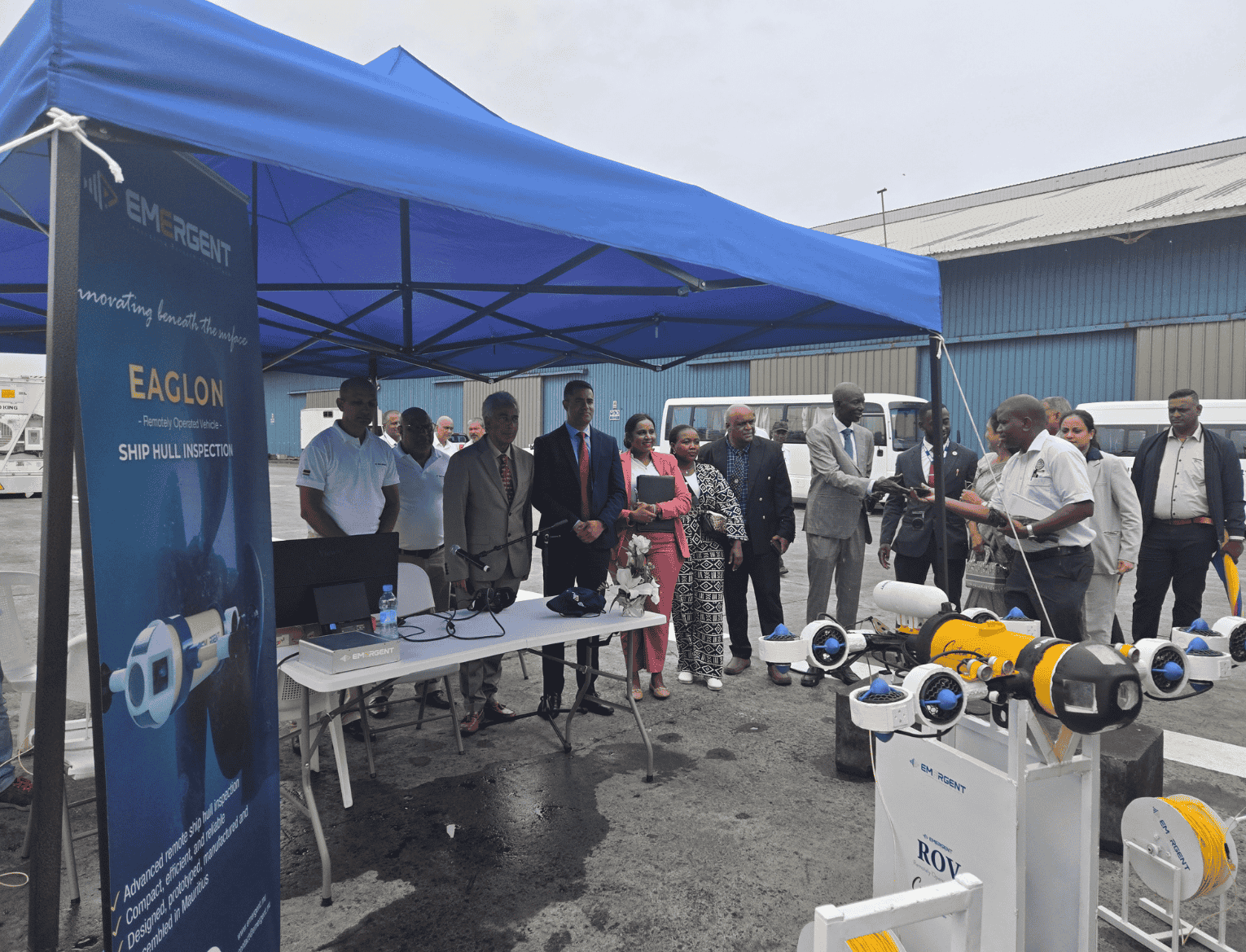
On a late January morning in Port Louis harbour, Shani Ghurburrun stood on the quay watching a small remotely operated vehicle disappear beneath the hull of the Mauritius Trochetia. For the founder and director of Emergent Maritime Technologies (EMT), the moment marked more than a technical demonstration. It was the culmination of a long effort to prove that a maritime technology designed, engineered and built in Mauritius could meet international operational standards, and be taken seriously beyond the island’s shores.

The system being demonstrated, known as EAGLON, is a diver-free underwater inspection vehicle designed to assess ship hulls and manage biofouling. It has been selected by the International Maritime Organization (IMO) following a global call for proposals under its Transfer of Environmentally Sound Technologies (TEST) Biofouling Project – the first time a Mauritian-developed maritime technology has been showcased under the programme.

For a country whose maritime sector has traditionally relied on imported systems and expertise, the selection represents a quiet but notable shift: from technology user to technology developer.

A global problem beneath the waterline

Biofouling – the accumulation of marine organisms on ship hulls – rarely attracts public attention, yet it sits at the centre of some of shipping’s most pressing challenges. Fouled hulls increase fuel consumption, raise operating costs and contribute to higher carbon emissions. They also play a major role in the spread of invasive species between marine ecosystems.

The IMO has been tightening its focus on the issue, and while hull inspections remain a recommendation for now, they are expected to become mandatory within the next two years. That prospect has triggered a global race to develop inspection technologies that are safer, more consistent and capable of operating under real port conditions.

Divers have limited operational capacity, and their inspections are not always reliable,” says Captain Babacar Diop, an IMO training consultant. “There is a global demand for alternatives.

It is into this space that EMT has stepped.

Built locally, tested locally

EAGLON was developed and tested entirely in Mauritius, using the island’s own maritime environment as a full-scale proving ground. Rather than positioning itself as a hardware manufacturer, EMT has structured its model around exporting high-value maritime services enabled by locally developed technology.

The Port Louis demonstration formed part of the IMO–NORAD TEST Biofouling Project and was held during a national technology demonstration and training workshop implemented by the Maritime Technology Cooperation Centre for Africa (MTCC Africa), under the IMO’s GloFouling Partnerships framework. It was supported by the Ministry of Agro-Industry, Food Security, Blue Economy and Fisheries and the Mauritius Ports Authority.

The inspection was carried out on the hull of the Mauritius Trochetia, berthed at Quay 3, in the presence of the minister and junior minister responsible for the blue economy, Arvin Boolell and Fabrice David, alongside representatives of regional port authorities and operators.


“It is proof that Mauritius can create world-class maritime technology”


For Shani Ghurburrun, the symbolism mattered as much as the technical result. “This is not just a company milestone,” he says. “It is proof that Mauritius can create world-class maritime technology. That is what Vision 2050 is supposed to be about. Moving from consumption to execution, and from importing technology to exporting services enabled by Mauritian engineering.

Policy, not capital, as the binding constraint

Unlike many technology ventures showcased under international programmes, EMT’s system has been entirely self-financed. Shani Ghurburrun is explicit that access to funding was not the primary obstacle.

The real issue is not money,” he says. “It is whether our policy and regulatory environment allow innovation to be retained, matured and scaled from Mauritius.

That concern echoes a wider dilemma faced by small innovation ecosystems. Local markets are often too small to sustain early-stage technologies, yet they are essential for testing, validation and learning. At the same time, those markets are frequently open to imported solutions that have not contributed to domestic capability building.

Countries that succeed in innovation, Shani Ghurburrun argues, do so deliberately. “They sequence market opening. They incubate strategic capabilities. And they design proportionate regulatory frameworks,” he says. “The question is not whether this technology will succeed internationally. The question is whether Mauritius will choose to remain the home of this capability.”

Environmental ambition meets industrial reality

For government, the project aligns with broader environmental and maritime objectives. Minister Arvin Boolell points to Mauritius’s collaboration with the IMO on biofouling, safety and marine environmental protection, and to the link between cleaner hulls and lower emissions.

By eliminating invasive species from ship hulls, vessels consume less fuel, he notes, reducing carbon emissions and supporting the decarbonisation of maritime transport. That a solution addressing these issues has been developed locally is, in his view, a source of national pride.

Captain Diop, for his part, highlights the system’s operational performance. The vehicle’s manoeuvrability and image quality, he says, meet the practical demands of hull inspection and the fact that it has been entirely designed and manufactured in Mauritius sets it apart.

Beyond a single demonstration

EAGLON is now slated for deployment in three international ports, while EMT’s strategic, technical and financial control remains anchored in Mauritius. For the company, exporting services rather than relocating development has been a deliberate choice.

The Port Louis demonstration positions Mauritius not only as a test site, but as a potential reference location for advanced hull inspection and maintenance technologies. Whether that position can be sustained will depend less on engineering capability, now proven, and more on policy choices still to be made.

Skip to content