Back to Bizweek
SEARCH AND PRESS ENTER
Latest News

“Countries that cling to fossil fuels are not protecting their economies – they are sabotaging them”

António Guterres, Secretary-General of the United Nations

  • “The fossil fuel age is flailing and failing. We are at the dawn of a new energy era.”
  • António Guterres outlines a six-point plan to supercharge clean energy ahead of COP30. 

United Nations Secretary-General António Guterres has called for a rapid acceleration of the global clean energy transition, warning that while the shift away from fossil fuels is now inevitable, it remains too slow and uneven to meet global climate and development goals.

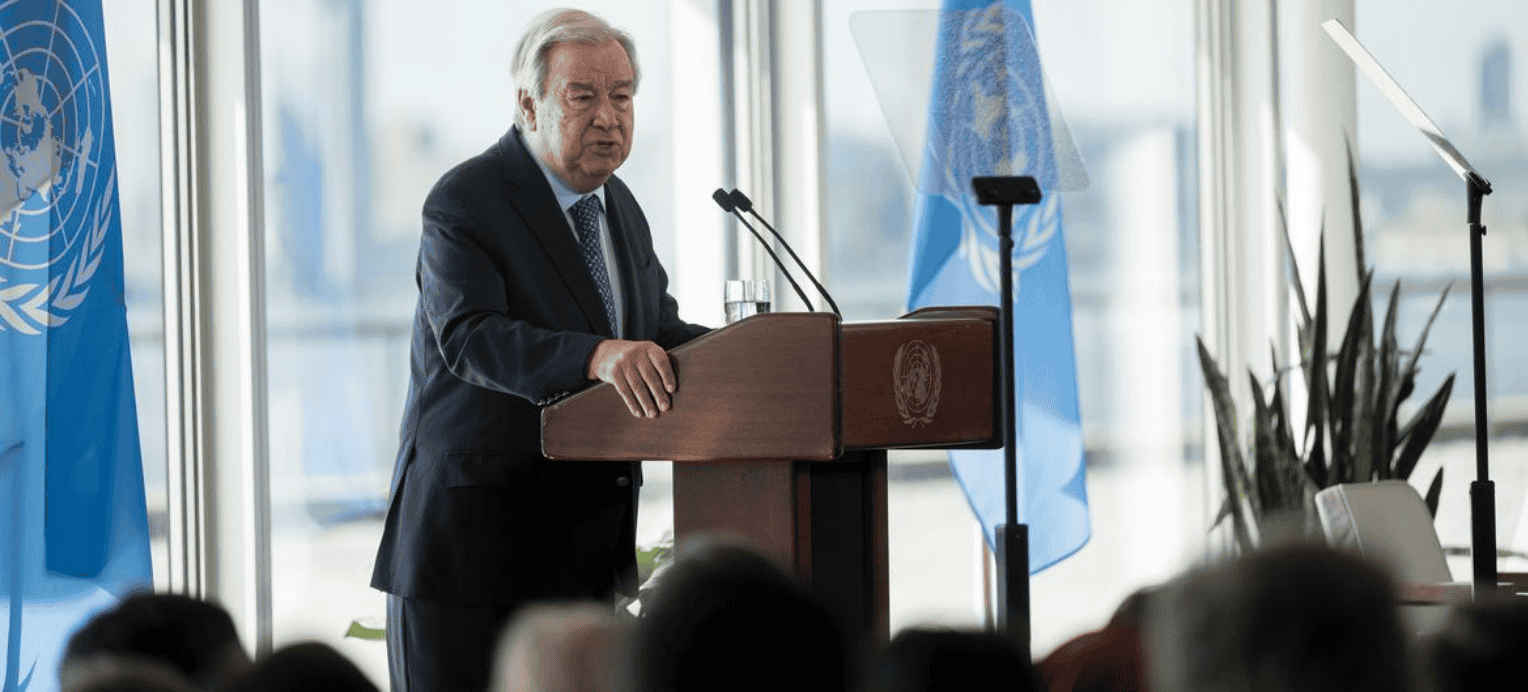
In remarks delivered at UN Headquarters last Tuesday under the theme “A Moment of Opportunity: Supercharging the Clean Energy Age,” António Guterres outlined a six-point action agenda designed to align national policy, finance, and infrastructure with what he described as a “new energy era.”

The speech of the Secretary-General of the United Nations, which coincided with the release of a joint report by the UN, the International Energy Agency (IEA), the International Renewable Energy Agency (IRENA), IMF, OECD, and the World Bank, painted a picture of accelerating technological progress juxtaposed with significant gaps in deployment and equity.

The fossil fuel age is flailing and failing,” he said. “We are at the dawn of a new energy era.”

Market Signals and Structural Imbalances

The Secretary-General pointed to recent market data indicating a clear shift in global energy investment trends. In 2024, clean energy received US$2 trillion in investment – $800 billion more than fossil fuels. Solar and wind energy, once far more expensive than fossil-based alternatives, are now among the cheapest sources of electricity, with offshore wind costs dropping by 53% and solar by 41%.

New renewables now account for nearly all new power capacity additions, and in 2023 alone, clean energy contributed 10% to global GDP growth, ranging from 5% in India to 33% in the European Union. According to António Guterres, clean energy jobs now exceed those in fossil fuels, totalling nearly 35 million globally.

Despite these gains, fossil fuels still receive nine times more consumption subsidies than renewables. He characterised this as a “clear market distortion” that hinders further progress and locks countries into what he described as economically and environmentally unsustainable pathways. “Countries that cling to fossil fuels are not protecting their economies – they are sabotaging them,” the Secretary-General stated.

Energy Security and Decentralisation

Citing the geopolitical and economic fallout of the war in Ukraine, António Guterres described fossil fuels as the main threat to global energy security due to price shocks, supply disruptions and volatility. In contrast, renewables offer a decentralised model with greater resilience. He argued that renewable technologies can empower nations with energy autonomy and are suitable for deployment in rural and remote settings. “There are no price spikes for sunlight. No embargoes on wind,” he noted.

Bridging Regional and Infrastructure Gaps

The Secretary-General acknowledged the uneven distribution of renewable energy investment. OECD countries and China account for 80% of current global renewable power capacity, while Africa – despite holding 60% of the world’s best solar resources – received only 2% of clean energy investment in 2024. By 2040, Africa could generate ten times its own electricity needs entirely from renewables, he said.

António Guterres also flagged infrastructure as a critical bottleneck. For every dollar invested in renewable power generation, only 60 cents go to enabling infrastructure such as storage and grid systems. He warned that renewable projects are being built faster than they can be integrated into national energy systems.


“There are no price spikes for sunlight. No embargoes on wind.”


The Six Opportunity Areas

The Secretary-General laid out six areas for immediate international and national action:

  1. National Climate Plans (NDCs)
    Governments must submit updated national climate plans ahead of COP30 in Brazil. These plans, he argued, should cover all emissions, align with the 1.5°C target, and integrate energy, climate, and sustainable development priorities. He invited leaders to present their new plans at a UN event in September, during the General Assembly. He also called on G20 countries – responsible for 80% of global emissions – to lead the effort and commit to doubling energy efficiency and tripling renewable capacity by 2030.
  2. Infrastructure and Electrification
    António Guterres urged a balanced investment strategy between generation and infrastructure, including smart grids, energy storage, and electrification of buildings, transport, and industry. He described infrastructure as the “backbone of a clean energy future.
  3. Managing Energy Demand Sustainably
    Highlighting growing electricity demand – especially from urbanisation and artificial intelligence – he called for AI and tech firms to run data centres on 100% renewable energy by 2030 and manage water use in cooling. By 2030, data centres could consume as much electricity as Japan does today, he said.
  4. A Just Energy Transition
    Governments must provide support for fossil fuel workers, youth, women, indigenous peoples and vulnerable groups through education, training and social protection. António Guterres also raised concerns over extractive practices in critical mineral sourcing and called for adherence to the UN Panel on Critical Energy Transition Minerals’ human rights-based framework. “Let’s build a future that is not only green – but just. Not only fast – but fair,” he said.
  5. Trade and Investment Policy Reform
    Trade policy should reinforce climate goals, the Secretary-General said. He urged the removal of tariffs on clean energy goods, support for South-South cooperation, and reform of outdated investment treaties. In particular, he criticised Investor-State Dispute Settlement provisions, which he said are being used by fossil fuel interests to delay transitions in developing countries.
  6. Mobilising Finance and Lowering Risk
    The Secretary-General stressed that clean energy investment in developing countries outside China must rise more than fivefold by 2030 to meet universal access and climate goals. He reiterated calls for multilateral development bank reform, increased concessional finance, and the scaling of debt-for-climate swaps.

Outdated risk models, he argued, are artificially inflating the cost of capital for developing nations. Credit rating agencies and investors must adopt new frameworks that account for climate risk, stranded assets, and the long-term potential of clean technologies.

With COP30 set to take place in Brazil in November, António Guterres framed the current moment as a confluence of technological readiness, economic feasibility, and environmental urgency.

We have the tools to power the future for humanity,” he concluded. “Let’s make the most of them. This is our moment of opportunity.

Skip to content