Back to Bizweek
SEARCH AND PRESS ENTER
Latest News

African pension funds seek higher returns and a bigger role in national development

9th Pension Funds and Alternative Investments Africa conference

  • Close to 60 pension funds, sovereign wealth institutions and development partners from over 20 countries, collectively overseeing about $330bn in assets under management, gathered in Mauritius.

With global capital more selective and borrowing costs still elevated, African pension funds and sovereign institutions are under growing pressure to deploy their own savings at home. At the 9th Pension Funds and Alternative Investments Africa conference in Mauritius, asset owners confronted a difficult equation: how to protect retirees’ money while financing the infrastructure, energy systems and digital networks that will shape the continent’s next phase of growth.

With global capital more selective and borrowing costs still elevated, African pension funds and sovereign institutions are under growing pressure to deploy their own savings at home. At the 9th Pension Funds and Alternative Investments Africa conference in Mauritius, asset owners confronted a difficult equation: how to protect retirees’ money while financing the infrastructure, energy systems and digital networks that will shape the continent’s next phase of growth.

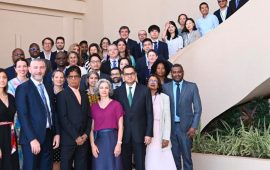
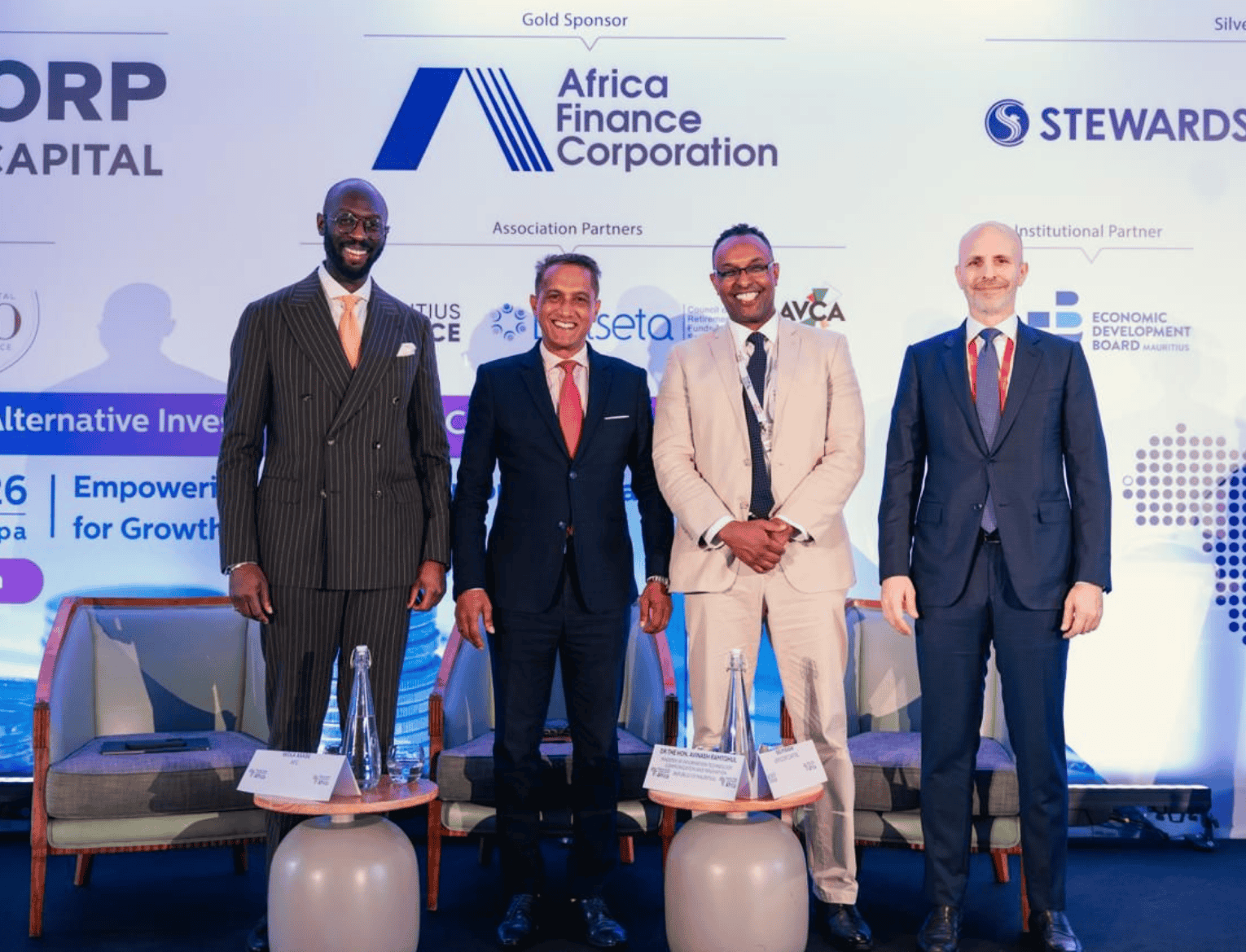
The conversations in Mauritius were not framed in slogans. They revolved around balance sheets, regulatory constraints and risk-adjusted returns. Nearly 200 delegates gathered for the 9th Pension Funds and Alternative Investments Africa conference organised by AMEtrade. Close to 60 pension funds, sovereign wealth institutions and development partners from more than 20 countries, overseeing roughly $330bn in assets under management, were represented.

Mahad Ahmed, chief executive of AMEtrade, opened the event by acknowledging the global context. “Around the world, we are facing geopolitical and economic tensions, high interest rates, tighter financial conditions, shifting trade policies and tariffs,” he said.

For African economies, those pressures coincide with pressing domestic needs: infrastructure deficits, climate vulnerability, job creation for a fast-growing population and, in several cases, elevated sovereign debt. Yet Mr Ahmed struck a measured note of optimism. “Africa’s institutional capital base is growing steadily, to almost two trillion dollars,” he said. That growth, he added, brings both “an opportunity and a responsibility” to safeguard the savings of millions of members and to help build the economies in which they will eventually retire.

According to recent UN Economic Commission for Africa projections, the continent is expected to post growth of about 4 per cent this year, rising slightly the following year. Strategic interest in Africa is increasing, supported by the implementation of the African Continental Free Trade Area and the expansion of digital connectivity.

Still, the central dilemma remains. “How to balance fiduciary duty with developmental economics?” Mr Ahmed asked. “African pension funds are no longer passive holders of government securities,” he said. They are becoming “strategic asset allocators of long-term capital, with potential to reshape their countries’ development.

Africa’s capital — largely untapped

Selim Basak, co-founder and head of origination at Gemcorp Capital, argued that Africa’s challenge is less about capital scarcity than about capital organisation. “Yes, Africa often has a capital shortage problem to bring projects to life,” he said. “But Africa’s solution to this problem actually lies in Africa, because Africa does have a lot of capital.” 

Gemcorp, which operates across west, east and southern Africa, has deployed $8bn over the past 11 years in infrastructure and trade finance, generating more than 11 per cent net returns in US dollar terms for investors. Last month, it launched a Pan-African Infrastructure Fund anchored by Gemcorp and Angola’s sovereign wealth fund, with the expectation that African pension funds will participate.

If you add up in aggregate all the sovereign wealth money, pension money and insurance money, you’re north of a trillion dollars,” Mr Basak said. Demonstrating credible performance, he suggested, would help crowd in additional global capital.

Wola Asase, of the Africa Finance Corporation (AFC), offered even larger figures. AFC estimates that Africa holds more than $4tn in domestic capital, including over $2tn in institutional hands. “These pools of savings represent the deferred income of African workers and citizens, and therefore the most patient long-term capital available on the continent,” he said. Yet only a limited share currently flows into infrastructure, industrial development and climate-resilient assets.

The central question before us is not whether Africa has capital, but how effectively we can mobilise, structure and deploy that capital into productive, bankable and well-governed assets that deliver both strong risk-adjusted returns and long-term developmental impact,” Mr Asase said.

Structuring to manage risk

Over two decades, AFC has invested more than $19bn across 36 African countries. Increasingly, it relies on credit enhancement, guarantees and blended finance structures to bring domestic pension funds into infrastructure projects while managing currency and tenor risk. “In many cases, these structures, including guarantees, repacks and concessional capital, unlock institutional capital, not the lack of appetite,” Mr Asase stated.

AFC’s renewable energy platform, expanded through the acquisition of Lekela, now includes 1.2GW of operational capacity and a 13.7GW pipeline. Its Infrastructure Climate Resilient Fund has secured $240m from the Green Climate Fund, using concessional capital as a risk cushion to attract private investors.

The emphasis throughout was practical: stronger pipelines, clearer governance and collaborative platforms rather than isolated transactions. “Mobilisation must translate into deployment,” Mr Asase insisted.

Infrastructure, now digital

Dr Avinash Ramtohul, Minister of Information Technology, Communication and Innovation, broadened the discussion of infrastructure. “Infrastructure is not just hospitals, roads, schools and universities,” he said. “It is also the fibre cables that we put across the country. It is also the data centres that are required.” 

Africa’s demographic trajectory, expected to yield the world’s largest youth population by 2050, represents a significant economic opportunity. Artificial intelligence and digital systems could provide what he described as a second acceleration, comparable to the mobile phone revolution. “Data is the future,” he said. “We need to ensure that we bring our data inland and protect it. Where the data is, the dollar will be there.” 

Institutional capital in Africa now exceeds $2tn, and by allocating to productive sectors, innovation and infrastructure, pension funds can influence economic diversification and resilience. Mauritius itself is implementing a 2025-2030 financial services roadmap and strengthening cyber resilience frameworks.

A question of stewardship

What distinguished the conference was its tone. There was little rhetoric about transformation; instead, there was an acknowledgment of responsibility.

Empowering domestic savings is not only about returns. It is about stewardship,” Mr Asase underscored. Aligning long-term savings with long-term national priorities ensures that Africa’s own capital becomes “a cornerstone of Africa’s own development.” 

For Mr Ahmed, the objectives remain consistent: to foster knowledge-sharing, build partnerships between asset owners and managers, and promote co-investment across borders.

The sums discussed during the conference were large. The expectations, however, were disciplined. Africa’s pension funds are not being asked to take reckless bets. They are being asked to engage more actively. To allocate carefully, structure intelligently and collaborate more deeply.

The capital is there. The frameworks are evolving. Whether the momentum translates into projects delivered, and returns secured, will define the next chapter of Africa’s institutional investment story.

Skip to content