Back to Bizweek
SEARCH AND PRESS ENTER
Latest News

“We can build the best hospitals, but it boils down to proper training”

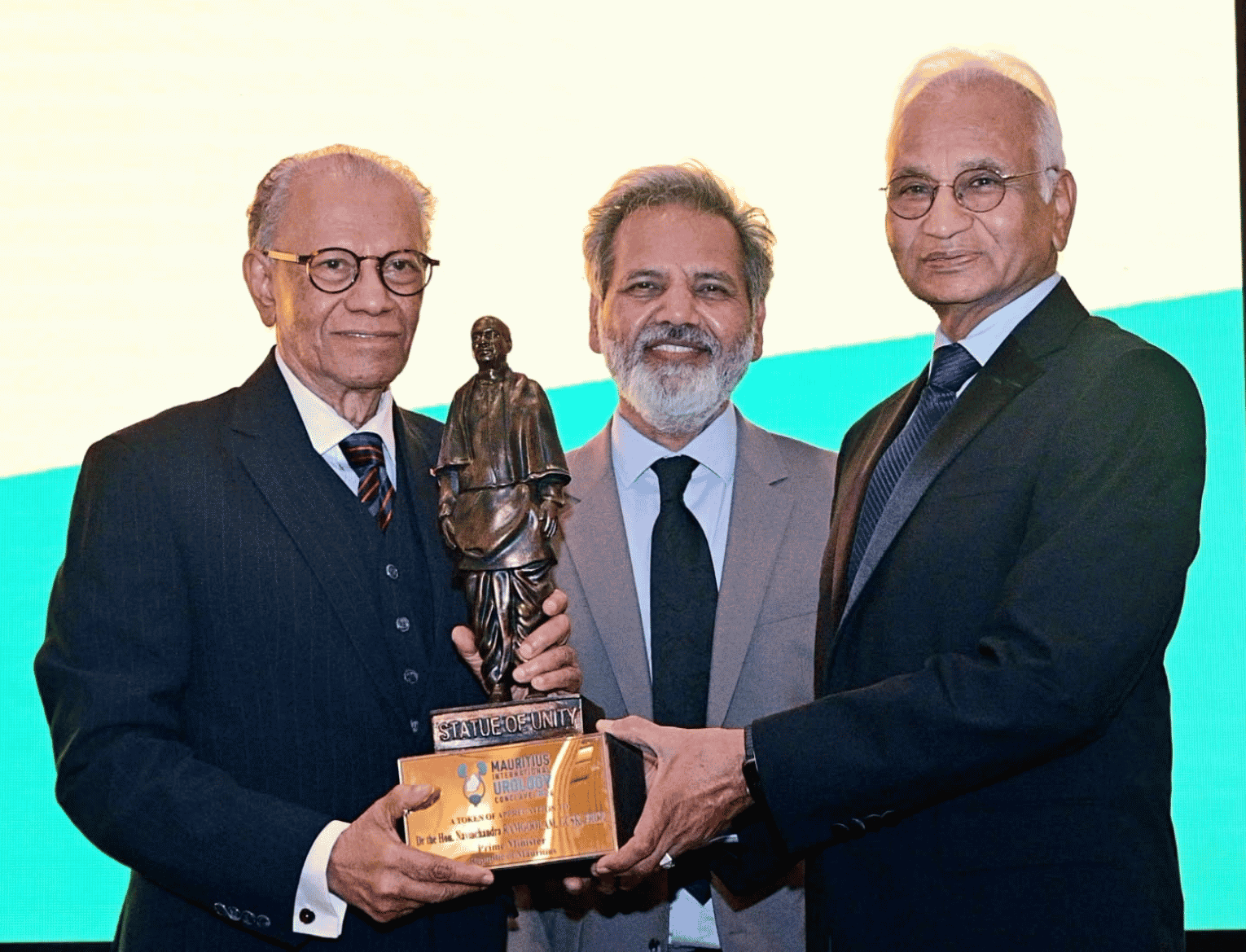
From left to right: Dr Navinchandra Ramgoolam, Prime minister of Mauritius; Dr Balbir Verma, eminent urologist and convener of the conclave, and Professor Mahendra Bhandari, Indian urologist and transplant surgeon based in Detroit.

Dr N. Ramgoolam, Prime Minister

At the Mauritius International Urology Conclave on 24 September, Prime Minister Navin Ramgoolam set out the country’s challenges in kidney disease, urinary stones and cancer. Professor Mahendra Bhandari called for a programme allowing organ donation after death, while organiser Dr Balbir Verma said the conclave should bring international expertise closer to Mauritian patients.

Mauritius needs trained medical teams and rigorous infection control as much as it needs new hospitals and equipment, Prime Minister Navin Ramgoolam said at the inaugural ceremony of the Mauritius International Urology Conclave 2026 on Thursday, 24 September.

Speaking to Mauritian and international specialists, he identified urinary stone disease, urological cancers and chronic kidney disease as three concerns for the country. Advances in minimally invasive surgery, transplantation, radiotherapy and artificial intelligence offered new possibilities, he said, but their value would be measured by the care patients received.

“It is very easy to build a new cancer centre, to put the latest technological machines there,” Dr Ramgoolam said. “But what you need is training, experience” among doctors and nurses. He also called for stricter adherence to disinfection protocols, saying infection rates in hospitals required attention.

The ceremony’s programme named Dr Ramgoolam as chief guest and included a felicitation ceremony for Professor Mahendra Bhandari, an Indian urologist and transplant surgeon based in Detroit. Professor Bhandari is Director of Robotic Surgery Research and Education at the Vattikuti Urology Institute at Henry Ford Hospital and chief executive of the Vattikuti Foundation.

Kidney care and the question of donation

Dr Ramgoolam linked the burden of advanced kidney disease in Mauritius partly to the prevalence of diabetes. He recalled his government’s decision after taking office in 1995 to make dialysis free and provide transport for patients at no cost. He said the decision followed the death of a young girl whose family had been unable to afford treatment, an episode he had raised in Parliament while Leader of the Opposition.

For patients whose kidney disease progresses to the point of requiring a transplant, the renal transplant unit at Jawaharlal Nehru Hospital represents an important step, he said. He thanked India for its support for Mauritian health infrastructure, citing the hospital as well as the new ENT hospital and other projects.

Bhandari said developing transplantation within Mauritius would allow patients to receive treatment close to their families. He proposed a further step: a programme through which organs could be donated after death. Such a system would require appropriate legislation, public awareness, transparent allocation and strong ethical safeguards, he said.

“With appropriate legislation, public awareness, transparent allocation and the highest ethical safeguards, Mauritius can develop a transplant programme comparable to the best in the world,” Professor Bhandari said.

Dr Ramgoolam also returned to the deaths of dialysis patients during the Covid-19 period. He criticised the previous government’s decision not to publish a report on the matter and said his government had made it public and established a commission of inquiry. Publishing such findings, he argued, was necessary to learn from failures rather than to assign blame.

On prevention, the Prime Minister defended the government’s sugar tax as a measure intended to discourage excessive consumption. He said public education on sugar and diabetes had to accompany treatment for the consequences of the disease.

Technology requires judgement

Urinary stones are common in Mauritius, Dr Ramgoolam said, though he did not offer a conclusion on whether diet, climate or other factors explain their prevalence. He noted that endoscopic and other minimally invasive procedures had changed the treatment available to patients.

He also recounted his own experience of seeking treatment for a stone abroad. His account illustrated, he said, why doctors benefit from discussing clinical choices with colleagues who have different experience. The conclave offered a setting in which Mauritian specialists could examine new approaches and their suitability for local patients.

Turning to cancer, Dr Ramgoolam said prostate cancer appeared to be increasing in Mauritius, while acknowledging that improved detection might account for some of the apparent rise. He pointed to modern surgical approaches and the development of a cancer centre with radiotherapy facilities, before stressing again that staff training was essential to make effective use of those investments.

Artificial intelligence and robotic surgery were changing diagnosis and treatment, he said. Scientific meetings should give clinicians the opportunity to assess those developments critically, share experience and decide how best to adapt them to Mauritius. The goal, he added, was safe, effective care supported by evidence.

Dr Ramgoolam said Mauritius had spent Rs 18 billion on healthcare in the previous year and needed to obtain better value from that expenditure. Continuous medical education and exchanges with specialists from abroad were part of that effort. He urged doctors to remain open to new knowledge, recounting an encounter with visiting veterinary surgeons to make his point: “We must keep learning. Don’t assume we know everything.”

He said future improvements in urology would also depend on prevention, early detection, awareness and timely referrals. Patients were too often referred late, he told the gathering.

A platform for collaboration

In welcoming delegates, Dr Balbir Verma, the convener of the conclave, described the event as the third edition of the Mauritius International Urology Conclave. Its purpose, he said, was to bring medical innovation and specialist expertise within reach of people in Mauritius through exchanges among clinicians and other participants.

Dr Verma paid tribute to Professor Bhandari, whom he described as his teacher and mentor, for travelling from Detroit to attend. Professor Bhandari, in turn, recognised Dr Verma’s contribution to urology and kidney care in Mauritius over several decades. He said he hoped the gathering would strengthen collaboration among Mauritius, India and the wider international medical community.

For Dr Ramgoolam, that collaboration must lead beyond presentations to better treatment. Recalling advice he received as a medical student, he urged doctors to look beyond test results and attend to the person in the hospital bed. “Medical technology is ultimately meaningful only if it improves the lives of our patients,” he said.

Skip to content