Back to Bizweek
SEARCH AND PRESS ENTER
Latest News

Our bonds need economic opportunity, not emotion alone

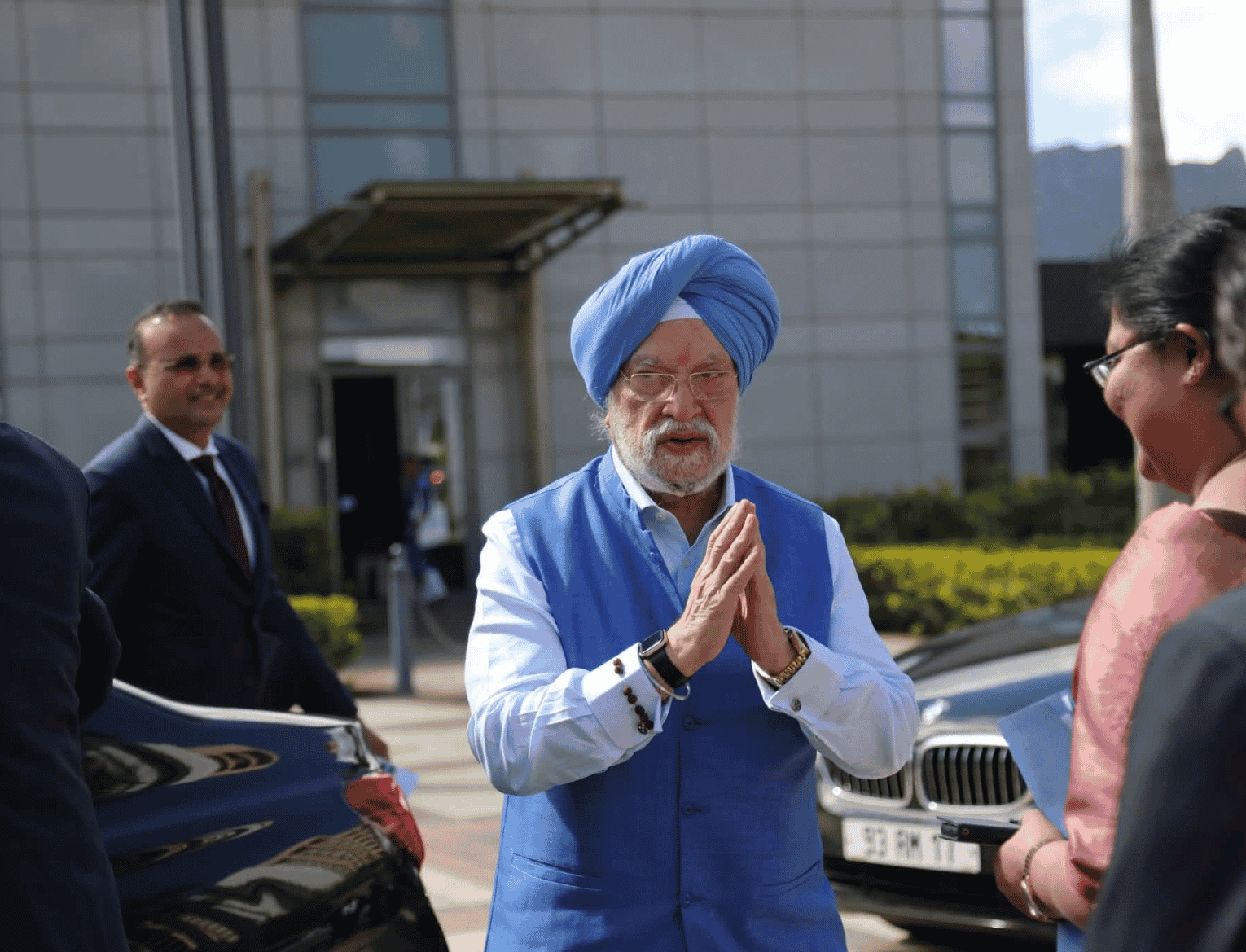
Hardeep Singh Puri, India’s Minister of Petroleum and Natural Gas

Hardeep Singh Puri, India’s Minister of Petroleum and Natural Gas

  • “While we draw satisfaction from the current levels of cooperation, I think the best is yet to come.”

India’s Minister of Petroleum and Natural Gas says that the new fuel supply framework will provide Mauritius with greater predictability and energy security. Addressing the Indian business community at the High Commission of India in Ebene, on Friday, Hardeep Singh Puri also called for deeper cooperation in aviation, renewable energy, innovation and emerging technologies.

India’s new petroleum supply arrangement with Mauritius will strengthen the country’s energy security by providing greater certainty and predictability in fuel procurement, according to Hardeep Singh Puri, India’s Minister of Petroleum and Natural Gas.

Speaking during an interactive session with members of the Indian Business Council (Mauritius), held on Friday at the High Commission of India in Ebene, the minister described the framework as a potential landmark in bilateral relations.


“There is potential for cooperation with Mauritius in biofuels, nuclear energy and green hydrogen.”


The arrangement comprises a government-to-government umbrella agreement and a commercial agreement involving IndianOil and the State Trading Corporation of Mauritius. It will initially cover products such as petrol and diesel, with the possibility of extending the framework to aviation turbine fuel and other petroleum products.

What makes this unique is that it will ensure predictability and security for the receiving country,” Hardeep Singh Puri told the gathering.

He said that India was well positioned to meet Mauritius’ requirements because of its expanding refining capacity and its position as a major exporter of refined petroleum products, despite remaining heavily dependent on imported crude oil and natural gas.

The minister recalled that a similar supply arrangement had existed in the early 2000s, when petroleum products were supplied to Mauritius by an Indian refinery. The new framework, he argued, would establish a more structured and durable basis for cooperation at a time of heightened uncertainty in global energy markets.

Beyond historical and emotional ties

Hardeep Singh Puri placed the agreement within the wider historical relationship between India and Mauritius. Referring to the arrival of Indian indentured labourers in Mauritius from 1834, he described the country as a striking example of how displaced communities built a successful society in a new environment. He noted that Indian workers who left their homeland during the 19th century travelled not only to Mauritius, but also to Fiji, Suriname, South Africa and other parts of the world.

Mauritius, he said, stood out for the manner in which successive generations transformed that difficult historical experience into economic and social progress. However, the minister cautioned that contemporary relations between India and Mauritius could not be sustained solely through history, emotion and goodwill. “The bonds between where you came from and where you are today cannot be sustained merely on the basis of emotion and goodwill. Those bonds will become more meaningful if there is economic opportunity and if there is business to be pursued,” he said.

In this context, he urged the Mauritian and Indian business communities to play a more prominent role in expanding trade, investment and commercial partnerships between the two countries.

Energy consumption as an economic indicator

Hardeep Singh Puri also drew attention to India’s economic transformation since 2014. He recalled that India was once grouped among the world’s “Fragile Five” economies, whereas it is now among the fastest-growing major economies.

Energy demand, he said, offers one of the clearest indicators of an economy’s underlying direction. “If you want to understand an economy, ask what its energy consumption is like. If energy consumption is going down, you can be reasonably sure that fault lines are beginning to surface,” he said.

India’s energy demand is growing at around three times the global average, according to the minister. This, he argued, reflects the scale of the country’s industrialisation, infrastructure development, urbanisation and expanding consumer demand.

He also referred to India’s response to the COVID-19 pandemic, including its large-scale vaccine production and support to other countries, as an illustration of the country’s growing manufacturing and technological capabilities.

More air links needed

Civil aviation was identified as another area where stronger connectivity could generate economic benefits for both countries. The minister pointed to the rapid expansion of India’s airport network, which has more than doubled since 2014. Yet, he said, air connectivity between India and Mauritius remained below its full potential.

I wish there were more flights from Mauritius to India,” he said, adding that increased frequencies could support tourism, trade and closer people-to-people relations.

Mauritius currently receives a relatively limited number of Indian visitors compared with the size and growth of India’s outbound travel market. Better air links, he suggested, could help the country attract a larger share of that market. “After what I have seen here, if you increase the number of flights, they will come,” the minister affirmed.

Improved connectivity would also facilitate business travel, educational exchanges and family links between the two countries.

Cooperation in biofuels and green hydrogen

While petroleum products remain central to the immediate bilateral agenda, Hardeep Singh Puri said that India and Mauritius should also explore opportunities arising from the global energy transition. “There is potential for cooperation with Mauritius in biofuels, nuclear energy and green hydrogen,” he argued.

India has been expanding its production and use of alternative fuels as it seeks to meet rising energy demand while reducing emissions and its dependence on imported fossil fuels. Mauritius’ experience in biomass and bagasse-based energy production could provide a platform for technical collaboration and investment.

The minister also referred to two Indian government programmes recently approved in the energy sector, including an intervention intended to encourage exploration and production, and another initiative related to biogas development.

Start-ups, education and innovation

Hardeep Singh Puri welcomed the emphasis being placed by Mauritius on start-ups, young entrepreneurs and innovation. He argued that artificial intelligence and other emerging technologies would create opportunities for smaller economies with strong education systems and skilled populations.

Mauritius, he added, benefits from high educational standards, a willingness to learn and a strong capacity to adapt. These attributes could support closer cooperation with India in technology, training and entrepreneurship.

The minister also recalled the longstanding educational links between the two countries and his own interactions with Mauritian students during his university years. Many of them, he said, subsequently built successful careers in Mauritius and internationally.

“The best is yet to come”

Hardeep Singh Puri described Mauritius as a country with which India enjoys a high degree of political trust and public goodwill. Cooperation already extends across several sectors and is supported by India’s broader strategic vision for the Indian Ocean region.

Yet, he insisted that both countries should look beyond that, explaining that “while we draw satisfaction from the current levels of cooperation, I think the best is yet to come.” 

The minister indeed invited members of the Indian Business Council to identify obstacles, opportunities and new areas for collaboration. His central message was that the historical relationship between Mauritius and India now needed to be translated into stronger commercial links, investment flows and practical economic outcomes.

The petroleum supply framework represents an important step in that direction. Its broader significance, according to Hardeep Singh Puri, lies in establishing a dependable economic foundation for a relationship often defined by history, culture and shared ancestry.

Skip to content