Back to Bizweek
SEARCH AND PRESS ENTER
Latest News

“Mauritius growth cools amid global headwinds and domestic constraints”

After a resilient 2024, Mauritius has entered 2025 on a more subdued footing. GDP growth slowed to 4.2% in the first quarter, with tourism and construction dragging down performance. Rising inflation, a widening trade deficit, and persistent global uncertainties add to the pressures on the island’s outward-oriented economy.

Mauritius’ economy lost momentum in the first quarter of 2025, with year-on-year GDP growth decelerating to 4.2%, compared to 5.2% in both Q4 2024 and Q1 2024. The slowdown reflects a broad moderation across key sectors, notably tourism and construction, as the island nation contends with softer external demand and lingering effects of drought conditions.

Tourism and Construction Sectors Contract

The report, issued by CARE Ratings (Africa), underscores that accommodation and food services contracted sharply by 4.4%, reversing a 3.7% gain in the previous quarter. Tourist arrivals dropped to 115,090 in May, down from 120,157 in April, as the sector entered its seasonal lull. Gross earnings also declined from MUR 8.6 billion to MUR 8.2 billion.

The construction sector also contracted by 4.3%, following a robust 6.3% expansion in Q4 2024. Analysts attribute this to a pause in project execution and waning public infrastructure investment.

Bright Spots: Agriculture, Manufacturing, and ICT

In contrast, agriculture was a rare outperformer, growing by 21.9%, buoyed by strong gains in tea, food crops, and livestock. Manufacturing edged up by 1.8%, driven by textile and non-sugar food output. Meanwhile, the ICT sector maintained a healthy 4.5% growth, in line with the government’s digital transformation agenda under the “Blueprint for Mauritius 2025”.

Other services sectors such as wholesale and retail trade (up 3.1%) and transportation and storage (up 5.2%) also offered resilience, reflecting ongoing domestic demand and logistical activity.

Downward Revision for 2025 Growth

While Statistics Mauritius revised 2024 growth upwards to 4.9%, it now expects real GDP to expand by only 3.1% in 2025, citing both external and internal risks. These include uncertainties over global trade, possible expiry of the 90-day reciprocal tariff pause by the U.S., and normalisation in construction activity post-2024.

Further, the lingering impact of drought conditions could weigh on agricultural recovery despite an expected rebound. The tourism sector also faces uncertainty in the second half of the year.

Nevertheless, selected sectors – namely financial services (projected 4.0% growth), ICT (4.8%), agriculture (7.9%) and wholesale/retail trade (3.2%) – are set to underpin overall growth. Public investment in road networks, drainage infrastructure, and social housing is expected to support domestic demand.

Inflation Jumps Post-Budget

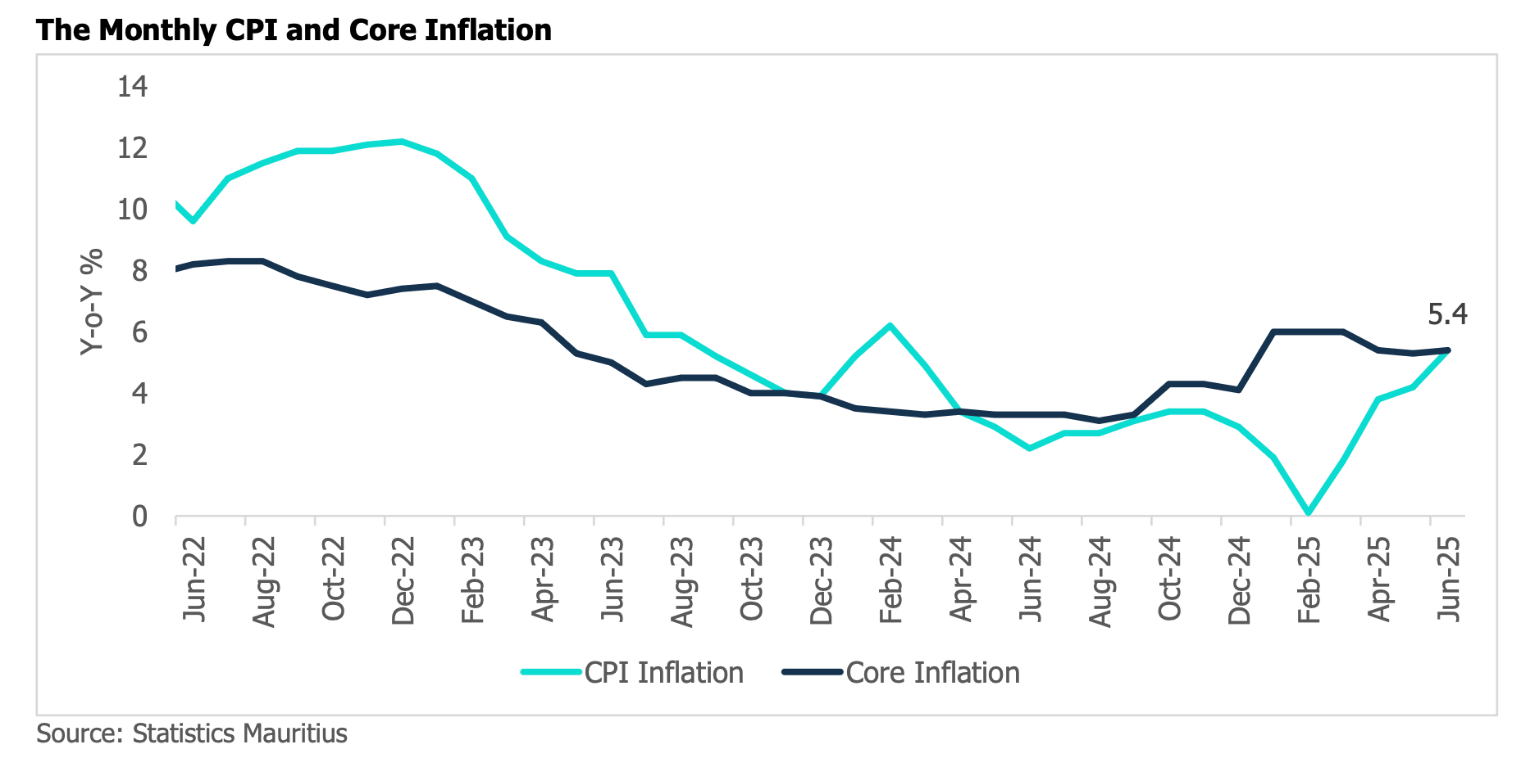
Headline inflation surged to 5.4% in June, up from 4.2% in May. The increase coincided with new fiscal measures in the 2025–2026 Budget, including higher excise duties on alcohol and tobacco and a doubled levy on sugar in beverages. Core inflation matched headline figures at 5.4%, indicating broader price pressures.

This inflationary trend is further aggravated by the depreciation of the Mauritian Rupee (MUR), volatile global commodity prices, and imported inflation from key trade partners in Europe and the UK.

Trade Deficit Widens Despite Higher Exports

Mauritius recorded a trade deficit of MUR 18.4 billion in April, widening from MUR 16.3 billion in March. While exports increased by 11.1% YoY in Q1, services exports fell by 3.2%. Imports rose 7.3%, driven by higher demand for both goods and services. The current account deficit (CAD) remained at 5.1% of GDP in Q1 2025, with IMF projections of a reduction to 4.7% for the full year now appearing optimistic.

Notably, Mauritius’ exports to the U.S., South Africa, and Madagascar remain strong, but risks loom large with the potential non-renewal of the African Growth and Opportunity Act (AGOA), which would hurt the textile and apparel sectors.

Reserves Strengthen, MUR Remains Stable

One positive development is the sharp rise in gross international reserves, up by 8.2% month-on-month to MUR 440.2 billion (USD 9.7 billion) in June. This provides import coverage for 13.2 months—one of the strongest buffers in the region. Despite short-term depreciation, the MUR has appreciated 2.5% against the USD since January 2024.

Outlook: Uncertain and Uneven

The CARE Ratings report concludes that the economic outlook for Mauritius remains clouded by multiple uncertainties, from the path of global trade negotiations to the inflationary impact of geopolitical tensions. With weak investment sentiment and a fragile export recovery, the island’s medium-term trajectory hinges on the government’s ability to navigate domestic vulnerabilities while maintaining external competitiveness.

Skip to content