Back to Bizweek
SEARCH AND PRESS ENTER
Latest News

“AI readiness is a precursor to any strategic plan or roadmap

The U.S. Embassy in Mauritius hosted an Executive Forum on AI Enablement and Business Transformation on Thursday, at Macarty House, Vacoas, to examine how organisations can move from exploring artificial intelligence to embedding it in day-to-day operations. Organised in partnership with the Law Innovation Agency and Kulana, the discussion focused on AI readiness, governance, training, implementation, infrastructure and Mauritius’s stated ambition to position itself as a regional hub for AI and technology.

Mauritius’s effort to move from AI curiosity to AI execution came into sharper focus on Thursday, as speakers at a U.S. Embassy-hosted executive forum argued that the real challenge is no longer whether artificial intelligence will transform institutions, but whether governments and businesses are prepared to put in place the data, governance, skills, infrastructure and internal discipline required to use it properly. If there was one idea that ran through the discussion, it was that AI strategy cannot be reduced to tools alone: it must be anchored in readiness, regulation, trusted partnerships and clearly defined use cases.

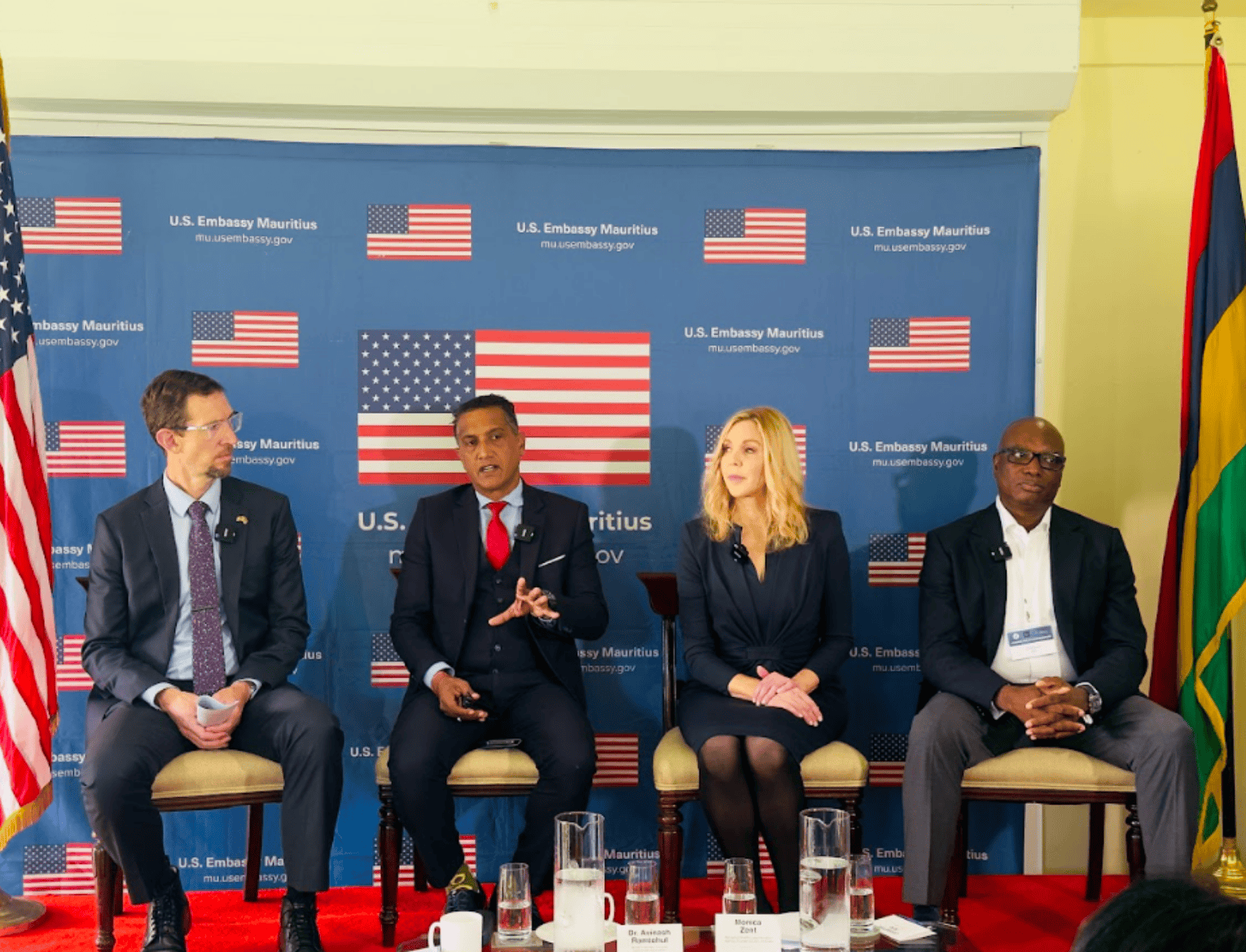
Held at Macarty House in Vacoas, the panel discussion was organised by the U.S. Embassy together with the Law Innovation Agency and Kulana. The event was a practical conversation on how organisations can prepare for AI, set clear rules and policies for its use, roll out tools across teams and manage change. The panel consisted of Chargé d’Affaires Craig Halbmaier; Avinash Ramtohul, Minister of Information Technology, Communication, and Innovation; Monica Zent, Managing Director of the Law Innovation Agency; and Jonathan Ane, Chief Executive Officer of Kulana.


“The United States and the current administration recognize that AI is a foundational, generational, and revolutionary technology.” 


From the outset, the discussion made clear that AI is now being treated as part of the broader economic and strategic relationship between Mauritius and the United States. The Chargé d’Affaires said the U.S. Embassy had, over the past two years, stepped up its engagement on technology and AI, citing the first-ever U.S.-Mauritius Business Summit in 2024, participation by U.S. companies such as Fortinet, the visit of former Microsoft executive Ernie Fernandez, an Oracle event held with the minister in January, and a March fireside chat on AI governance and cybersecurity. He also linked Mauritius’s AI agenda to a wider U.S. interest in trade and investment on the African continent. 

“The United States and the current administration recognize that AI is a foundational, generational, and revolutionary technology,” the Chargé d’Affaires said. He added that Washington was taking “a promote-and-protect approach that’s not one size fits all or too heavy handed, but rather a more sector by sector approach that is pro-innovation while managing risks.”

For government, the forum was above all an opportunity to elaborate on the newly released national AI strategy. Avinash Ramtohul stated that the document was not intended to be another dormant policy paper, but part of a wider implementation framework already linked to the government programme and the Blueprint published in May last year. He noted that the 84 projects emerging from that Blueprint were being tracked through a dashboard accessible to ministers, permanent secretaries, the Prime Minister’s Office and the Prime Minister himself. 

The AI strategy, he said, follows the same implementation logic. “The vision that we have established for it is to make of Mauritius a regional leader in AI, and we have what it takes,” he said, arguing that the country already has the foundations, the data collection points, the mindset and the talent to position itself accordingly.


“The vision that we have established is to make Mauritius a regional leader in AI.” 


The Minister stated the strategy is built around six pillars, including infrastructure, the AI start-up ecosystem, talent and the regulatory framework. He also revealed that government is already leveraging a fully-fledged data centre housed at Mauritius Telecom, alongside GPU-as-a-service arrangements in Mauritius and abroad, while preserving data residency. The strategy, he added, is not aimed only at businesses or technical experts, but at nine different layers of the population, from the working and non-working population to retirees and schoolchildren. An implementation working group is being established, and he indicated that AI implementation is likely to receive attention in the next budget exercise.

Another central component is the AI marketplace launched alongside the strategy. Avinash Ramtohul described it as a platform designed to connect the supply side and the demand side of AI services. Hosted through the AI unit’s portal, it allows local developers, start-ups and established firms to post AI use cases and examples of AI agents, while users from Mauritius and abroad can consult the available services. The minister said the demand side would be international, extending to Africa and India, while the supply side would remain local in order to give Mauritian start-ups visibility and prevent the platform from becoming unmanageable. He presented it as the first AI marketplace of its kind in Africa.

Monica Zent and Jonathan Ane brought the conversation back to the practical questions organisations face when trying to deploy AI. Monica Zent insisted that no institution should embark on an AI journey without a clear roadmap. Such a roadmap, she argued, must be structured enough to align with strategic goals, yet flexible enough to adapt as AI adoption evolves. Return on investment, she said, is one goal, but AI should not be treated as a simple tech project. It is a broader organisational transformation, one that requires work on AI readiness, change management, human oversight, literacy, upskilling, use cases, workflows, policy and governance. 

“AI readiness is critical and it’s a precursor to any strategic plan or roadmap,” she argued.

Jonathan Ane developed a similar argument from another angle. Citing Gartner, he warned that many AI projects are expected to fail by 2027 because companies will run into data integrity, governance and execution problems. In his view, too many institutions are approaching AI as they previously approached digital transformation, without properly assessing internal culture, systems and data quality. He suggested a staged approach: discovery and assessment, roadmap design, execution and training – or training and execution, depending on organisational culture – followed by a sustainable governance and accountability model. 

What problem are you solving with AI?” he asked, returning repeatedly to the need for clearly defined use cases rather than abstract enthusiasm.

The question of governance naturally became one of the central themes of the afternoon. Craig Halbmaier said the United States saw itself as playing a role in shaping norms and standards around AI, while continuing to promote innovation through investment and public-private partnerships. 

As for Avinash Ramtohul, he said that the Mauritian government had chosen, at least for now, not to legislate specifically for AI. Instead, it is opting for a principles-based approach that builds on existing laws such as the ICT Act, the Cybersecurity and Cybercrime Act, and the Electronic Transactions Act, while adding an accompanying document known as FAIR – for fairness, accountability, algorithmic integrity and inclusion, and responsibility. 

“We cannot legislate now, because it will stifle innovation. And we want to let innovation breathe,” he said, noting that Mauritius was not in the same position as the European Union, whose AI Act imposes far heavier barriers to entry.

But the Minister’s remarks also made clear that a principles-based approach should not be mistaken for a light or casual one. He used a series of examples to show how algorithmic bias, data bias and lack of explainability could translate into real legal and ethical problems. A model trained elsewhere, he argued, cannot simply be imported into Mauritius without regard for local culture, local practices, local medical realities or local data. He warned of the risks posed by biased recruitment systems, AI-enabled medical devices, weaponisation and automated surveillance. 

“If we are putting garbage into the system, whether it is a super intelligent system or AI, there will only be garbage that will be coming out of the system,” he argued. 

He also suggested that the world may be moving towards a point where some form of AI Bill of Rights will be needed, especially in relation to due process, constitutional rights and the limits of automation. Citing the Loomis v. Wisconsin case, he argued that sensitive outcomes generated by such systems should always be verified by humans.

That emphasis on the “human in the loop” was echoed by the private-sector panellists. The Managing Director of the Law Innovation Agency said change management is a game changer, and that organisations need to examine not only systems and workflows, but also fears around employment, displacement and the quality of continuous learning available to staff. She spoke of the need for AI literacy, mentoring and programmes that allow employees to adapt rather than be sidelined. 

Jonathan Ane, for his part, stressed that legal and compliance teams should be involved from the start, especially where data inputs, procurement criteria, intellectual property rights and accountability are concerned. He argued that organisations cannot treat procurement as “business as usual” when the tools in question rely on sensitive data and increasingly opaque forms of automation.

The discussion also touched repeatedly on data readiness and the internal quality of information systems. Monica Zent warned that without properly assessing what AI is touching and what data is feeding those systems, employees risk being held accountable for outputs they were never equipped to control. She spoke of the need to know whether organisational data is structured or unstructured, redundant, flawed or cleansed, and whether the relevant workflows have even been mapped. If systems are not aligned and data is fragmented, AI will merely expose the dysfunction more quickly.

Asked whether instability in the Middle East could create an opening for Mauritius to position itself as a data centre or disaster recovery site for AI and cloud services, Avinash Ramtohul acknowledged that opportunities do exist, and said the country is already in discussion with firms interested in locating here. 

At the same time, he cautioned against oversimplification. “When I say energy is not an issue, it doesn’t mean we can have 20 data centers tomorrow,” he said, noting that while current reserves were tight, Mauritius had plans to add around 400 megawatts over three years, while also exploring greener solutions. 

Energy developers also pushed back against the idea that electricity should become a reason to delay new data centres. A member from the audience said data centres have the advantage of relatively predictable consumption and could, with the right schemes and support, be integrated into a more renewable-heavy energy mix. Minister Ramtohul replied that the government would indeed build new data centres and would encourage them to be green data centres, precisely to reduce their dependency on conventional energy production.

He also cited labour and specialised skills as medium- to long-term issues, though he argued that Mauritius’s role as an education hub and its cooperation with India could help attract the talent needed.

On a separate question about whether local entrepreneurs could gain easier access to U.S. investors, Craig Halbmaier said interest exists, but that deeper people-to-people and institutional connections remain essential. He referred to strong U.S. investment firms already present in Mauritius, said the U.S. foreign direct investment stock stood at just below USD 7 trillion, and pointed to upcoming opportunities linked to July’s summit, as well as trade discussions that had already involved Mauritius’s Industry Minister and U.S. Trade Representative Jamieson Greer. He also mentioned a forthcoming American innovation event on 6 May, which would look specifically at start-up ecosystems and incubators.

Infrastructure came back into the discussion when Raj Makoon, part of the AI strategy team, raised the issue of redundancy and subsea connectivity. Craig Halbmaier responded by drawing on his experience, saying the U.S. government had supported cable networks, telecommunication infrastructure and landing stations in the Pacific Ocean through government-to-government and public-private cooperation, including via the Development Finance Corporation. 

Avinash Ramtohul explained that when he took office in November 2024, he found there was no proper backup disaster recovery centre for the Government Online Centre, which meant government services could have been severely exposed in the event of a fire. He said steps had since been taken to establish a first external data centre at Mauritius Telecom’s hosted site, with additional space and equipment arrangements, and with GPUs potentially available on a service basis while keeping data in Mauritius. He also referred to discussions with the U.S. government, and to the Mauritian Minister of Foreign Affairs’ visit to the United States for talks linked to support for the AI strategy.

The audience also raised a more sensitive question: how can employees be held responsible for AI-assisted outputs when many systems remain black boxes? In response, Jonathan Ane argued that the answer lies in involving all stakeholders from the start and demystifying what AI is actually doing inside the institution. Monica Zent added that organisations need to undertake serious AI readiness and data-readiness work before expecting staff to rely on such tools. The issue was not simply one of technical oversight, but of fairness: employees cannot be set up for failure by systems they do not understand and data they do not control.


Bilateral ties and AI-enabled cooperation 

In his closing remarks, Craig Halbmaier congratulated Avinash Ramtohul for his “thought leadership, and actual leadership,” and said the objective for Mauritius should be to get “ahead of the curve, ahead of the wave,” so that the country benefits from AI rather than merely reacting to it. He also pointed to the future U.S. Embassy building in Bagatelle as an example of energy-efficient design, referring to photovoltaic solar panels, automated curtains, rainwater capture and the use of white Omani limestone to reflect heat.

Recalling that the United States is celebrating 250 years of independence and that bilateral ties with Mauritius date back to 1794, he spoke about the island’s surprising connection to the Apollo programme: a Mauritian flag that travelled to the moon with Apollo 11 and a moon rock held in Mauritius. From there, he drew a line to present-day cooperation in space and AI, citing the work of the Mauritius Research and Innovation Council and an example involving Skylight AI, a U.S. non-profit using space-based data, ship information and AI analysis to help identify illegal, unreported and unregulated fishing in Mauritian waters for the Coast Guard. 

The Chargé d’Affaires ended on a light note, saying that he looked forward to “the next 232 years of AI-enabled cooperation.”

Skip to content