Back to Bizweek
SEARCH AND PRESS ENTER
Latest News
A brighter side of Grey

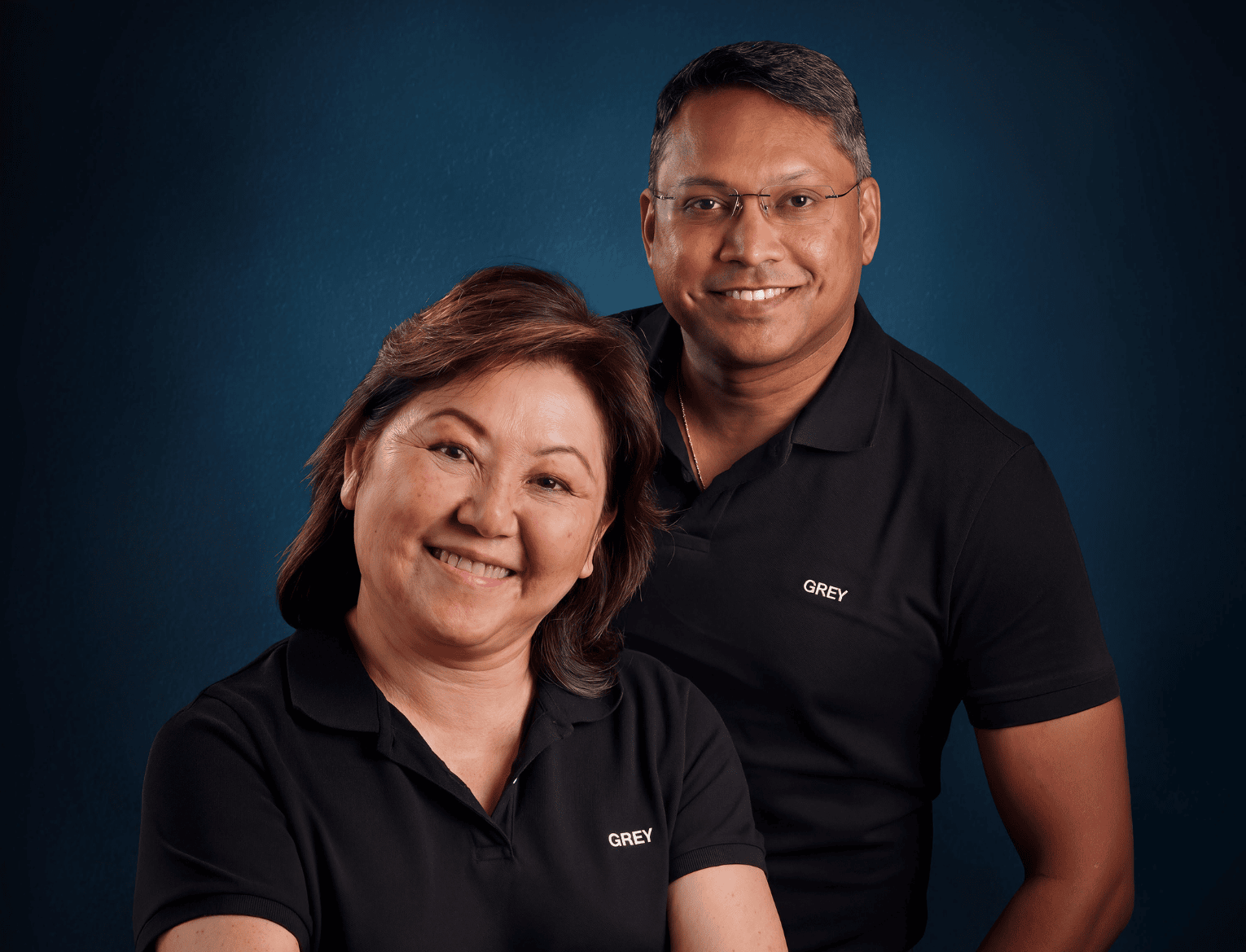
In an industry often driven by visibility and signature styles, Grey Mauritius has gradually built a reputation anchored in something else: effectiveness. From its roots in Mauritius to a growing regional footprint, the agency has consistently chosen to place brands, not itself, at the centre of the narrative. Behind this approach lies a culture shaped by listening, collaboration, and a sharp understanding of how people connect with stories. A closer look reveals how this understated philosophy has translated into work that resonates, adapts, and endures.

It is just before noon in Soreze, Pailles, and something feels different inside the offices of Grey Mauritius. The usual rhythm of an advertising agency – the quiet intensity, the glow of screens, the steady pressure of deadlines – has softened. In its place rises the smell of food, the sound of laughter, the clatter of utensils… 

It is Chinese New Year when we go in for a visit, and the team has decided to cook together. There is no formal plan, no assigned roles. A strategist is slicing vegetables, a designer is stirring a sauce, and someone is plating dumplings with surprising care. Conversations drift between work and everyday life. It all feels relaxed, and yet, there is a natural flow to things; the same instinctive coordination that seems to define how the agency works. 

It is only a small moment, but it reveals something essential about Grey Mauritius: here, ideas are not only produced; they are lived.

Founded in 2004 by Hans Puttur and Alix and Francesca Chung, Grey Mauritius has grown steadily over the past two decades, building a presence that extends to Reunion Island, Madagascar, Comoros and parts of Eastern Africa, including Tanzania, Mozambique and Kenya. Its client base reflects this dual anchoring, spanning both local and international brands. 

On the local front, it includes names that strongly resonate with Mauritian audiences, like Loto, Lottotech and My.t, brands the agency helped build from the ground up, alongside established institutions like Mauritius Telecom, SBM and SICOM, which have been repositioned to stay relevant in a modern landscape. Internationally, the portfolio extends beyond Nestlé to include brands such as Absa and Pepsi, reinforcing the agency’s regional and global reach.

Yet, despite this reach and a long list of recognitions, the agency has chosen a path that runs against industry instincts. It does not try to stand out. “Make the brand famous, not the agency,” is a principle that comes up repeatedly in conversations with the team. In a sector where agencies often cultivate strong visual identities or signature styles, Grey Mauritius has deliberately stepped back. It does not impose itself on the work. Each campaign is shaped around the brand it represents, while the agency disappears into the idea.

That discipline has not limited its impact. On the contrary, it has helped Grey Mauritius build a body of work that is both diverse and consistent in its effectiveness. Campaigns showcased in its portfolio illustrate this clearly: The New Normal, a web series developed during the pandemic, resonated widely because it captured a shared moment rather than pushing a message; a campaign for the Economic Development Board that balanced clarity with national ambition; the transformation of Lottotech’s weekly draw into “Nou Mercredi,” turning a routine event into a cultural marker; a blind-tasting concept for D’light that challenged perception; a post-pandemic narrative for Air Mauritius centred on reconnection and identity; and a campaign for Nescafé Ricoffy that spoke quietly to resilience and everyday life. 

Across these projects, the pattern is clear: the story comes first, and it is grounded in real experience.

This approach has translated into strong industry recognition. At the Créatives 2025 Awards, Grey Mauritius was named both Agence de l’Année and Agence Digitale de l’Année in Reunion Island, while also securing multiple category wins across corporate, packaging, social media and radio campaigns. The agency has also been recognised at the African Cristal Festival in Morocco. Yet, internally, awards are not the centre of gravity. They are acknowledged, but they are seen primarily as confirmation that the work delivers. “They matter because they show that it works,” one team member says, summing up a mindset that prioritises effectiveness over visibility.

Grey Mauritius does not define itself strictly as an advertising agency. It sees its role more broadly as one of communication. “It’s not about advertising for the sake of advertising,” a team member explains. “It’s about communicating precisely.” This distinction reflects a wider shift in the industry. Audiences are fragmented, platforms are multiple, and attention is increasingly difficult to capture. A single message no longer speaks to everyone. Campaigns must be shaped with care and adapted to different audiences, different contexts, different moments. The digital space has become central to this process, not simply as a channel, but as an environment where conversations happen in real time.

That shift has also made attention more elusive. Shorter attention spans and constant content flows mean that brands must work harder to be noticed. Grey Mauritius approaches this challenge directly. If attention is not given, it must be earned, sometimes even taken. This has led to campaigns that are often playful, occasionally disruptive, but always grounded in insight. A campaign for Nestlé illustrates this clearly. Instead of delivering a conventional message about breakfast, the agency created a “breakfast patrol” that stopped people in public spaces and playfully “fined” those who had skipped their morning meal, rewarding them with the product. It turned a simple idea into an experience; something people could participate in rather than just observe.

Underlying this work is a belief that creativity does not begin in isolation. “The best ideas are already there,” one team member says. “You just have to listen.” This perspective shapes the way campaigns are developed. For Fairy, a brand with years of established communication, the agency chose to break away from familiar patterns and introduce a concept that felt closer to how people actually speak and interact. The aim was not simply to refresh the brand, but to reconnect it with the present.

Some campaigns go further, engaging with broader social questions. A campaign for Milo, for example, centred on a young girl aspiring to become a boxer; a departure from traditional representations of sport, which usually portray a boy on a football pitch. The narrative, built around persistence and transformation, resonated because it reflected a real shift in how society views gender roles. The message was not imposed. It was shown. “The best way to make people think,” a creative notes, “is not to tell them what to think.”

Grey Mauritius is also willing to test boundaries. A radio campaign for Pepsi, built around the sound of a prolonged burp, divided opinion. Some found it inappropriate; others found it authentic. The bold approach was ultimately recognised by the industry, earning an award at the Créatives 2025. For Hans Puttur, the reaction highlighted a broader contradiction in how people consume media: audiences are exposed daily to more provocative content online, yet respond differently when similar expressions appear in traditional formats. The campaign was less about shock and more about reflecting a shift in cultural norms, particularly among younger audiences.

At the same time, the agency is conscious of the influence it carries. Advertising shapes perception of products, of lifestyles, of identity. With that influence comes responsibility. “We have refused campaigns,” a team member says. The decision to say no is part of the same philosophy that guides the work: communication should not only be effective; it should also make sense within a broader social context.

Inside the agency, this thinking is reflected in a culture built on trust and openness. The atmosphere observed during the Chinese New Year preparation is not an exception. It is part of a broader environment where people are encouraged to contribute, to question, to bring their own perspectives. Hierarchies exist, but they do not dominate. Ideas move freely across teams. Creative, digital and commercial departments work closely together, each shaping the outcome. “It’s about listening,” someone says. “And building together.

The people behind the work often come from varied and sometimes unexpected paths. One designer initially considered accountancy before moving into creative work. Another took time after school to explore different interests before joining the agency. These journeys are not seen as detours, but as sources of perspective. Creativity, in this environment, is not linear. It is shaped by experience, curiosity and exposure.

The same balanced approach applies to technology. Artificial intelligence is present, as it is across the industry, but it is not seen as a replacement for creative thinking. It is a tool, useful, efficient, but limited. “It helps,” one creative says, “but it doesn’t replace instinct.” There is also an awareness that over-reliance on AI can lead to uniformity, producing work that lacks distinction. What sets an idea apart, the team believes, is still the human ability to interpret context and create something unexpected.

In the digital space, where the agency is increasingly active, this human element is particularly important. Social media requires not just content, but connection. It requires an understanding of how people speak, what they respond to, and what matters in a given moment. Campaigns must adapt quickly, often in real time, while remaining coherent. There is no single message anymore. There are multiple conversations, happening simultaneously across platforms.

For Grey Mauritius, success is not defined solely by metrics. Reach and engagement matter, but they are not the whole story. What matters is the impact; whether a campaign changes something, even in a small way. Whether it stays with people. Whether it feels relevant. This is what the agency refers to when it speaks of being “famously effective.

As the Chinese New Year lunch comes to an end, the office slowly returns to its usual rhythm. Plates are cleared, conversations fade, and screens light up again. Work resumes. But the sense of connection remains. It lingers in the way people interact, in the ease with which ideas move, in the shared understanding of what they are trying to do. In an industry often defined by noise and visibility, Grey Mauritius has chosen a quieter path. It listens more than it speaks. It observes before it creates. And in doing so, it produces work that connects. Not by being louder, but by being closer to people.


Accolades and industry recognition

Until recently, Grey Mauritius had remained largely outside the regional awards landscape. Its first participation at the Créatives 2025 Awards in Reunion Island marked a notable moment, with the agency earning multiple distinctions. It was notably crowned both Agence de l’Année and Agence Digitale de l’Année at national level – a dual recognition that underscores its strength across both traditional and digital segments.

Beyond these headline titles, Grey Mauritius secured multiple category wins, demonstrating the breadth of its creative output:

    • 1st Prize – Corporate (Mauritius): Lottotech
    • 1st Prize – Logo (Mauritius): Hotpicks
    • 1st Prize – Packaging (Mauritius): Nestlé
    • 1st Prize – Social Media (Mauritius): Crest
    • 2nd Prize – Social Media (Mauritius): Fairy
    • 3rd Prize – Social Media (Mauritius): Nestlé and Phoenix Panaché
    • 2nd Prize – Radio (Mauritius): Pepsi
    • Mention – Event (Mauritius): Nescafé
  • Additional recognition in press campaigns (Crest)

These awards highlight not only creative excellence but also consistency across multiple disciplines, from brand identity and packaging to digital storytelling and broadcast media.

At the continental level, the agency has been recognised at the African Cristal Festival in Morocco, notably for its work in social and influencer campaigns, positioning it among the leading creative agencies across Africa.

Internally, the agency emphasises that these accolades are not pursued as ends in themselves, but as indicators of effectiveness. The recognition aligns with its long-standing positioning as a “famously effective” agency; one that prioritises impact for clients over visibility for itself.

Skip to content