Back to Bizweek
SEARCH AND PRESS ENTER
Latest News

“Let us hold hands and conquer African markets together”

Netai Loice Magade,Director – Light Industry, Ministry ofIndustry and Commerce of Zimbabwe

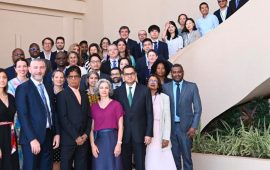
“Alone we whisper, but together we roar.” This message captures Zimbabwe’s ambition to strengthen economic ties with Mauritius, a prospect explored at the Mauritius–Zimbabwe Business Forum, held in August at the initiative of the Zimbabwe National Chamber of Commerce (ZNCC) and the Mauritius Chamber of Commerce and Industry (MCCI). The forum featured presentations by the MCCI, Zimbabwe’s Ministry of Industry and Commerce, the Economic Development Board (EDB) and Mauritius’ Ministry of Financial Services and Economic Planning, highlighting opportunities in trade, investment and regional integration. In this interview, Netai Loice Magade explains how the two economies could leverage their complementary strengths, develop integrated value chains and jointly expand into African markets. She also identifies a major missing link: direct air connectivity, which she believes “could unlock the movement of people, goods and business between both markets”.

The Mauritius-Zimbabwe trade and investment mission comes at a time when both countries are looking to deepen intra- Africa trade. What concrete opportunities do you see for Mauritian companies to enter the Zimbabwean market and vice versa?

Indeed, at this point in time, as members of SADC, both Zimbabwe and Mauritius, we really agreed on the need for us not to look at our internal small markets, but to look at the broader, either regional market under SADC or the continental market under the AfCFTA. The best way to be able to do that is for us to synergise and collaborate, leveraging each others strengths.

Zimbabwe is very strong in raw materials and natural resource endowment. This provides a solid footing for the industrialisation agenda, which is one of Africa’s main priorities under Agenda 2063. Even within SADC, industrialisation is a very important theme.

So, that is the route that Zimbabwe has decided to take.

On the other hand, we have seen that Mauritius is very strong in financial services and logistics. Mauritius can actually serve as a gateway. We therefore have an opportunity to network, collaborate and internalise our value chains within the region, so that we do not have to compete to penetrate the African market. Instead, we collaborate and partner to penetrate that market as a team. We go there as a team. We have the raw materials, while Mauritius has the finances, technologies and logistics. We can then evaluate where each country has a comparative advantage and leverage each other’s strengths.

Mauritius has a comparative advantage as a gateway to the broader global market, as well as in finance and logistics. Zimbabwe has resources, while human capital is also one of our strengths. We simply need to leverage one another and partner to penetrate this very important market.

What is particularly important is that we should not be penetrating markets by exporting raw materials in the way we traditionally did to Europe and elsewhere, only to import processed products made from our own raw materials at a higher price.

We are saying: let us add value on our continent as partners. We need to agree on where each country has a comparative advantage, focus on that, help one another and penetrate markets as partners.

There is an African saying: “Alone we whisper, but together we roar.” On your own, you can go some way, but together, you go very far.

What are the main trade barriers currently limiting bilateral commerce between Mauritius and Zimbabwe, particularly in terms of customs, standards, regulations, and market access, and what can both governments do to remove them?

Trade barriers these days are increasingly about non- tariff barriers. Given that we belong to SADC and the AfCFTA, we have already agreed on tariff reductions.
In many areas, tariffs are therefore no longer the main barrier to trade. The issue is non-tariff barriers which certainly needs to be addressed.

Logistics, particularly trade logistics, is another major challenge. This is what has inhibited Africa from trading more effectively within itself.

If you look at the European Union, they trade significantly among themselves. East Asia, including China, also has very high levels of intra-regional trade. In Africa, however, intra-African trade remains below 20%.

This is why we really need to put our act together, increase our efforts and overcome these non-tariff barriers.

People have realised that they cannot continue to use tariffs as the main barrier, but restrictions now take different forms through non-tariff measures. This is an area that we need to tackle collectively.

Zimbabwe has strong potential in sectors such as manufacturing, agri-processing and value addition, while Mauritius offers expertise in finance, logistics, services, and investment facilitation, as you mentioned. So, which sectors do you believe offer the greatest potential for joint ventures and investment partnerships?

Excellent question. As both sides have indicated in our presentations, one area with significant potential is value addition in the cotton-to-clothing sector. You start with cotton, move up the value chain through ginning, spinning and weaving, and then into garment manufacturing. I think this is one area where we can really make it.

Mauritius has decades of experience in garment manufacturing. Although I was told that many companies have since relocated to Madagascar and to other countries. But I am sure the expertise is embedded in the DNA of this economy. This is what we are looking for. We are currently developing our own cotton-to-clothing development plan.

Sugar is another area. We have just launched our sugar development plan. Instead of being known as a country that produces a large quantity of sugar for export, we want to move in another direction, towards derivatives and innovative products.

We are talking about ethanol, molasses and other products. Molasses sugar, for instance, is a niche product and can command a higher value. We are therefore looking at how best to diversify and move beyond sugar itself.

We also have challenges with yields and increasing productivity. We need to increase the amount of sugar cane and sugar produced per hectare. Once we do that, we want it to form the basis of agro- industrial value addition. Also, we want secondary industries to be created around these sectors so that we create jobs internally within our two countries.

We should be able to integrate our sugar value chain and our cotton value chain. At the end of the day, we create jobs in Zimbabwe and Mauritius and generate exports, maximising export proceeds.

If you export sugar, it is different from exporting a high-value, branded and quality product such as the premium molasses sugar we are talking about. That is the approach we are taking.

We do not want Zimbabwe to be known simply as the breadbasket of anyone. We used to be the breadbasket of Africa. Now, we want to be known as the agro-industrial hub of Africa.

We have the agricultural raw materials. Let us convert them, develop industries around them and add value so that Zimbabwe becomes a hub for innovation and new products. That way, we maximise exports and create jobs.

You spoke about the frameworks such as SADC, COMESA and AfCFTA. According to you, how important are regional frameworks in turning bilateral relationships like this one into actual business?

They are important. They form what I would call the stepping stone because, for one thing, they give us common ground. We are already committed to certain norms of doing business. We subscribe to rules and regulations under these frameworks.

Based on that, nobody has to reinvent the wheel. We simply bilateralise what we have at the regional level and make the business relationship and economic collaboration more intimate.

It is unlike taking somebody from South America, for example, who has their own way of doing things culturally, and then trying to establish a relationship. The road becomes longer because there is much more to do before reaching a point of convergence.

With SADC member states, COMESA member states and, indeed, under the AfCFTA, we have already converged. When we signed these agreements, we had already established that convergence. All we are now doing is bringing it from the regional level down to the operational level.

What will this MOU, according to you, change in practical terms for a Mauritian or Zimbabwean company wanting to do business in other markets?

The way we discussed this issue is that we are not focusing only on the Zimbabwean or Mauritian market. These are relatively small markets. What we are saying is that: let us partner so that we can actually do business in other markets.

We will identify the requirements of those markets and then ask: if this market requires XYZ, what can Zimbabwe bring to the table? What can Mauritius bring? How do we synergise and partner to penetrate that market?

We can literally hold hands and penetrate a given market together.

What it takes is for us to understand the role of our national trade promotion organisation, ZimTrade, which undertakes market profiling. It goes into a market without necessarily having prior knowledge of it, to assess whether there is potential for trade between Zimbabwean companies and that market. It starts by understanding and learning from scratch.

With Zimbabwe’s natural resource endowment as our comparative advantage, and Mauritius’ financial services, capital and logistics capabilities, we can jointly penetrate markets.

Let me mention that one of the many issues that has really affected intra-Africa trade is trade logistics. It is very expensive. If I am not mistaken, the statistic I used to have been that around 18% of the cost of intra-African trade is attributable to transportation.

We really ought to be able to open our borders and smoothen the flow of traffic.

The Secretary-General of the AfCFTA, Wamkele Mene, has pointed out that for a product to travel through perhaps three African countries, the number of stops that cargo goes through is incredible. There is so much bureaucracy, and at each point, a cost is added.

So, we need to smooth the flow of trade traffic across the continent so that we can become competitive.

As a representative of the Ministry of Industry and Commerce of Zimbabwe, how will you ensure that the MOU that has been signed produces tangible outcomes rather than remaining simply an institutional agreement?

It is true that a signed MOU can simply gather dust in a drawer. But I think the onus is on us, as the Ministry of Industry and Commerce, to ensure, through ZNCC, that there is concerted follow- up so that we know where we stand in terms of implementing the MOUs that have been signed.

What we normally do back home is when we have a meeting and when we sign these MOUs, we come up with an implementation matrix setting out what each side is expected to do within agreed timelines. We then meet at an agreed point to evaluate or review whether we have managed to meet those targets.

It is important to agree on an implementation framework, and then you keep tracking. That is the only way people can be accountable.

You have mentioned that logistics are very expensive. What about air connectivity – is it an issue as well?

It is an issue and a pertinent one too that really needs to be addressed. A direct air connection is one of the most practical things that can be done. It would not only encourage the movement of people, but also the movement of goods in both directions. It is something that will be raised in due course.

As the Chinese say, “a journey of a thousand miles begins with one step.” We start with what we have done today, but as we go along, these are some of the areas that need to be looked into.

To improve this, it would be good if we could have a direct flight connection. With time, this will have to be looked at, and the onus will be on the respective transport ministries to take that step further.

What we are doing today is setting the tone.

Skip to content