Back to Bizweek
SEARCH AND PRESS ENTER
Latest News

“It is a shame our bioethanol is exported as we import fossil fuels”

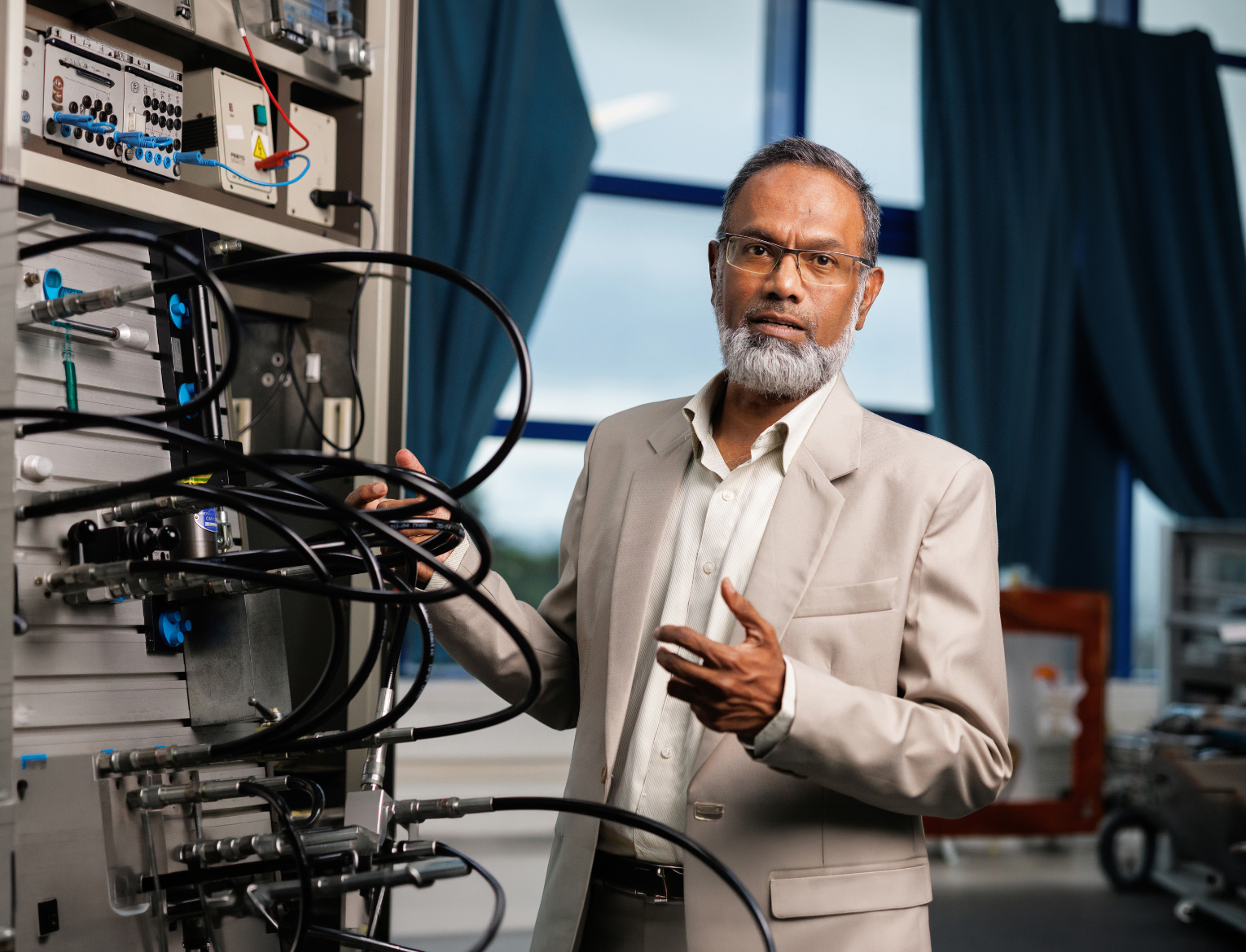
Professor Khalil Elahee, Director – MARENA

Mauritius has the stated goal of reaching a 60% renewable energy goal in its electricity mix by 2035. India, one of the world leaders in the domain, could play an important role in helping the country achieve its energy transition. This is the view of Professor Khalil Elahee, Director of the Mauritius Renewable Energy Agency (MARENA). For that transition to be successful will also require the public and private sectors to work together to adopt a holistic approach to the energy sector. “Leadership and governance have failed us in the past,” he says, “but I believe we can do better today.”

Mauritius and India want to start a partnership in the energy sector. This agreement is not new though, is it?

It is nothing new as, if you recall, we have their support already for the first floating PV project. It is also a fact that in the past, they provided us with fuel from Mangalore through a G2G agreement. 

The Energy Efficiency Management Office owes a lot to the Bureau of Energy Efficiency of India, which helped build its capacity at its inception some 15 years ago. India, according to my humble view, is one of the world leaders in energy conservation and efficiency. Now it is emerging as a giant in renewable energy, including green hydrogen technology, for the future generations. 

There are many instances of cooperation between the two countries. I recall the visit of Minister Farooq Abdullah in the past to consolidate collaboration between the Ministry of Energy of India and that of Mauritius, leading to exchanges between the two countries at a time when renewable energy was only emerging as a promising venture.

How can India be an important partner in helping Mauritius with its energy transition?

One proposal I made on a personal basis to the STC, the Ministry of Commerce, as well as the Ministry of Transport, without engaging MARENA – and in fact dating maybe before my appointment as its Chairperson – is the introduction of bioethanol. Ideally, it should be from local molasses, but given the complexity of such an initiative, I have written in my own name to the authorities to ask that we import bioethanol from India along with gasoline. 

Mixtures of up to 5% or even 10% should not be an issue for most vehicles, if not for all of them. In India, up to 20% is mixed mandatorily. We can do the same at source before shipping, or here even. Costs will go down, and it will also be good for the environment. Imagine cutting down CO2 emissions by 5% or 10% through this single measure. We will also rely less on fluctuations related to oil prices on the market. In the long term, we can turn to local bioethanol from the cane industry as the ecosystem becomes implemented.

If countries like Pakistan and South Africa have succeeded in their energy transition despite massive crises, can Mauritius achieve the same with the help of India? 

In India, a state installs 50 to 100 MW on residential rooftops. It is also the case in Pakistan. It has been even more impressive over the last year, with the Israel-US war with Iran causing a supply crisis in fuel oil and a surge in electricity prices, not to mention the grid itself being erratic in places like Karachi. In South Africa, load shedding has been a thing of the past for more than 18 months now because of decentralised off-grid solar installations with batteries. 

Yes, India can accompany our energy transition in this way, as it also has the manpower to install such facilities. The Minister of Energy has indeed announced a project for 100 000 household kits, including battery storage, with the help of India. 

The CEB has announced the importation of its own photovoltaic panels. What is your opinion?

The reason is that some installers have increased their prices to include some of the Rs 75 000 grant from the Government as their own profits in some way. The fear is that this grant does not trickle down to the households who deserve it. The number of installers has increased within a month from a few dozen to more than 120 today. It must be noted that some are taking money and disappearing, while others offer technologies with no warranty or of poor quality. The CEB cannot import and sell itself. But a separate entity with due accountability can be created for this purpose, with due compliance with existing legislation in terms of separation of roles, as well as fair competition. 

Some say Mauritius could have started cooperation with Reunion Island, which is well known for its green policies…

I understand that this is ongoing. The acid test will be to see concrete outcomes in how the EDF can assist the CEB to make its grid smarter and more resilient. Studies show that for every euro invested in renewables, one euro may be needed for grid modernisation. Our grids need modernisation now, not later, and Reunion Island is well placed to help. 

In the past, I have personally been disappointed with the real impacts of programmes like the Plan National d’Efficacité Énergétique, as I consider that we did not train Mauritians to become expert energy auditors, assessors and managers, relying too much on Reunion Island or French experts to conduct projects in Mauritius. At the beginning, this is understandable, but at the end, we need to learn and become autonomous.  

We may, on a different note, learn from Reunion Island how to introduce biomass liquids in CEB engines on a trial basis to partially replace fuel oil. With high import prices for the latter, partial substitution makes sense as the supply route is secure, and environmentally it is sound. One step at a time, we can move in the right direction, but decisions must not be delayed and implementation must be done professionally. Bureaucracy is a systemic disease we need to address. 

The Prime Minister also mentioned a partnership in biofuel production.

I am not sure about production as such, but why not?  I think that under the Global Biofuels Alliance, of which India is a key driver, we can develop a full policy implementation framework. A report has been submitted recently on the same, but I think this is just a start. 

We, Mauritians, must work together across the public and private sectors, beyond our petty silo mentality, to build a new ecosystem for its holistic implementation. It is good to recall that Brazilians came here in the 70s and learned how to make bioethanol commercially feasible from the sugar cane industry. Today, they lead the world because they developed a whole bioethanol-run vehicle ecosystem. It is a shame our bioethanol, today, is exported as we import fossil fuels. 

Simplistic solutions will obviously not work, but we need to envisage a realistic transition without compromising on our ambitions for a more resilient, greener economy. Leadership and governance have failed us in the past, but I believe we can do better today, particularly in partnership with India, China and others in the region.

Where does Mauritius stand, today, in its energy transition? 

We are doing well in first avoiding load shedding, and second, in sticking to our new commitment of 60% RE for the electricity mix by 2035. We can only fool ourselves by keeping the same target for 2030, that is in 3.5 years. 

The 60% share is nothing but a function of our demand management capacity. All modern economies are moving towards smart, efficient, resilient, decentralised, digitalised and decarbonised systems. Today, demand, supply and storage are integrated. In the short term, along with avoiding load shedding, we must set the foundation for a long-term transition by having a holistic framework around institutions that are models of good energy governance.

This is what the Renewable Energy Strategic Plan of MARENA is about. The challenge is its implementation, and we need the support of all stakeholders for that. I believe we must restore trust in ourselves also. If we say we cannot do it, it is unlikely to succeed. Unless we go beyond our differences and think for the common good for the future, the energy transition is not going to happen as intended.

Are we still threatened by a blackout?

The term blackout is inappropriate. Load shedding will still be a risk during the evening peak on weekdays, when people use air-conditioning without limits. The Government should come up with a new Energy Saving Campaign this summer. I hope that the concept of Time of Use also becomes a familiar one for large consumers already fitted with digital smart meters. This threat of load shedding may also incidentally come with too low demand if we have a high share of solar energy produced. This is why storage is a key factor in future energy systems.

Skip to content